Failed FMGE by 5, 10 or 20 Marks: How to Analyse Your Score and Prepare for the Next Attempt
Jul 14, 2026

Our team has spent 10 years of experience analyzing FMGE results. The June 2026 session was brutal. A pass percentage of just 12.38 percent. If you did not cross the 150-mark threshold, the disappointment is heavy.
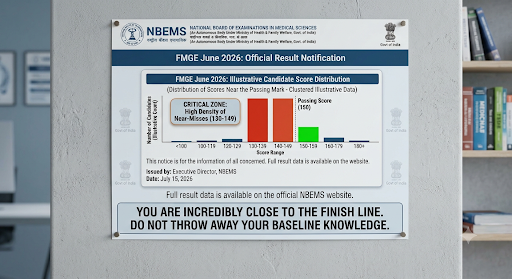
But staring at a score of 145 or 130 requires a specific type of autopsy. You do not need to read all 19 subjects from scratch. You need to analyze the gaps.
Here is how to decode your failure and build a bulletproof strategy for your next attempt.
Decoding the Deficit: Failed by 5, 10, or 20 Marks
A failure is not just a failure. The exact margin tells a very specific story about your exam temperament.
Failed by 5 Marks (Scores 145 to 149)
This hurts the absolute most. If you scored 147, your core knowledge is excellent. You did not fail because you did not know the syllabus. You failed because of exam-day psychology. You changed the correct answers to the wrong ones in the last ten minutes. You overthought simple one-liners. You made silly calculation errors. This is an execution problem, not a knowledge problem.
Failed by 10 Marks (Scores 140 to 144)
Scoring in the low 140s means you had minor conceptual gaps under pressure. You remembered the drug but forgot the exact contraindication. You knew the disease but forgot the specific gold-standard investigation. You suffered from recall fatigue during the second half of the exam.
Failed by 20 Marks (Scores 130 to 139)
Dropping into the 130s indicates a mix of time mismanagement and missing core high-yield topics. You probably spent too much time reading massive clinical vignettes and had to blindly guess the last 30 questions. Your clinical integration across subjects needs serious work.
|
|
Subject-Wise Gap Identification
You must perform a ruthless MCQ accuracy review. Do not just look at the overall score. You have to break down where the bleeding happened. Let us integrate this with actual clinical scenarios.
General Medicine
Did you lose marks in Nephrology? The KDIGO 2024 criteria for Acute Kidney Injury are heavily tested. If a patient has a serum creatinine increase of 0.3 mg/dL within 48 hours, that is Stage 1 AKI. If you marked normal variant, you lost a crucial mark. You must master exact cutoffs.
Surgery and Emergency Management
NBEMS loves trauma. According to the ATLS 11th edition, a patient losing 35 percent of their blood volume is in Class III hemorrhagic shock. They will have a drop in blood pressure and require blood products, not just crystalloids. If you missed these specific staging questions, your Surgery foundation needs an update.
Pharmacology
Pharma is deeply integrated now. You see a patient on clopidogrel who gets an infection. They started on omeprazole. Suddenly, they have a massive stent thrombosis. Why? Omeprazole inhibits CYP2C19, blocking the activation of clopidogrel. If you failed by 10 marks, you probably missed these deep drug-drug interactions.
Pathology
Spotting amyloidosis requires a Congo Red stain demonstrating apple-green birefringence under polarized light. Normal light will not show the birefringence. If you skipped the word polarized in the vignette and marked the wrong stain, that is a careless error costing you a year.
MCQ Accuracy Review & Revision Reset Plan
Your next attempt preparation strategy starts with the math. Look at your mock tests leading up to the June 2026 exam. Did you attempt all 300 questions? Did you get 140 right and 160 wrong? With no negative marking in FMGE, attempting all 300 is mandatory. But your accuracy must sit above 55 percent.
- Months 1 and 2: Do not re-read your strong subjects. Dive straight into your weak zones. If OBG pulled you down, master the step-wise management of postpartum hemorrhage immediately.
- Months 3 and 4: Shift to mixed block practice. Start testing your stamina.
- Months 5 and 6: Pure revision and daily mock tests.
Strategic Hacks for the Long Vignettes
FMGE questions are getting incredibly long. You are dealing with 15-line clinical scenarios. Traditional reading will drain your cognitive battery by question 100.
Deploy the Last Line First technique. When a massive clinical vignette pops up, do not start reading from the top. Your brain will fatigue fast. Read the very last sentence first. Then look at the four options.
Now your brain knows exactly what disease, nerve, or drug it is hunting for. Scan the bulky text specifically for vital signs, lab abnormalities, and unique clinical markers. This hack saves precious seconds and prevents overthinking.
Topper Tactics: The 20th Notebook
Our 10 years of experience reveal one universal secret among students who bounce back from a failure. The 20th Notebook. You have 19 standard subjects. The 20th notebook is your personal diary of failures and highly volatile facts.
This is where you dump the highly technical data you constantly get wrong. The specific translocations like t(14;18) for follicular lymphoma. The exact pediatric dosing of adrenaline. The Glasgow Coma Scale breakdown.
In the final 72 hours before your next attempt, you shut all standard textbooks. You only cycle through your 20th Notebook. It keeps your short-term memory loaded and prevents those silly 5-mark deficit errors.
PrepLadder Version XI Integration
A fresh attempt calls for a highly upgraded arsenal. This is where the PrepLadder Version XI, updated for April 2026, completely changes your preparation.
We have completely revamped the QBank to exactly match the length, difficulty, and clinical integration of the recent June 2026 paper. We are heavily adding video questions to the QBank to match the new dynamic format.
Use the new Active Recall Flashcards to hammer those volatile 20th Notebook facts into your long-term memory instantly.
Most importantly, our specialized Mini Tests are strictly engineered to mimic the high-pressure environment of the real exam. Practicing these daily builds the stamina required to sit through 300 clinical questions without losing focus in the final hour.

Frequently Asked Questions (FAQs)
Q1. What should I do if I failed the FMGE by exactly 2 marks?
Do not touch your primary notes for a month. Your theory is solid. You need to focus entirely on MCQ practice and minimizing careless errors. Start doing 100 random MCQs daily to fix your exam-day execution.
Q2. Is it advisable to change my study materials after a failed attempt?
No. Changing your primary source material builds massive confusion. Stick to your core notes, but upgrade your testing platforms. Use the updated PrepLadder Version XI QBank to test your knowledge against the latest clinical patterns.
Q3. How do I identify which subjects cost me the exam?
Analyze your final 5 Grand Tests before the real exam. Look at the analytics breakdown. If you consistently scored below 40 percent in PSM and Microbiology, those are your definitive gap areas.
Q4. Should I attempt all 300 questions in the FMGE?
Absolutely. Since there is zero negative marking in the FMGE, leaving any question blank is a mathematical sin. Always make an educated guess using option elimination for the ones you do not know.
Q5. How can I remember volatile facts like chromosomal translocations?
Use the 20th Notebook tactic. Write them down in one dedicated notebook. Review this specific notebook every single Sunday morning. By the time your next attempt arrives, the data will be cemented in your brain.
Final Clinical Pearl
Failing by a narrow margin does not mean you will make a bad doctor. It simply means your exam execution needs surgical precision. Treat this failure like a morbidly obese patient presenting for an elective cholecystectomy.
You do not rush in blindly. You optimize the patient. You control the blood sugars, you check the cardiac status, and you plan the anesthesia carefully.
Optimize your study plan exactly like this. Stop cramming aimlessly. Analyze your weak subjects. Build your 20th Notebook. Master the Last Line First technique.
You already have the medical knowledge inside you. Now refine the execution, trust the process, and clear that 150-mark barrier.

PrepLadder
Access all the necessary resources you need to succeed in your competitive exam preparation. Stay informed with the latest news and updates on the upcoming exam, enhance your exam preparation, and transform your dreams into a reality!
Navigate Quickly
Decoding the Deficit: Failed by 5, 10, or 20 Marks
Failed by 5 Marks (Scores 145 to 149)
Failed by 10 Marks (Scores 140 to 144)
Failed by 20 Marks (Scores 130 to 139)
Subject-Wise Gap Identification
General Medicine
Surgery and Emergency Management
Pharmacology
Pathology
MCQ Accuracy Review & Revision Reset Plan
Strategic Hacks for the Long Vignettes
Topper Tactics: The 20th Notebook
PrepLadder Version XI Integration
Frequently Asked Questions (FAQs)
Q1. What should I do if I failed the FMGE by exactly 2 marks?
Q2. Is it advisable to change my study materials after a failed attempt?
Q3. How do I identify which subjects cost me the exam?
Q4. Should I attempt all 300 questions in the FMGE?
Q5. How can I remember volatile facts like chromosomal translocations?
Q6. Will the next FMGE session be heavily clinical like the June 2026 paper?
Final Clinical Pearl
Top searching words
The most popular search terms used by aspirants
- fmge exam analysis
- FMGE Preparation Strategy