Glycolysis vs Gluconeogenesis: Key Differences, Enzymes & Regulatory Steps Explained
Nov 10, 2025
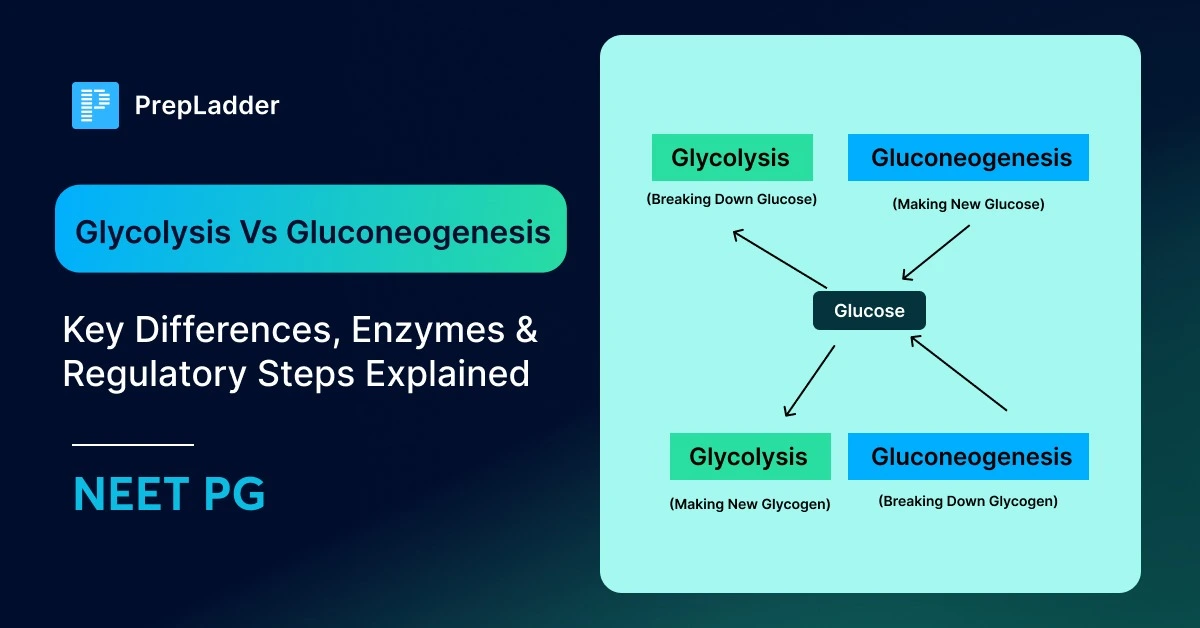

What is Glycolysis?
Glycolysis is the splitting of the 6-carbon compound glucose to form two products, depending upon the process occurs aerobically or anaerobically.
Glycolysis - Products
Every glucose molecule is generated.
- Aerobic glycolysis - 2 Pyruvates and 7 ATPs.
- Anaerobic glycolysis - 2 Lactate and 2 ATPs.
Significance of Glycolysis
Glycolysis is the only pathway that generates ATPs even in the absence of oxygen.
Glycolysis - Cells Dependent
- Physiologically, the following cells are dependent on glycolysis for ATP production, as they lack mitochondria
- RBCs
- Retinal cells
- Corneal cells
- White muscle fibres: Due to a lack of fresh blood supply during isometric contractions. Any blood vessel entering the muscle gets constricted due to muscular contraction. They won't get a fresh supply of oxygen, nor do they have myoglobin (a Storage form of oxygen). Thus, they depend on anaerobic glycolysis.
- Renal medulla: In ischaemic or hypoxic damage to the kidney, the renal medulla is affected the most as it receives relatively low blood supply. It has low O₂ supply and relies more on glycolysis.
|
|

Difference of Glycolysis in Anaerobic Cells (RBCs) and Aerobic Cells (Neurons)
Glycolysis in Anaerobic Cells (RBCs) Glycolysis in Aerobic Cells Neurons Anaerobic glycolysis. Aerobic glycolysis. 2 Lactates are formed. 2 Pyruvates are formed. 2 ATPs are generated. 32 ATPs are generated on the complete oxidation of glucose in neurons via7 ATPs from Glycolysis.2 NADH × 2.5 ATP = 5 ATPs on conversion of 2 Pyruvates → 2 Acetyl CoA.Acetyl CoA enters the TCA cycle to produce 10 ATPs per molecule.2 Acetyl CoA × 10 ATPs = 20 ATPs.
Steps of Glycolysis
Step-01: Glucose → Glucose 6 Phosphate.
- Glucose enters the cell.
- The first enzyme to act on is Glucokinase or Hexokinase.
- This enzyme utilises 1 high-energy phosphate (ATP) for conversion.
Step-02: Glucose 6 Phosphate (G6P) ⇄ Fructose 6 Phosphate (F6P).
- Phosphate Hexose Isomerase enzyme is involved.
Step-03: Fructose 6 Phosphate (F6P) → Fructose 1,6 bisphosphate.
- Phosphofructokinase I uses one ATP for the conversion.
Steps 01 - 03 are named the investment phase because 2 ATPs are utilised.
Further steps are considered in the Harvest phase (ATPs are generated).
Step-04: Fructose 1,6 bisphosphate → Glyceraldehyde 3 Phosphate + Dihydroxyacetone Phosphate.
- Aldolase A is important in glucose glycolysis.
- Aldolase B is important in fructose glycolysis.
Step-05: Glyceraldehyde 3 Phosphate ⇄ Dihydroxyacetone Phosphate.
- The enzyme involved is Phosphate Triose Isomerase.
Step-06: 2 Glyceraldehyde 3 Phosphate → 2 1,3 bisphosphoglycerate.
- Glyceraldehyde 3 Phosphate dehydrogenase enzyme is involved.
- This reaction is an example of oxidative phosphorylation.
- Gives two hydrogens to NAD to form 2 NAD → 2 NADH.
.
Step-07: 2 1,3 Bisphosphoglycerate → 2 3-Phosphoglycerate.
- An example of substrate-level phosphorylation.
- Enzyme - Phosphoglycerate kinase.
- 2 ATPs are generated directly.
Step-08: 2 3-Phosphoglycerate → 2 2-Phosphoglycerate.
- Enzyme - Phosphoglyceromutase.
Step-09: 2 2-Phosphoglycerate → 2 Phosphoenolpyruvate.
- Enolase acts by removing a water molecule.
Step-10: 2 Phosphoenolpyruvate → 2 Pyruvates.
- Catalysed by pyruvate kinase.
- An example of substrate-level phosphorylation.
- 2 ATPs are generated directly.

What happens when the same process occurs anaerobically?
It has two impacts:
- NADH cannot enter ETC; thus, the process lacks 5 generated ATPs. NAD cannot be regenerated, causing NAD deficiency and making Glyceraldehyde 3 Phosphate dehydrogenase enzyme inactive; further glycolysis is arrested.
- To counteract these limitations, in anaerobic cells, Lactate dehydrogenase converts Pyruvates into Lactates by regenerating NAD.
Facts About Glycolysis
1. The products of aerobic glycolysis are 2 Pyruvate and 7 ATPs.
2. The products of anaerobic glycolysis are 2 Lactate and 2 ATPs.
3. The rate-limiting enzyme of glycolysis is Phosphofructokinase I.
4. Arsenate inhibits phosphoglycerate kinase.
5. Glyceraldehyde 3-phosphate dehydrogenase is inhibited by iodoacetate.
GLUCONEOGENESIS
This process is a reversal of glycolysis, where two molecules of pyruvate are combined to form glucose (irreversible steps of glycolysis). It takes place in the liver and kidneys.
Steps Involved in Gluconeogenesis
There are four steps with three enzymes
Pyruvate kinase: It is a two-step process
- Step-01: Pyruvate → oxaloacetate (OAA) in the presence of pyruvate carboxylase.
- Step-02: Oxaloacetate→Phosphoenolpyruvate in the presence of PEPCK (phosphoenolpyruvate carboxykinase).
- PEPCK uses GTP as its coenzyme.
- Step-03 PFK-1:
| Reversible step (Glycolysis) | Irreversible Step (Gluconeogenesis) |
| Fructose-6-phosphate → fructose 1,6 bisphosphate. | Fructose-1,6-bisphosphate → fructose 6 phosphate Enzyme: Fructose 1,6-bisphosphatase (rate-limiting step). |
- Hexokinase/ Glucokinase: Step 04
| Reversible step (Glycolysis) | Irreversible Step (Gluconeogenesis) |
| Glucose to Glucose 6-phosphate by the enzyme hexokinase | Glucose to Glucose 6 phosphate by the enzyme hexokinase |
Enzymes Involved in Gluconeogenesis
There are four enzymes involved in gluconeogenesis
- Pyruvate carboxylase
- PEPCK
- Fructose-1,6-bisphosphatase
- Glucose-6-phosphatase (In Liver and Kidney only)
- The first three enzymes are present in all the tissues
- Conversion of two molecules of pyruvate to one molecule of glucose: 11 ATP.
Facts for the Regulation of Glycolysis and Gluconeogenesis
- Common Allosteric regulator (fructose 2,6-bisphosphate).
- Fructose 2,6 bisphosphate is a stimulator of glycolysis (PFK-1).
- Fructose 2,6 bisphosphate is an inhibitor of gluconeogenesis (Fructose 1,6 bisphosphatase).
- Fructose 2,6 bisphosphate is the product of a tandem enzyme(bifunctional enzyme with both phosphorylation and dephosphorylation functions) - PFK2.
- Fructose 2,6-bisphosphatase activity is stimulated by phosphorylation.
Important MCQS
Q1: A neonate presented with hemolytic anaemia. A peripheral smear revealed that it's a case of non-spherocytic hemolytic anemia. Pyruvate kinase activity was remarkably low (0.675 U/g Hb). Which of the following explains hemolytic anaemia in this condition?
- High 2,3 BPG production
- Low 2,3 BPG production
- High ATP production
- Failure of the Sodium Potassium ATPase pump
Answer: Failure of the Sodium Potassium ATPase pump
Q2: Which of the following is a product of anaerobic glycolysis?
- 2 Pyruvate 10
- 2NAD
- 7 ATP
- 2 ATP
Answer: 2 ATP
Q3: All of the following cells are dependent on glycolysis except?
- Neurons
- RBC
- Renal medulla
- Red muscle fibres
Answer: Red muscle fibres
Q4: Glucose is trapped inside the cells as
- ? D-glucopyranose (The most common physiological form of glucose).
- UDP glucose
- Glucose 6 phosphate
- Fructose 6-phosphate
Answer: Glucose 6 phosphate
Q5: The irreversible steps of glycolysis are all except
- Pyruvate kinase
- Phosphoglycerate kinase
- Hexokinase
- Phosphofructokinase
Answer: Phosphoglycerate kinase
Q6: The steps in which oxidative phosphorylation occurs in glycolysis are:
- Pyruvate kinase
- Phosphoglycerate kinase
- PFK
- Glyceraldehyde 3 Phosphate Dehydrogenase
Answer: Glyceraldehyde 3 Phosphate Dehydrogenase
Q7: In anaerobic glycolysis, lactate is formed
- For the generation of ATP
- For the regeneration of lactate
- For the regeneration of pyruvate
- For the regeneration of NAD
Answer: For the regeneration of NAD
Q8: The significance of the Rapoport-Luebering Shunt is
- ATP production
- Lactate formation
- Source of fatty acids
- 2, 3 BPG production
Answer: 2, 3 BPG production
Q9: The enzyme involved in the Rapoport-Luebering Shunt is
- Phosphoglycerate kinase
- Bisphosphoglycerate kinase
- Bisphosphoglycerate mutase
- Phosphoglycerate mutase
Answer: Bisphosphoglycerate mutase
Q10: Fructose 1, 6 bisphosphatase is seen in:
- Liver
- Skeletal muscle
- a & b
- none
Answer: Liver
Q11: Fructose 1, 6 bisphosphatase is seen in:
- Liver
- Skeletal muscle
- a & b
- none
Answer: Both a and b
Q12: Malate shuttle is used in:
- Glycolysis
- Gluconeogenesis
- Citric acid cycle
- None of the above
Answer: Gluconeogenesis
Q13: The tandem enzyme that regulates glycolysis and gluconeogenesis is
- PFK1
- PFK2
- Fructose 1,6 bisphosphatase
- Pyruvate carboxylase
Answer: PFK2
Q14: In a well-fed state, which of the following enzyme activities will be high?
- Pyruvate carboxylase
- PFK2
- Fructose 1,6 bisphosphatase
- Fructose 2,6 bisphosphatase
Answer: PFK2
Download the PrepLadder app now and unlock a 24-hour FREE trial of premium high-yield content. Access Video Lecturesalso in हिंglish, digital notes, QBank, and Mock Tests for FREE to ace your NEET PG preparation. Elevate your study experience and gear up for success. Start your journey with PrepLadder today!

PrepLadder
Access all the necessary resources you need to succeed in your competitive exam preparation. Stay informed with the latest news and updates on the upcoming exam, enhance your exam preparation, and transform your dreams into a reality!
Navigate Quickly
What is Glycolysis?
Significance of Glycolysis
Glycolysis - Cells Dependent
Difference of Glycolysis in Anaerobic Cells (RBCs) and Aerobic Cells (Neurons)
Steps of Glycolysis
What happens when the same process occurs anaerobically?
Facts About Glycolysis
GLUCONEOGENESIS
Steps Involved in Gluconeogenesis
Enzymes Involved in Gluconeogenesis
Important MCQS
Top searching words
The most popular search terms used by aspirants
- NEET PG Biochemistry
- NEET PG Biochemistry Preparation