Rapid Revision Reignite Biochemistry: Question-Answer Format
Sep 16, 2025

Introduction To Metabolism
Big Question 1: What is metabolism and how is energy generated through catabolism?
Broad Answer: Metabolism refers to the process by which the body assimilates food and converts it into energy and building blocks for growth. It has two components: catabolism and anabolism. Energy from catabolism is trapped in the form of ATP either by substrate-level phosphorylation or oxidative phosphorylation.
Detailed Questions
Q1.1: What are the components of metabolism?
Answer:
- Catabolism
- Anabolism
Q1.2: What happens during catabolism?
Answer:
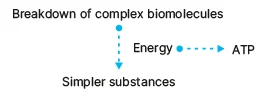
- Energy is trapped as ATP
- Trapping energy as ATP avoids its loss as unwanted heat
Q1.3: What are the types of catabolism based on ATP trapping?
Answer:
1. Substrate-level phosphorylation
2. Oxidative phosphorylation
Q1.4: What is substrate-level phosphorylation?
Answer:
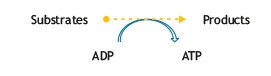
- ATP is generated directly at the substrate level
- Catalyzed by kinases
Q1.5: What are examples of substrate-level phosphorylation?
Answer:
- Phosphoglycerate kinase (glycolysis)
- Pyruvate kinase (glycolysis)
- Succinyl thiokinase (Citric Acid Cycle)
- Creatine kinase (muscle)
Q1.6: What is oxidative phosphorylation?
Answer:
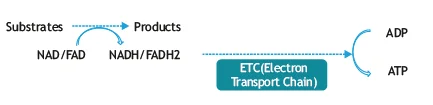
- ATP is generated indirectly
- Catalyzed by dehydrogenases
- More common due to aerobic nature of humans

Carbohydrate Metabolism
Big Question 2: How is glycogen metabolized, and what are the glycogen storage disorders?
Broad Answer:
- Glycogen is the storage form of glucose, kept in the liver and skeletal muscle.
- Glycogen metabolism involves synthesis (glycogenesis) and breakdown (glycogenolysis), regulated by specific enzymes.
- Enzyme deficiencies cause glycogen storage disorders (GSDs), each with unique biochemical and clinical features.
- GSDs may cause fasting hypoglycemia, exercise intolerance, or organ damage due to abnormal glycogen accumulation.
| Type | Name | Enzyme Defect |
| Type 0 | Glycogen synthase deficiency | Glycogen synthase (called as Type 0 Glycogen storagedisorder because it is a glycogen storage disorderwithout glycogen storage) |
| Type I | Von Gierke's Disease | Glucose-6-phosphatase Enzyme of gluconeogenesis and glycogenolysisDefect - Severe fasting hypoglycemia |
| Type II | Pompe's Disease | Acid maltase/ α glucosidase - |
| Type III | Cori's Disease | Debranching enzyme |
| Type IV | Anderson's Disease | Branching enzyme |
| Type V | McArdle's Disease | Muscle Phosphorylase |
| Type VI | Her’s Disease | Hepatic phosphorylase |
| Type VII | Tarui's Disease | Phosphofructokinase-1 |
Detailed Questions
Q2.1: Where is glycogen stored, and what are its structural features?
Answer:
- Glycogen is stored only in:
- Liver — raises blood glucose during fasting.
- Skeletal muscle — uses glycogen locally for contraction energy.
- Structure:
- Most highly branched polysaccharide.
- Linkages:
- α-1,4 linkages ® along straight chains.
- α-1,6 linkages ® at branch points.
Q2.2: Which enzymes are involved in glycogen metabolism, and what are their roles?
Answer:
- Glycogen Synthase
- Rate-limiting enzyme of glycogenesis.
- Forms α-1,4 linkages.
- Branching Enzyme
- Creates α-1,6 branches.
- Glycogen Phosphorylase
- Rate-limiting enzyme of glycogenolysis.
- Breaks α-1,4 linkages.
- Debranching Enzyme
- Breaks α-1,6 linkages.
- Glucose-6-phosphatase
- Converts glucose-6-phosphate ® glucose in the liver.
- Absent in muscle; thus muscle glycogen does not contribute to blood glucose.
Q2.3: How does glucose-6-phosphatase deficiency affect glycogen metabolism?
Answer:
- Deficiency of glucose-6-phosphatase leads to:
- Both gluconeogenesis and glycogenolysis failing to raise blood glucose.
- Severe fasting hypoglycemia.
- Clinical example:
- Von Gierke's Disease (GSD Type I).
- First discovered glycogen storage disorder.
Q2.4: How are glycogen storage disorders categorized based on symptoms?
Answer:
| Category | Diseases |
| Fasting hypoglycemia | Type- 0, Type-I, Type-III, Type-VI |
| Exercise intolerance | Type-0, Type-III, Type-V, Type-VII |
| Both fasting hypoglycemia and exercise intolerance | Type-0, Type-III |
| Neither Fasting hypoglycemia nor exercise intolerance | Type-II, Type-IV |

Heme Synthesis And Porphyrias/ Lipids
Big Question 3: How are Porphyrias classified, what is the basis for their classification, and what are the enzyme defects seen in porphyrias?
Broad Answer: Porphyrias are classified based on the predominant site of enzyme defect and the type of symptoms. Clinically, they are grouped into acute porphyrias (with neurovisceral or neuropsychiatric symptoms), cutaneous porphyrias (with photosensitivity), or mixed types (showing both). This helps guide diagnosis and management.
Detailed Questions
Q3.1: Classify porphyrias.
Answer:
Classification of Porphyrias:
- With Neuropsychiatric manifestations
- ALA Dehydratase Deficient Porphyria (ADP) - ALA accumulates
- Acute Intermittent Porphyria (AIP) - ALA & PBG accumulate
- With Photosensitivity
- Congenital Erythropoietic Porphyria (CEP)
- Porphyria Cutanea Tarda (PCT)
- Hereditary Erythropoietic Protoporphyria (HEP)
- Both
- Hereditary Coproporphyria (HCP)
- Variegate Porphyria
Q3.2: Describe the classification of Porphyrias in the form of a schematic diagram.
Answer:
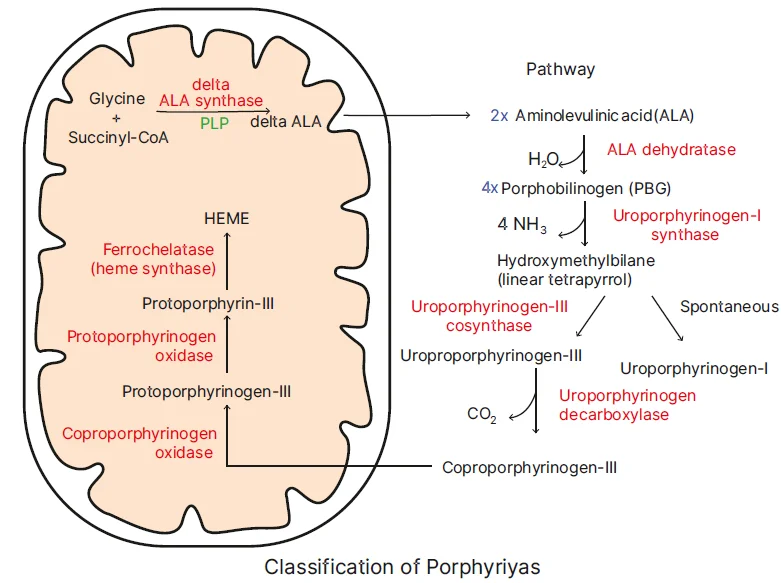
| Enzyme defect | Name of the disorder |
| ALA synthase II | X link sideroblastic anaemia |
| ALA Dehydratase | ALA dehydratase deficient porphyria |
| Porphobilinogen Deaminase (Hydroxymethylbilane Synthase) | Acute intermittent porphyria |
| Uroporphyrinogen III synthase | Congenital erythropoietic porphyria (most severe) |
| UP Decarboxylase defect | Porphyria Cutanea Tarda (PCT) |
| Coproporphyrinogen oxidase | Hereditary Coproporphyria |
| Protoporphyrinogen oxidase | Variegate porphyria |
| Ferro chelatase | Erythropoietic protoporphyria (EPP) |
Q3.4: What are the consequences of Defective ALA Dehydratase?
Answer:
- Defective ALA Dehydratase - ALA accumulates
- ALA is toxic to neurons
- This presents with Neuropsychiatric manifestations
Q3.5: What are the features of Acute Intermittent Porphyria?
Answer: In Acute Intermittent Porphyria,
- When there is a defect of Uroporphyrinogen -1 synthase
- There will be accumulation of both ALA and PBG
- This presents with Neuropsychiatric manifestations because ALA and PBG are toxic to neurons
- No porphyrin ring is formed yet
- They do not present with Photosensitivity
Clinical Biochemistry
Big Question 4: What is Massive Blood Transfusion?
Broad Answer:
- More than 10 units of packed red blood cells in 24 hrs.
- More than 4 units of packed red blood cells in 4 hours with anticipation of further requirements in the next 24 hrs.
- More than 1 blood volume in 24 hrs or more than 50% of the blood volume in 4 hrs.
Detailed Questions
Q4.1: Massive blood transfusion causes all of the following except?
A. Hypokalemia
B. Hypocalcemia
C. Hypomagnesemia
D. Alkalosis
Answer: A. Hypokalemia
- RBCs in stored blood do not have oxygen, leading to reduced ATPs.
- Low ATP impairs the Na+ K+ ATPase pump, resulting in hyperkalemia.
- Citrate, which is used as an additive, chelates calcium and magnesium, resulting in hypocalcemia and hypomagnesemia, respectively.
- Citrate is metabolised to produce HCO₃¯, resulting in alkalosis.
Q4.2: What are the other adverse reactions to Massive Blood Transfusion?
Answer:
1. Hypothermia
2. Dilutional coagulopathy
3. Hypocalcemia and hypomagnesemia
4. Hyperkalemia
5. Lactic acidosis
6. TRALI
Also Read : Biochemistry Essentials - Deep Dive into High-Yield Concepts and PYQs
Gear up for your final prep with Rapid Revision Reignite by PrepLadder. Designed for Medical PG aspirants, it offers concise Q&A notes, high-yield MCQs, and expert-led revision videos—your perfect companion for last-minute success.
Download the PrepLadder app now and unlock a 24-hour FREE trial of premium high-yield content. Access Smarter Video Lectures also in हिंglish, Game Changing Qbank, Audio QBank, Structured Notes, Treasures, Mock test for FREE to ace your NEET PG preparation. Elevate your study experience and gear up for success. Start your journey with PrepLadder today!

PrepLadder Medical
Get access to all the essential resources required to ace your medical exam Preparation. Stay updated with the latest news and developments in the medical exam, improve your Medical Exam preparation, and turn your dreams into a reality!
Navigate Quickly
Introduction To Metabolism
Detailed Questions
Carbohydrate Metabolism
Detailed Questions
Heme Synthesis And Porphyrias/ Lipids
Detailed Questions
Clinical Biochemistry
Detailed Questions
Top searching words
The most popular search terms used by aspirants
- Medical PG Biochemistry
- NEET PG Preparation
- Rapid Revision