7 Ways Version XI Helps You Score Higher in NEET PG 2026
Mar 10, 2026

You have studied the content. Your score does not reflect it:
A final-year MBBS graduate has completed two readings of Pathology, solved 3,000+ MCQs, and watched over 300 hours of video lectures. The mock test score is 480/800. Six months of effort, and the rank projection still falls outside the 10,000.
The frustrating part is that the student knows the material. The problem is not knowledge. It is retrieval under pressure. I have seen this pattern across 40+ batches. The gap between "I have studied this". I can recall this in 60 seconds during the exam," is where most aspirants lose 30–50 marks. That is the difference between a rank of 5,000 and 15,000.
Version XI is built to close that gap, not by adding more content but by making what you have already studied stick.

Here are 7 specific ways Version XI helps you score higher in NEET PG 2026.
QUICK OVERVIEW
Version XI targets the retention-to-recall gap that costs PG and INI-CET aspirants 30–50 marks per exam.
Its 7 score-boosting mechanisms include PYQ-mapped Rapid Revision, system-wise Integrated Essentials, SPARK spaced-repetition flashcards, 5,000+ new exam-aligned MCQs, error-tagged learning real cadaver dissections, and Printed Summary Charts. Content goes live April 2026.
NEET PG & INI-CET RELEVANCE
PG 2026 is expected in August 2026. 200 MCQs, 210 minutes +4/−1 marking.
INI-CET July 2026 session follows a 200-question format with +1/−⅓ marking and a stronger emphasis on integration-based reasoning.
Version XI addresses both exam patterns through features that build recall speed, reduce marking, and strengthen cross-subject integration.
In This Post:
Why studying more is not the answer
Way 1: PYQ-Mapped Rapid Revision Targets what examiners actually ask
Way 2: Integrated Essentials prepares you for subject MCQs
Way 3: SPARK Flashcards turn passive knowledge into active recall
Way 4: Error Tagging prevents the mistakes that cost 8–12 marks per paper
Way 5: Revamped QBank builds exam-day accuracy
Way 6: Cadaver Dissection Videos boost applied anatomy scores
Way 7: Printed Summary Charts lock in high-yield facts before exam day
How Version XI addresses NEET PG vs INI-CET differences
- Key Takeaways for score improvement
- FAQs
- Why studying more is not the answer
- The average NEET PG aspirant studies 8–10 hours daily for 6–8 months.
- That is 1,500–2,400 hours of preparation.
- Yet the median score remains below 50% of the marks.
The bottleneck is rarely effort or hours. It is how those hours convert into knowledge on exam day. Version XI helps you score higher in PG 2026 by making what you have already studied stick.
Cognitive science research consistently demonstrates that retrieval practice strengthens memory more effectively than re-reading or passive review.
The testing effect shows that students who practise recall retain 50–70% more than those who re-read the material.
Version XI applies this principle to exam preparation. Each of the 7 ways connects a specific Version XI feature to a proven score-improvement mechanism.
Version XI helps you score higher in PG 2026 by targeting the retention-to-recall gap.
Version XI helps you score higher in PG 2026 by building recall speed and reducing negative marking.
Version XI is the key to scoring in NEET PG 2026.
Way 1: PYQ-Mapped Rapid Revision Targets What Examiners Actually Ask
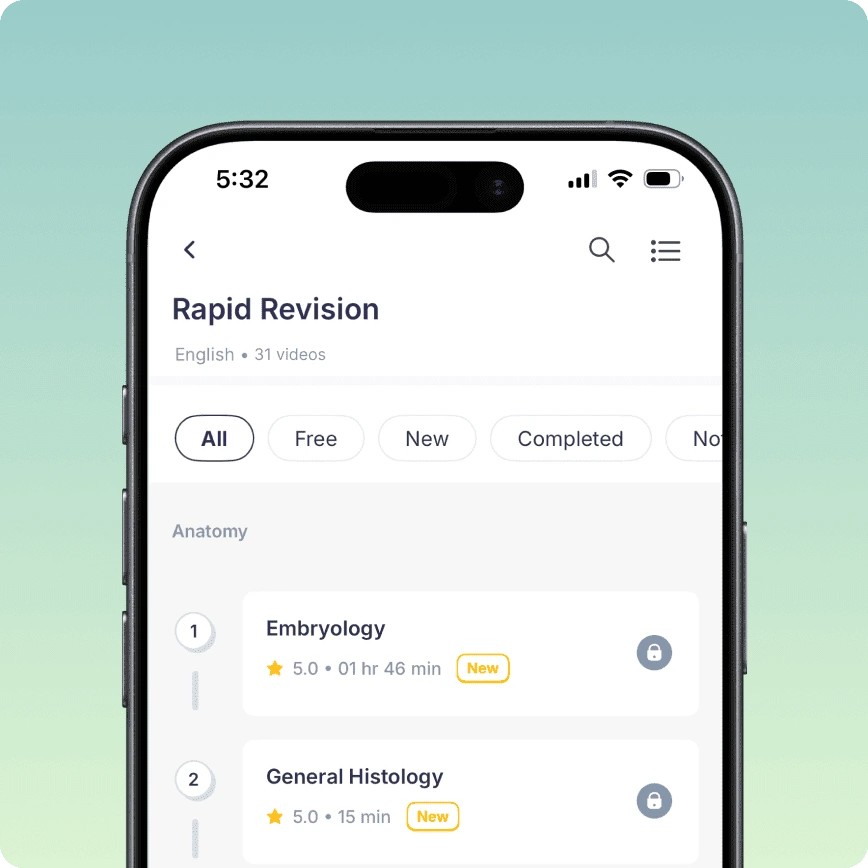
The score problem it solves: You study all topics equally, but examiners do not ask questions equally. Some topics generate 60–70% of questions. Without knowing which questions were asked before, you focus on topics that're not that important and ignore the ones that are actually asked.
How it works: Version XIs Rapid Revision has 280+ hours of videos. These videos are based on questions from NEET PG, FMGE, and INI-CET. This means what you study is what examiners have asked before.
The score impact: When you know what questions were asked before you prepare for the exam, not the syllabus. We call this making decisions. You focus on what is most likely to be asked.
- If a topic has been asked before, you should study it more.
- If a topic has not been asked in a time you can study it less.
- At 280+ hours across all 19 subjects, this is enough to be your study resource in the last 8–12 weeks, before the exam.
Way 2: Integrated Essentials Prepares You for Cross-Subject MCQs
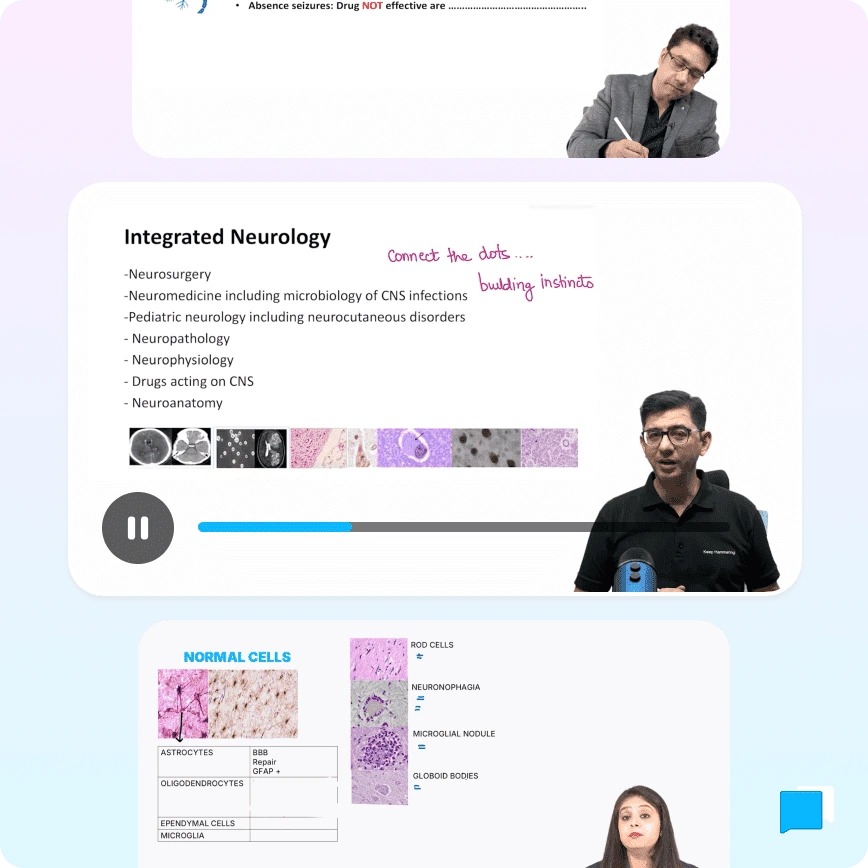
The score problem it solves: Both NEET PG and INI-CET increasingly test integration-based questions — MCQs that require you to connect concepts across Physiology, Pathology, Pharmacology, and Medicine in a single answer. If you've studied each subject in isolation, these questions feel unpredictable. They shouldn't.
How it works: Integrated Essentials delivers 50+ hours of system-wise learning. Instead of studying jaundice separately in Physiology (bilirubin metabolism), Pathology (hepatocellular vs obstructive), Medicine (clinical evaluation), and Surgery (interventions), you study the hepatobiliary system as one connected unit.
Score impact: INI-CET is particularly known for its emphasis on conceptual integration. A question on portal hypertension might require simultaneous recall of portosystemic anastomoses (Anatomy), sinusoidal pressure dynamics (Physiology), cirrhosis staging via Child-Pugh score (Medicine), and shunt procedures (Surgery). Students who study in silos struggle with these. Students who study in systems find them intuitive.
This module also eliminates the time wasted on redundant learning — the same concept explained three different ways across three subjects. That recovered time can be redirected toward QBank practice and targeted revision.
Way 3: SPARK Flashcards Turn Passive Knowledge Into Active Recall
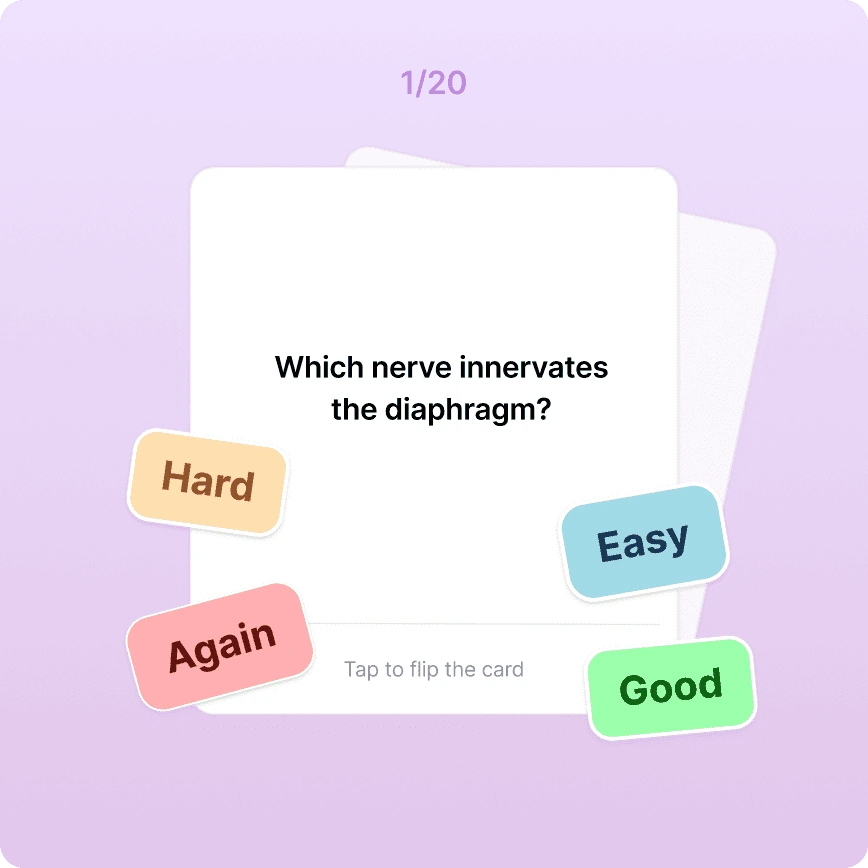
The problem with remembering things: You read something, you get it. Two weeks later, you can't recall it when it shows up as a multiple-choice question. This is what happens when you forget things over time. Your memory gets worse and worse if you don't review things at the right time.
How SPARK works: SPARK is a flashcard system that uses spaced repetition. It tracks what you remember. What you forget. If you remember something easily, it shows up often. If you struggle with something, it shows up often just when you're about to forget it. Over time, this creates a plan to help you review your weak areas.
What SPARK can do for your score: Spaced repetition has been. Proven to work over many years, and it's used by medical students all over the world to prepare for exams like USMLE, PLAB, and NEET PG. The difference with SPARK is that it's part of the PrepLadder system, so you don't have to make your flashcards or import new content.
Some advice from my experience: Start using SPARK from day one, not just when you're reviewing things. The earlier SPARK starts tracking what you remember and forget, the better it can help you with your areas by the time the exam comes.
Way 4: Error Tagging
Error tagging can help you avoid mistakes that can cost you 8-12 marks per paper.
The problem with making mistakes: If you get a question on a test with a +4/-1 scoring system, like NEET PG, you don't just lose 1 mark. You lose 5 marks (the 4 you could have gotten plus the 1 penalty). If you make 8-12 mistakes per paper, that's 40-60 marks lost. For students, just getting rid of these mistakes would improve their rank by thousands of places.
How error tagging works: Version XIs Rapid Revision videos have error files that show the common mistakes students make on each topic. These aren't just warnings. They're specific insights based on how students have answered questions in the past.
What error tagging can do for your score: I've seen many students make the same mistakes over and over. Like confusing different types of kidney failure or mixing up certain medical terms. Error tagging helps you avoid these mistakes before you make them.
Of making a mistake on a test, finding out about it later, and hoping you remember to correct it on test day, you learn about the common mistake before you see it. That's the difference between learning from a mistake and learning to avoid a mistake. And learning to avoid a mistake is more reliable when you're under pressure.
Way 5: Revamped QBank Builds Exam-Day Accuracy
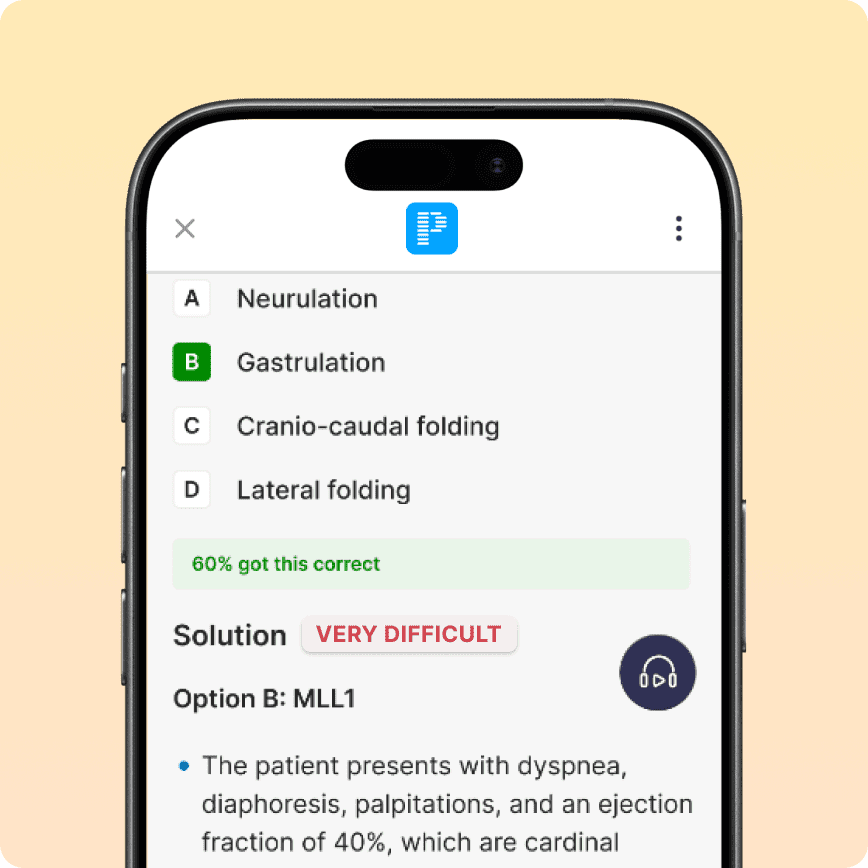
The problem with the score is that when you practice with poorly written questions, you get a false sense of how good you are. You do well on the questions, but then you do not do as well on the actual exam day. This is because the real exam is different from what you practiced. The questions are harder. The answers are not as easy to figure out.
The revamped QBank is trying to fix this problem. It has more than 5,000 new questions that are similar to the ones on the latest NEET PG and INI-CET exams. These questions were reviewed by people who recently took the exam and know how hard it is. They made sure the questions are like the thing with answers that are tricky to figure out.
When I have helped students study, I have seen that it is better to have questions than a lot of questions. A student who takes their time to answer 5,000 questions and learns from their mistakes will do better than a student who rushes to answer 15,000 questions without really understanding them.
The revamped QBank is designed to help students do this. It has questions, but each one is carefully written to help students get the right answers and understand the patterns they need to know for the exam.
For students who want to take the INI-CET exam, the questions are a little different. They require thinking and understanding of how to apply what you know. The revamped QBank has questions that are like this, so students can practice and get ready for either the INI-CET or the NEET PG exam. Many students take the INI-CET first. Then the NEET PG, because the subjects they need to study are very similar.
Way 6: Cadaver Dissection Videos Help You Understand Anatomy Better
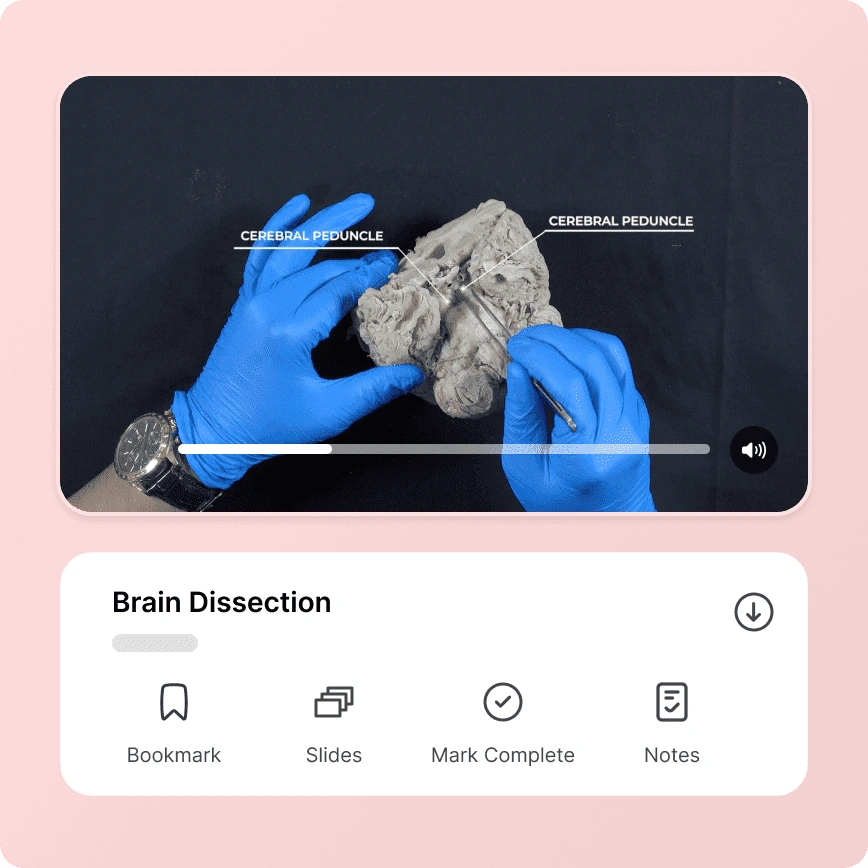
The score problem it solves: Anatomy questions in PG and INI-CET exams are now more about applying what you know rather than just recalling facts. These questions show images of body parts. Ask you to identify them.
- They want you to know what you see in a CT scan or what might get hurt during surgery.
- But looking at diagrams in a book can't help you understand how body parts relate to each other in 3D.
How it works: Our Version XI has 20 hours of videos showing cadaver dissection. You see body parts as they really are with all their connections, layers, and variations.
- It's not. Illustrated.
- It's footage of a human body.
Score impact: Students who understand anatomy in 3D do better on anatomy questions.When you see where the common bile duct is in relation to parts, a question about accidentally hurting it during surgery makes sense.
- You don't have to memorize it.
- This feature is especially helpful for students who didn't get to do dissections during medical school.
- The 20 hours of footage help fill the gap.
- It gives you an understanding of anatomy, which helps with your scores.
- Cadaver dissection videos are very helpful for PG and INI-CET exams.
- They help you understand anatomy better and boost your scores.
Way 7: Printed Summary Charts Help You Remember Facts Before The Exam

The problem that Printed Summary Charts solve is that you have to go through a lot of topics in the 48 hours before the exam. You need to make sure you can remember the facts. If you have big notes, you will have a hard time going through all 19 subjects in just two days. You need something that sums up the important facts for each topic on just one page.
So here is how Printed Summary Charts work. They take each topic. Put all the important information on one page. They only include the facts that are asked about again and again. They do not have any information or long explanations. They just have the facts, numbers, and drug doses that you need to know for the exam.
Using Printed Summary Charts can really help your score. After you finish your Rapid Revision, QBank practice, and SPARK flashcard cycles, you can use the Summary Charts to check how well you know everything. If you look at a chart and you know all the facts, then you are ready for the exam. If you see something that you do not know, then you know what you need to study before the exam.
This is like a checklist that doctors use before they do surgery. It helps you review everything at the same time, so you do not forget anything important. The students I have helped who use these kinds of summary sheets on the day before the exam say they feel more confident and do better on the exam than the students who just flip through their notes randomly. Printed Summary Charts are a help when it comes to remembering the important facts for the NEET PG INI-CET exam.

How Version XI Addresses NEET PG vs INI-CET Differences
Exam Dimension NEET PG 2026 INI-CET July 2026 How Version XI Helps Total questions 200 MCQs 200 MCQs QBank covers both question pools Duration 210 minutes (3.5 hrs) 180 minutes (3 hrs) SPARK builds faster recall speed Marking scheme +4 / −1 +1 / −⅓ Error tagging reduces negative marking Question style Pattern-recognition, factual Conceptual, integration-based Integrated Essentials builds cross-subject reasoning Anatomy emphasis Moderate High (applied + cross-sectional) 20 hrs cadaver dissection videos Revision efficiency High-yield focus needed Depth + breadth needed 280+ hrs PYQ-mapped Rapid Revision Recall under pressure Critical (1 min/question) Critical (54 sec/question) SPARK spaced repetition trains retrieval speed Syllabus overlap ~90% shared with INI-CET ~90% shared with NEET PG Single ecosystem covers both exams Score differentiator Avoiding negative marks Depth of understanding Error tagging + Integrated Essentials
Key Takeaways for Score Improvement
- The first way is PYQ-mapped Rapid Revision, which is around 280 plus hours. This way of studying helps you focus on the topics that are actually tested in the exams, not the syllabus. This can help you get 20 to 30 marks just by not wasting time on topics that are not important.
- The second way is Integrated Essentials, which is around 50 plus hours. This way helps you learn how to connect subjects together, which is what exams like NEET PG and INI-CET are looking for. When you learn things in a way, you will find it easier to answer questions that need you to think about different subjects at the same time.
- The third way is using SPARK flashcards. These flashcards help you remember things by repeating them at the time. This is a good way to learn, as it helps you change from just reading to actually remembering. You should start using these flashcards so you can get the most benefit from them.
- The fourth way is to identify the mistakes that you make often. These mistakes can cost you around 8 to 12 marks per paper. If you can avoid making these mistakes, you can improve your rank because of the way marks are given and taken away.
- The fifth way is to practice with the QBank, which has over 5,000 new questions. These questions are made to be like the ones you will get in the exam and have been checked by people who have recently passed the exams. Practicing with these questions will help you get an idea of how you will do in the exam, not just a false idea that you are doing well.
- The sixth way is to watch cadaver dissection videos, which are around 20 hours long. These videos help you learn about the anatomy which is needed for some types of questions in the exams. This is an area that is becoming more important in both PG and INI-CET exams.
- The seventh way is to use Printed Summary Charts. These charts help you revise everything in a way in the last 48 hours, before the exam. They make sure that you can easily access the facts when you need them the most.

Frequently Asked Questions
How many extra marks can I really get if I remember things better?
Most people who take tests lose 30 to 50 marks on each paper because they studied something, but cannot recall it during the test. If you use tools like repetition and PYQ-mapped revision, you can get back a lot of those marks. It depends on how you were doing before, but even getting 20 more marks can make a big difference in your rank in NEET PG.
Can Version XI help me prepare for both PG and INI-CET at the same time?
Yes, it can. The subjects that are covered in PG and INI-CET are about 90% the same. Version XI has things like Integrated Essentials and Rapid Revision that cover the subjects, and the QBank has questions that are like the ones on NEET PG and INI-CET.
When should I start using SPARK flashcards to get the most out of them?
You should start using them as soon as you can. The more SPARK knows about how well you remember things, the more it can help you make a plan to review. If you start using it when you first start reading, it will have a lot of time to figure out the way to help you by the time of the test.
Is the Rapid Revision content the same as the video lectures?
No, it is not. The Rapid Revision videos are new. Made just for reviewing. They are shorter. Focus on what you need to know for the test. The main video lectures have been updated a bit for Version XI, and the notes that go with them have been updated, too.
How does error tagging work when I am studying?
Each Rapid Revision video has tags that show where students usually make mistakes on that subject. These tags appear when the teacher is talking about the part where people usually get confused, and they show how to avoid making those mistakes.
When will Version XI be available?
Version XI will be available on April 12, 2026. Until then, people who subscribe will still be able to use all of the Version X content. They will get to see some of the new features. When you switch between versions, your progress and analytics will still be there.

PrepLadder
Access all the necessary resources you need to succeed in your competitive exam preparation. Stay informed with the latest news and updates on the upcoming exam, enhance your exam preparation, and transform your dreams into a reality!
Navigate Quickly
Here are 7 specific ways Version XI helps you score higher in NEET PG 2026.
NEET PG & INI-CET RELEVANCE
How Version XI addresses NEET PG vs INI-CET differences
Way 1: PYQ-Mapped Rapid Revision Targets What Examiners Actually Ask
Way 2: Integrated Essentials Prepares You for Cross-Subject MCQs
Way 3: SPARK Flashcards Turn Passive Knowledge Into Active Recall
Way 4: Error Tagging
Way 5: Revamped QBank Builds Exam-Day Accuracy
Way 6: Cadaver Dissection Videos Help You Understand Anatomy Better
How Version XI Addresses NEET PG vs INI-CET Differences
Key Takeaways for Score Improvement
Frequently Asked Questions
How many extra marks can I really get if I remember things better?
Can Version XI help me prepare for both PG and INI-CET at the same time?
When should I start using SPARK flashcards to get the most out of them?
Is the Rapid Revision content the same as the video lectures?
How does error tagging work when I am studying?
When will Version XI be available?
Top searching words
The most popular search terms used by aspirants
- medical pg version x
- NEET PG Preparation Strategy
- neet pg version x