Marfan vs Noonan vs Turner Syndrome: Signs, Genetics & Key Differences
Sep 1, 2026
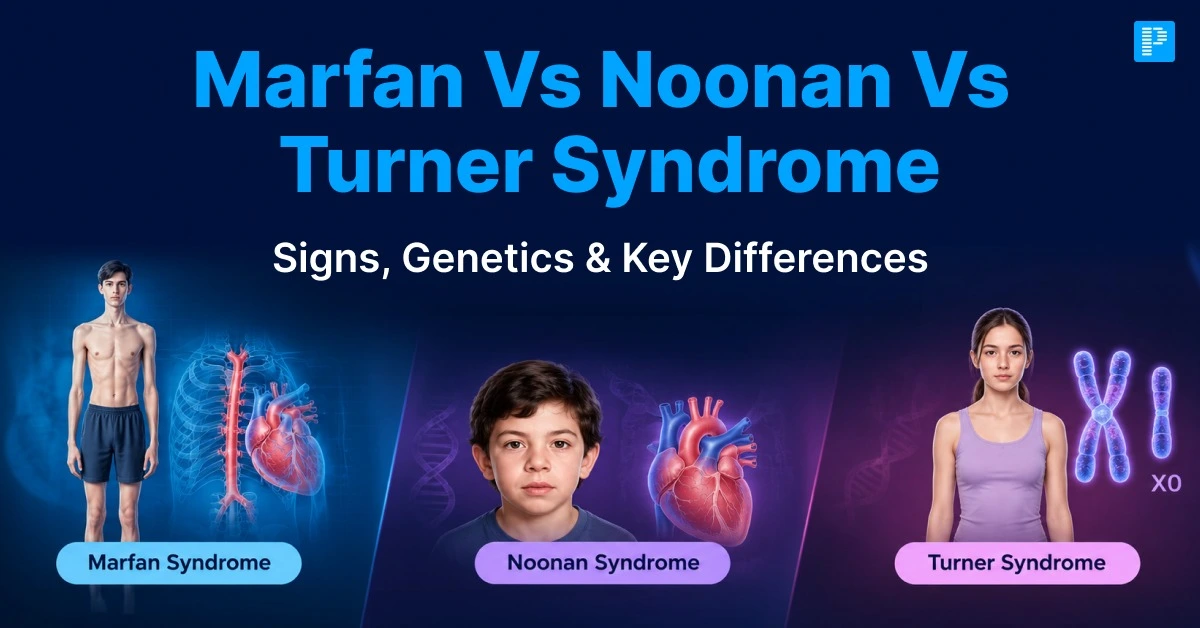
Marfan, Noonan, and Turner syndromes can appear similar in clinical questions because of overlapping skeletal, growth, and cardiovascular features. However, they differ significantly in their genetics, inheritance, stature, cardiac defects, and associated clinical findings.
In short: Marfan syndrome is typically associated with tall stature and aortic root dilation, Noonan syndrome with short stature and pulmonary valve stenosis, and Turner syndrome with short stature and left-sided cardiac defects such as bicuspid aortic valve and coarctation of the aorta.
This comparison explains the key differences between Marfan, Noonan, and Turner syndromes for quick revision and clinical differentiation.

Marfan vs Noonan vs Turner Syndrome: Comparison Table
Feature Marfan Syndrome Noonan Syndrome Turner Syndrome Genetics FBN1 (15q21.1) gene mutation PTPN11, SOS1, RAF1 45,X (Monosomy X) or Mosaicism Inheritance Autosomal Dominant Autosomal Dominant (usually de novo) Not inherited (sporadic chromosomal aneuploidy) Pathophysiology Fibrillin-1 deficiency → impaired sequestration of latent TGF-β → excess active TGF-β signaling RAS-MAPK pathway dysregulation (RASopathy) Complete or partial absence of one X chromosome Sex Affected Males and Females Males and Females Females only Stature Tall with long limbs (Dolichostenomelia) Short stature (Proportional) Short stature (SHOX haploinsufficiency) Cardiac Features Aortic root, Mitral valve Right heart, Myocardium Left heart, Aortic arch Key Cardiac Lesions Aortic root dilation, Mitral valve prolapse Pulmonary valve stenosis, Hypertrophic cardiomyopathy Bicuspid aortic valve (~25–30%), Coarctation of the aorta Cognitive Profile Normal intelligence Normal to mild learning difficulties Normal verbal IQ; possible visuospatial deficits
Pathology Most Important 100 one-liners - Download Free PDF!
Marfan Syndrome: Genetics, Clinical Features & Cardiac Findings
Marfan syndrome is a systemic disorder of connective tissue that primarily affects the cardiovascular, skeletal, and ocular systems.
Genetics and Inheritance
- It is an autosomal dominant condition caused by a mutation in the FBN1 gene on chromosome 15.
- This gene encodes fibrillin-1, a crucial scaffolding protein that normally sequesters latent TGF-β in the extracellular matrix.
- Defective fibrillin releases more active TGF-β and leads to cystic medial degeneration, classically termed “cystic medial necrosis,” of the aortic wall.
Cardiovascular Features
- The most life-threatening complications are progressive aortic root dilation, which can lead to dissecting aortic aneurysms, and mitral valve prolapse (MVP) with regurgitation.
Skeletal Features: Marfanoid Habitus
- Patients present with a tall, thin frame, dolichostenomelia (disproportionately long limbs), and arachnodactyly (abnormally long, slender fingers).
- Other skeletal findings include pectus excavatum or carinatum, severe scoliosis, joint hypermobility, and a high-arched palate with dental crowding.
Ocular and Pulmonary Features
- A hallmark sign is ectopia lentis with superotemporal (upward and outward) dislocation of the lens.
- Patients are also at higher risk for spontaneous pneumothorax due to apical lung blebs.


Noonan Syndrome: Genetics, Clinical Features & Cardiac Findings
Historically and incorrectly labelled as “Male Turner Syndrome,” Noonan syndrome is a distinct genetic condition belonging to a group of diseases known as RASopathies.
Genetics and Inheritance
- It is an autosomal dominant disorder caused by gain-of-function mutations in genes of the RAS-MAPK signalling pathway.
- The most common mutation is in PTPN11 (~50% of cases), followed by SOS1, RAF1, and KRAS.
- Although the inheritance pattern is autosomal dominant, the majority of cases arise from de novo mutations rather than being inherited from an affected parent.
Cardiovascular Features
- Congenital heart defects in Noonan syndrome predominantly affect the right side of the heart and the myocardium.
- Dysplastic pulmonary valve stenosis is the most common lesion.
- Hypertrophic cardiomyopathy (HCM) is also highly prevalent, particularly in patients with RAF1 or RIT1 mutations.
Craniofacial Features
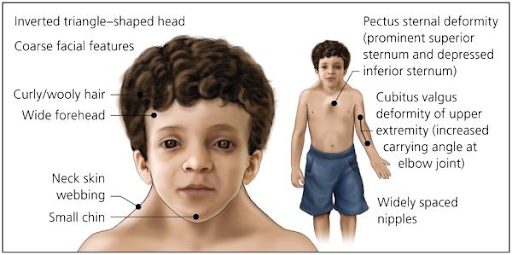
- Eyes: Hypertelorism (widely spaced eyes), low-set down-slanting palpebral fissures, epicanthal folds, ptosis (drooping eyelids), and light blue/green irises.
- Ears: Low-set, backward-rotated ears with thick helices.
Musculoskeletal Features & Stature
- Short Stature: Delayed growth spurt, usually apparent after birth.
- Chest Deformities: Pectus carinatum superiorly (protruding sternum) combined with pectus excavatum inferiorly (sunken sternum), along with widely spaced nipples.
- Extremities: Cubitus valgus (increased carrying angle at the elbow).
Associated Complications
- Males frequently present with cryptorchidism (undescended testicles), which can impact fertility.
- Patients may also have a bleeding diathesis, most often factor XI deficiency, though other coagulation factor deficiencies and platelet dysfunction can also occur, along with varying degrees of learning disability.
Turner Syndrome: Genetics, Clinical Features & Cardiac Findings
Turner syndrome is a sex chromosome disorder resulting from the complete or partial absence of one X chromosome.
Genetics and Inheritance
- The most common karyotype is 45, X, resulting from sporadic non-disjunction; most 45, X cases arise from loss of the paternal sex chromosome.
- Mosaicism (e.g., 45, X/46, XX) and structural abnormalities (e.g., isochromosome X) also occur.
- Unlike Marfan and Noonan syndromes, Turner syndrome is not inherited in an autosomal dominant pattern and affects females only.
Cardiovascular Features
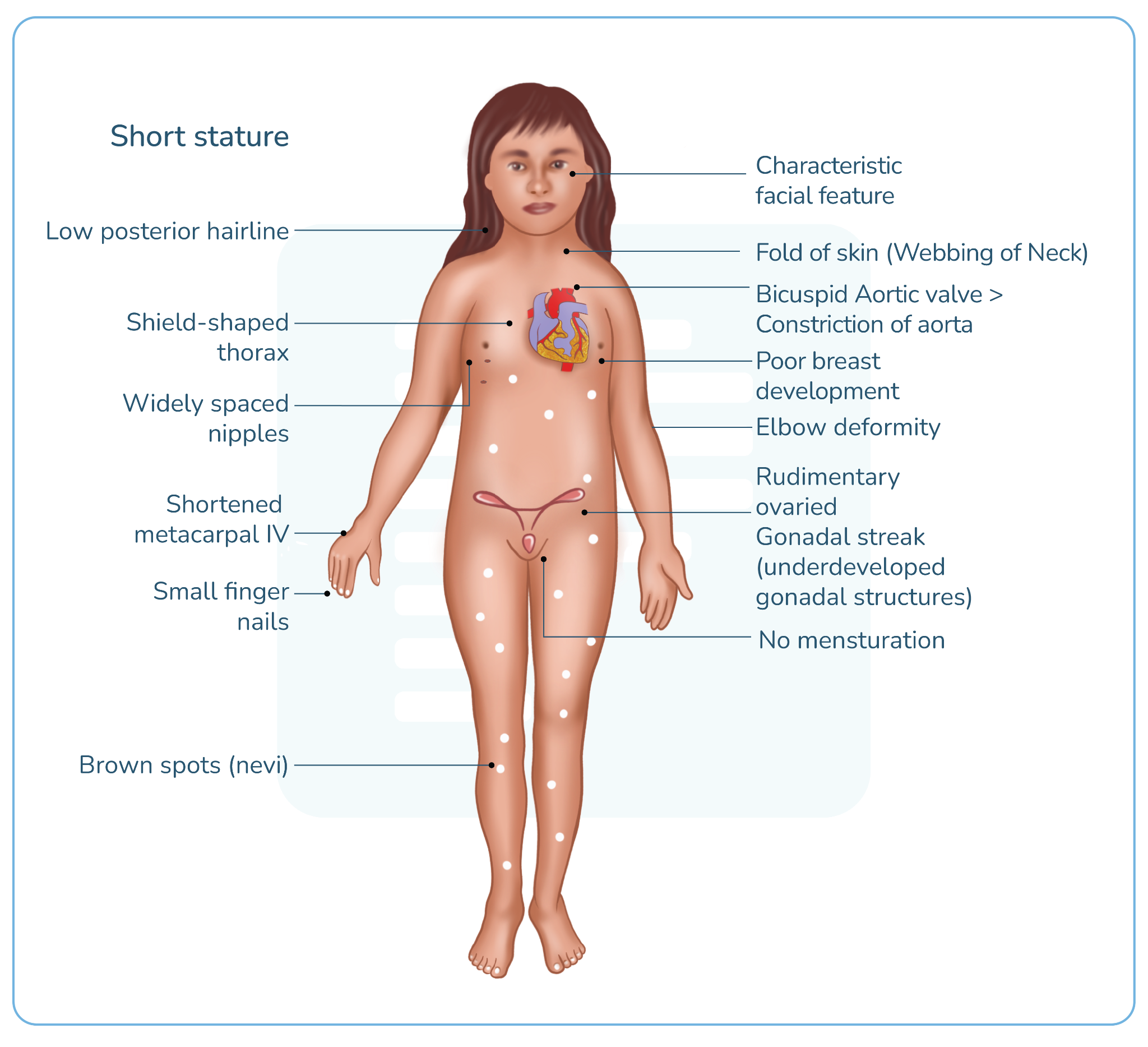
- Left-sided heart lesions dominate the clinical picture. Bicuspid aortic valve (BAV) is the most common defect, with a reported prevalence of roughly 25–30%.
- Coarctation of the aorta is also a classic finding, and patients carry an elevated lifetime risk of aortic dissection.
Physical Features
- Short stature is nearly universal, largely due to loss of the SHOX gene on the missing X chromosome.
- Characteristic physical signs include a webbed neck resulting from cystic hygromas in utero, a broad “shield” chest with widely spaced nipples, low posterior hairline, and cubitus valgus.
- Neonates often present with congenital lymphedema of the hands and feet.
Endocrine and Reproductive Features
- Patients experience primary gonadal failure due to streak ovaries, where fibrous tissue replaces normal ovarian stroma.
- This leads to primary amenorrhea, hypergonadotropic hypogonadism, absent secondary sexual characteristics without hormone replacement, and infertility.
- There is also an increased risk of autoimmune (Hashimoto) thyroiditis and horseshoe kidney.

How Do You Differentiate Marfan, Noonan and Turner Syndromes?
The easiest way to differentiate Marfan, Noonan, and Turner syndromes is to compare sex affected, stature, genetics, and characteristic cardiac lesions.
The Gender Rule
- If the patient is a male presenting with short stature, a webbed neck, and a chest deformity, the diagnosis strongly suggests Noonan syndrome.
- Turner syndrome occurs exclusively in females.
The Cardiac Lesion Rule
- Left-sided defects such as bicuspid aortic valve and aortic coarctation point towards Turner syndrome.
- Right-sided or myocardial defects such as pulmonary stenosis and hypertrophic cardiomyopathy strongly point towards Noonan syndrome.
- Vessel wall dilation and valve prolapse, particularly aortic root aneurysm and mitral valve prolapse, point towards Marfan syndrome.
The Stature Rule
- Marfan syndrome is the only condition among the three characterised by tall stature and disproportionately long limbs.
- Both Turner and Noonan syndromes present with restricted growth and short stature.
Key Takeaway
For quick differentiation, remember: Marfan = tall stature + aortic root dilation, Noonan = short stature + pulmonary valve/right-heart abnormalities, and Turner = female + short stature + left-heart/aortic arch abnormalities.
Frequently Asked Questions
What is the main difference between Marfan, Noonan, and Turner syndromes?
Marfan syndrome typically causes tall stature, long limbs, aortic root dilation, and ectopia lentis. Noonan syndrome causes short stature and is commonly associated with pulmonary valve stenosis or hypertrophic cardiomyopathy. Turner syndrome affects females and is commonly associated with short stature, bicuspid aortic valve, and coarctation of the aorta.
Can Noonan syndrome occur in females?
Yes. Despite its outdated clinical alias as “Male Turner syndrome,” Noonan syndrome is an autosomal dominant condition, with most cases arising de novo, that affects both biological males and females.
Which syndrome is associated with pulmonary stenosis: Noonan or Turner syndrome?
Pulmonary valve stenosis is classically associated with Noonan syndrome. Turner syndrome is more commonly associated with left-sided cardiovascular abnormalities such as bicuspid aortic valve and coarctation of the aorta.
How does lens dislocation in Marfan syndrome differ from other conditions?
In Marfan syndrome, the lens typically subluxates upward and outward (superotemporal). This is clinically distinct from homocystinuria, a metabolic disorder with a similar marfanoid body habitus, where the lens classically dislocates downward and inward (inferonasal).
What causes short stature in Turner syndrome compared with Noonan syndrome?
In Turner syndrome, short stature is directly attributed to haploinsufficiency of the SHOX (Short Stature Homeobox) gene, located in the pseudoautosomal region of the X chromosome. In Noonan syndrome, short stature relates to systemic dysregulation of the RAS-MAPK pathway affecting growth hormone/IGF-1 signalling.
Are cognitive abilities affected similarly across Marfan, Noonan, and Turner syndromes?
No. Intelligence in Marfan syndrome is generally normal. Turner syndrome patients generally have normal verbal IQ but may show specific deficits in non-verbal, spatial, or executive processing. Noonan syndrome has a higher association with mild intellectual disability and generalised learning delays.
Understanding these pathophysiological and clinical differences can help distinguish Marfan, Noonan, and Turner syndromes accurately in examinations and clinical scenarios.

PrepLadder
Access all the necessary resources you need to succeed in your competitive exam preparation. Stay informed with the latest news and updates on the upcoming exam, enhance your exam preparation, and transform your dreams into a reality!
Navigate Quickly
Marfan vs Noonan vs Turner Syndrome: Comparison Table
Pathology Most Important 100 one-liners - Download Free PDF!
Marfan Syndrome: Genetics, Clinical Features & Cardiac Findings
Genetics and Inheritance
Cardiovascular Features
Skeletal Features: Marfanoid Habitus
Ocular and Pulmonary Features
Noonan Syndrome: Genetics, Clinical Features & Cardiac Findings
Genetics and Inheritance
Cardiovascular Features
Craniofacial Features
Musculoskeletal Features & Stature
Associated Complications
Turner Syndrome: Genetics, Clinical Features & Cardiac Findings
Genetics and Inheritance
Cardiovascular Features
Physical Features
Endocrine and Reproductive Features
How Do You Differentiate Marfan, Noonan and Turner Syndromes?
The Gender Rule
The Cardiac Lesion Rule
The Stature Rule
Key Takeaway
Frequently Asked Questions
What is the main difference between Marfan, Noonan, and Turner syndromes?
Can Noonan syndrome occur in females?
Which syndrome is associated with pulmonary stenosis: Noonan or Turner syndrome?
How does lens dislocation in Marfan syndrome differ from other conditions?
What causes short stature in Turner syndrome compared with Noonan syndrome?
Are cognitive abilities affected similarly across Marfan, Noonan, and Turner syndromes?
Top searching words
The most popular search terms used by aspirants
- NEET PG Pathology
- NEET PG Pathology Preparation