Most Important Pharmacology Tables for NEET PG 2026
Jun 25, 2026
Let’s be honest about Pharmacology. It’s the one subject that can either skyrocket your rank or leave you totally buried. You’re looking at hundreds of drugs, thousands of side effects, and mechanism diagrams that honestly look like a bowl of spaghetti.
If you try to read Pharmacology like a novel, page by page, you are going to struggle with recall during the actual exam. NEET PG 2026 isn't just about knowing a drug; it’s about Clinical Differentiation.
The examiners love giving you a patient with a complex history and then forcing you to choose a drug based on its interaction with other medications or its specific side-effect profile. This is where Pharmacology Tables save your life.
In our 10 years of mentoring medical students, our team has seen that the toppers consistently Table-fied their notes. Tables allow you to see the "fork-in-the-road" differences between drugs in seconds.

Why Tables are the Secret Logic of Pharmacology
The modern exam pattern uses what we call Exclusion Logic. To get a 5-line Medicine vignette right, you often have to rule out three drugs based on their metabolic pathways or side effects. If you’ve studied via tables, your brain naturally groups drugs into Safe and Dangerous categories.
- Spotting the Outliers: A table forces you to see the exceptions. For example, in a table of Beta-blockers, you’ll instantly spot Esmolol as the ultra-short-acting outlier. That is exactly where the NBEMS panel strikes.
- High-Velocity Recall: In the final month, you can't re-read 200 pages of Pharma notes. But you can scan 10 high-yield tables in 30 minutes. It’s the most efficient way to keep information fresh.
- Solving the Psych-Pharma Crossover: Management of Extrapyramidal Side Effects (EPS) is a favorite for examiners. Using a table to differentiate between Akathisia and Acute Dystonia is the only way to avoid the 50/50 trap.
Download the Academic PDF for FREE and Boost your Exam Prep

The Must-Know Pharma Tables for 2026
Our team has identified seven specific tables that appear in some form in almost every single paper.
1. The Autonomic Receptors (ANS)
This is the Foundation Stone of Pharma. If you don't know the receptors, you can't predict the clinical actions.
| Receptor | Primary Location | Clinical Action | Standout Drug |
|---|---|---|---|
| M1 | Gastric Glands / CNS | Secretion / Learning | Pirenzepine |
| M2 | Heart (SA/AV node) | Bradycardia | Atropine (Blocker) |
| M3 | Smooth Muscle / Glands | Contraction / Secretion | Pilocarpine |
| Alpha-1 | Blood Vessels | Vasoconstriction | Phenylephrine |
| Beta-1 | Heart / Kidney | Tachycardia / Renin | Dobutamine |
| Beta-2 | Lungs / Vessels | Bronchodilation | Salbutamol |
2. Management of Extrapyramidal Side Effects (EPS)
This is a high-yield Psych-Pharma crossover table. You must know the timing and the specific treatment.
| Condition | Typical Timing | Clinical Feature | Drug of Choice |
|---|---|---|---|
| Acute Dystonia | Hours to Days | Torticollis / Oculogyric crisis | Promethazine / Benztropine |
| Akathisia | Days to Weeks | Subjective restlessness | Propranolol |
| Pseudoparkinsonism | Weeks to Months | Tremor / Rigidity / Bradykinesia | Trihexyphenidyl (THP) |
| Tardive Dyskinesia | Months to Years | Choreo-athetoid movements | Valbenazine / Deutetrabenazine |
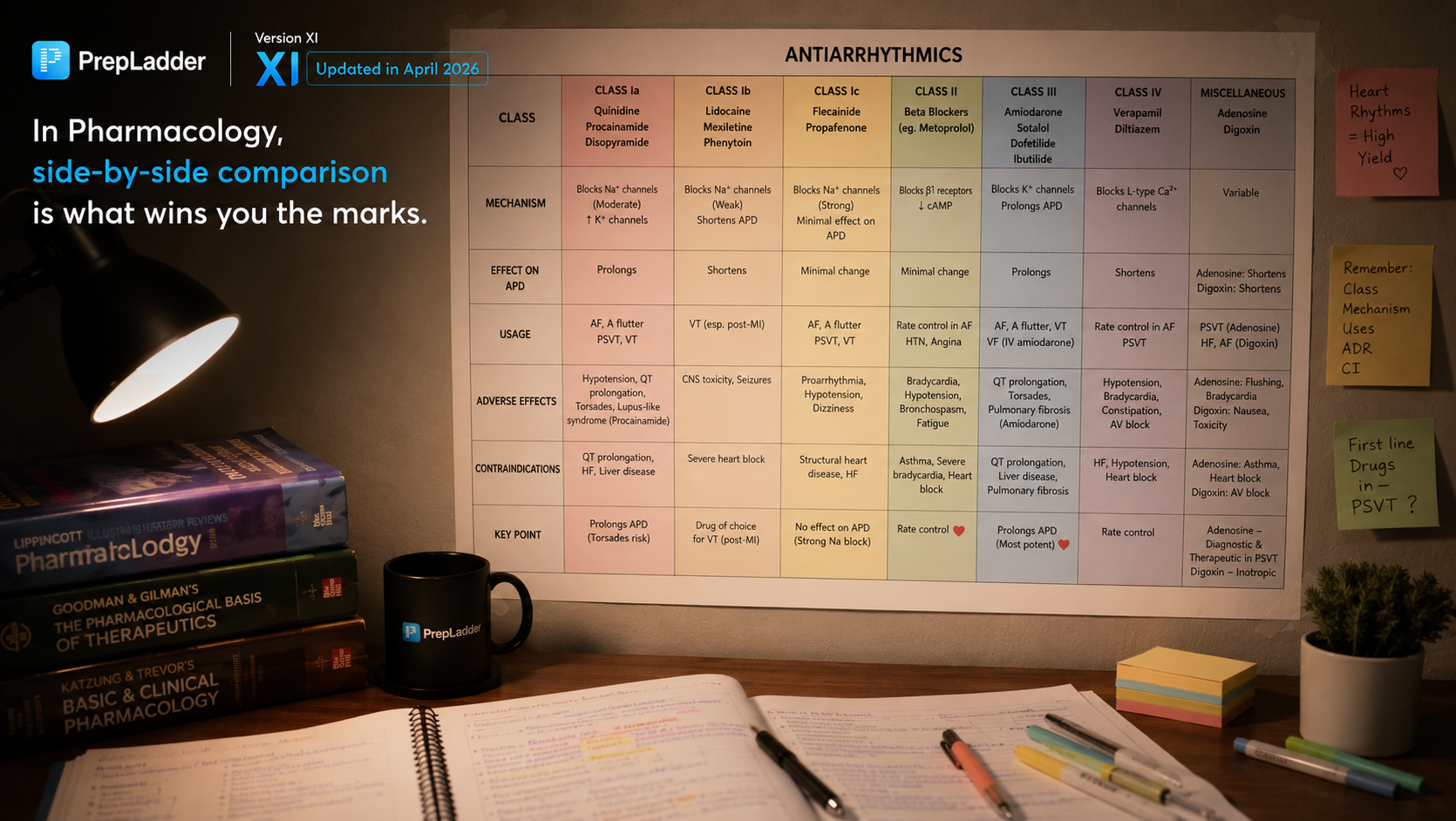
3. Vaughan-Williams Classification (Antiarrhythmics)
You will almost certainly get a question on Class I vs. Class III mechanisms.
| Class | Mechanism | Standout Drugs | Key Clinical Pearl |
|---|---|---|---|
| Class IA | Na+ Block (Intermediate) | Procainamide | Can cause SLE-like syndrome |
| Class IB | Na+ Block (Fast) | Lidocaine | Drug of choice for Post-MI VT |
| Class IC | Na+ Block (Slow) | Flecainide | Absolutely avoid in post-MI |
| Class II | Beta-blockers | Propranolol | Useful in hyperthyroidism |
| Class III | K+ Channel Blockers | Amiodarone | Causes thyroid/pulmonary toxicity |
| Class IV | Ca2+ Channel Blockers | Verapamil | Never combine with Beta-blockers |
4. Diuretics: Electrolyte and pH Changes
This table is critical for solving Nephrology and Medicine vignettes.
| Diuretic Class | Site of Action | Potassium (K+) | pH Change | Clinical Pearl |
|---|---|---|---|---|
| Acetazolamide | PCT | Decreased | Acidosis | Used in Glaucoma / Mountain Sickness |
| Loop (Furosemide) | Thick Ascending Limb | Decreased | Alkalosis | Most potent; causes Ototoxicity |
| Thiazides | DCT | Decreased | Alkalosis | Causes Hypercalcemia; avoids stones |
| K-Sparing | Collecting Duct | Increased | Acidosis | Blocks Aldosterone (Spironolactone) |
5. Antiepileptic Drugs: Spectrum of Activity
Seizure Type First-Line Choice Standout Side Effect GTCS Valproate Neural Tube Defects in pregnancy Absence Ethosuximide First-line only for Absence Myoclonic Valproate Weight gain / PCOS risk Partial (Focal) Levetiracetam Mood changes / Irritability Status Epilepticus Lorazepam (IV) Respiratory depression
6. Cytochrome P450 Modulators (Drug Interactions)
It explains why a patient on Warfarin suddenly starts bleeding after taking an antibiotic.
| Enzyme Inducers (Decrease drug levels) | Enzyme Inhibitors (Increase drug levels) |
|---|---|
| Rifampicin (The most potent) | Ketoconazole / Itraconazole |
| Phenytoin | Erythromycin / Clarithromycin |
| Carbamazepine | Cimetidine |
| Griseofulvin | Ciprofloxacin |
| Phenobarbitone | Grapefruit Juice |
| Chronic Alcoholism | Acute Alcohol Intoxication |
7. Emergency Antidotes
This is the easiest 4 marks you will get. You should know this list by heart.
| Poison / Drug Toxicity | The Specific Antidote |
|---|---|
| Organophosphates | Atropine / Pralidoxime |
| Paracetamol | N-acetylcysteine |
| Opioids | Naloxone |
| Heparin | Protamine Sulfate |
| Warfarin | Vitamin K / FFP |
| Iron | Deferoxamine |
| Benzodiazepines | Flumazenil |
How Version XI Revolutionizes Pharma Prep
With the launch of PrepLadder Version XI in April 2026, our team has fundamentally changed how you interact with these tables.
1. The NEW Flashcards (The 50/50 Killer)
Version XI introduces a massive library of Interactive Flashcards.
- The Hack: Instead of just looking at a table, the flashcards use Active Recall. It will show you a condition like Akathisia, and you have to name the drug of choice before flipping the card. This forced retrieval is the only way to lock volatile drug names into your long-term memory.
2. The Revamped QBank (Clinical Application)
In the April 2026 update, we have removed simple recall questions. Every single MCQ in the Version XI QBank is now a patient vignette. You’ll be given a patient with a specific comorbid condition (like Gout) and asked to pick a diuretic that doesn't exacerbate their condition (since Thiazides cause hyperuricemia).
3. Integrated Subject Circles
Version XI features Integrated Circles that link these tables to the relevant Medicine and Pathology modules. You can jump from the side effects of Antipsychotics directly to the Psychiatry module on Schizophrenia with one tap.

Frequently Asked Questions
Q1. Which Pharmacology table should I prioritize?
If you are short on time, master the ANS Receptors and EPS Management. These are the Master Keys because they appear across multiple subjects.
Q2. How do I use the new Version XI Flashcards effectively?
Don't do them all at once. Use your dead time, while commuting or waiting for lunch, to flip through 20-30 cards. Consistency is better than a 5-hour marathon.
Q3. Why do I keep forgetting the Diuretic electrolyte changes?
It’s a common struggle. Our team recommends focusing on pH and Calcium. Remember: Thiazides save calcium, while Loop diuretics lose calcium.
Q4. Are the 2024-2025 guideline updates included in the tables?
Yes. The April 2026 Version XI update includes the latest SGLT2 inhibitor guidelines for heart failure and the updated KDIGO guidelines for renal drugs.
Q5. How do I handle tables with too much information?
Focus on the Standout Fact. Examiners don't test common side effects like nausea. They test specific named findings, like Gingival Hyperplasia for Phenytoin or Hemorrhagic Cystitis for Cyclophosphamide.
Q6. Is the Revamped QBank harder than the old one?
It is more Clinically Relevant. It mirrors the 2026 NEET PG pattern of using long vignettes where the answer hinges on a single pharmacological differentiator.
Clinical Pearl
In Pharmacology, a table is not just a list; it is a clinical map. Don't just memorize the rows; understand why the drug in Row A is the friend and the drug in Row B is the foe.
Over our 10 years of mentoring, we’ve found that Pharmacology is a high-reward subject. If you know the table, you get the mark. Dive into the Version XI Flashcards, master your high-yield tables, and we’ll see you on the rank list.

PrepLadder
Access all the necessary resources you need to succeed in your competitive exam preparation. Stay informed with the latest news and updates on the upcoming exam, enhance your exam preparation, and transform your dreams into a reality!
Navigate Quickly
Why Tables are the Secret Logic of Pharmacology
Download the Academic PDF for FREE and Boost your Exam Prep
The Must-Know Pharma Tables for 2026
1. The Autonomic Receptors (ANS)
2. Management of Extrapyramidal Side Effects (EPS)
3. Vaughan-Williams Classification (Antiarrhythmics)
4. Diuretics: Electrolyte and pH Changes
5. Antiepileptic Drugs: Spectrum of Activity
6. Cytochrome P450 Modulators (Drug Interactions)
7. Emergency Antidotes
How Version XI Revolutionizes Pharma Prep
1. The NEW Flashcards (The 50/50 Killer)
2. The Revamped QBank (Clinical Application)
3. Integrated Subject Circles
Frequently Asked Questions
Q1. Which Pharmacology table should I prioritize?
Q2. How do I use the new Version XI Flashcards effectively?
Q3. Why do I keep forgetting the Diuretic electrolyte changes?
Q4. Are the 2024-2025 guideline updates included in the tables?
Q5. How do I handle tables with too much information?
Q6. Is the Revamped QBank harder than the old one?
Clinical Pearl
Top searching words
The most popular search terms used by aspirants
- NEET PG Pharmacology
- NEET PG Pharmacology Preparation