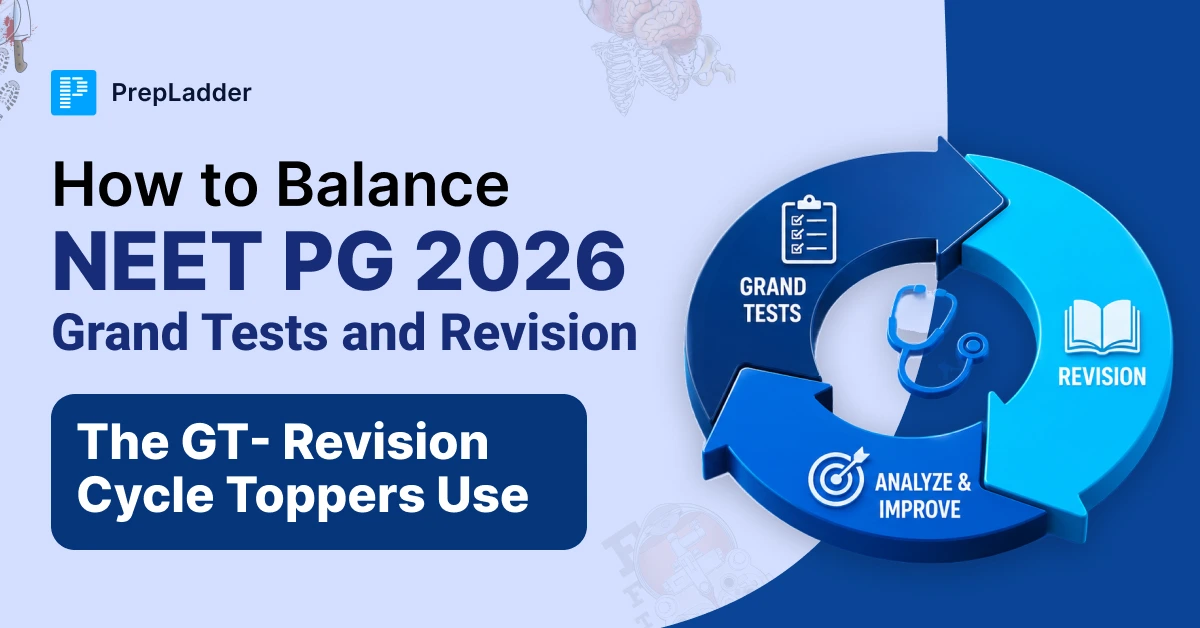
How to Balance NEET PG 2026 Grand Tests and Revision: The GT-Revision Cycle Toppers Use
May 29, 2026
We can discuss a situation that occurs every Sunday morning.
Imagine a 24-year-old intern accessing his test platform. He has just completed a 3.5-hour marathon. He is hoping for a breakthrough. Then, the score blinks back: 412/800.
His heart sinks. Last week, he received a 440. He’s spent the last fourteen days in a room revising until his eyes hurt, and yet, his score actually dropped. He still has 14 GTs to go and five subjects that remain complete mysteries. The next thing is the panic: Do I quit taking GTs and simply read more? Or am I continuing to test and hope that the numbers will increase one day?
This is what we hear most of the NEET PG aspirants say to our team every year. The quickest method of hitting a plateau is to get this balance wrong. Without a system, you will not simply cease to get better; you may even begin to get worse at the very time you need it the most.
The Quick Answer
Grand Tests (GTs) are 200-question simulations that are full-length. They are inhuman, yet they are needed. The ideal balance is 1:2 based on our 10 years of experience mentoring students. You must spend at least two hours on specific revision, on the basis of what that test just told you, for every hour you spend taking a GT.
Toppers with 650+ tend to complete 30-40 GTs, but take 4 hours to analyze each one. It is not about the number of tests you can take, but the amount of learning you can extract.

Why This is Important to 2026.
The 2025 analysis revealed that the exam has become 32% clinical vignettes, 21% integrated cases, and 18% image-based. You cannot "read" your way into being good at this. The only way to train your brain to alternate between a Radiology image and a Pharmacology mechanism in 60 seconds is through GT practice.
What Are Grand Tests and Why Do They Matter?
Imagine a GT as a dress rehearsal. You have 200 MCQs, 3.5 hours, and that section-locking feature where you cannot go back after you have completed a block.
GTs accomplish three tasks that cannot be achieved by reading a textbook:
- They Develop Exam Stamina: 210 minutes of clinical questions is a mental marathon. Your brain becomes fatigued. Silly mistakes are caused by fatigue. You need to condition your brain to remain alert throughout the entire time, just as a surgeon remains alert during a lengthy operation.
- They Reveal Inter-Subject Interference: You may know Pharmacology when you are reading a Pharma book. But do you know it when you have just answered 40 questions on Surgery and Pathology? GTs challenge your memory of facts in the presence of noise.
- They Train Your "Skip Logic": The average student is losing 40-60 marks simply due to negative marking. The high-stakes decision of whether to attempt this or not is only practiced in GTs.

Download NEET PG Previous Year Question Papers PDF For Free
The GT-Revision Controversy: Why Students Get This Wrong.
Two categories of students have failed this cycle in our team:
- The GT Addict: They take a test every 2 days. They have completed 60 GTs, but they are at 450. Why? Since they do not read the reports. It is as though you are running a blood test daily, but you never read the results. The interpretation is essential to the test.
- The Eternal Reviser: They say, I will begin GTs after my third revision. By July, they have mastered their notes, yet have only made 2 GTs. They enter the examination hall and break down under the pressure of time. Their test-taking ability is 0, whereas their knowledge is 10/10.
The correct path is a systematic process in which the GT informs you on what to update.

The 1:2 Rule: Our Success Framework.
To have your scores soaring, you must devote time to the following order:
- The Test: 3.5 hours.
- The Analysis: 3-4 hours (The same day or the next morning).
- Targeted Revision: 3-4 hours (Based only on your mistakes).
Time per cycle: 11 hours. This will allow you to complete one complete cycle in 2-3 days in the last three months.
The Analysis of a GT Properly.
The majority of students analyze by examining their score and being sad. That’s not analysis; that’s an emotional reaction. The following is the clinical process that we suggest:
Step 1: The 4-Bucket Error Audit
Check all the wrong or missed answers and place them in one of the following buckets:
- Bucket A (Knowledge Gap): You just did not know the fact. (e.g., You were not aware that Dapsone causes methemoglobinemia).
- Bucket B (Conceptual Confusion): You were familiar with the subject but became confused between two choices. (e.g., You mixed up ACE inhibitors and ARBs).
- Bucket C (Silly Mistakes): You were aware of the answer but read LEAST likely incorrectly or pressed the incorrect button.
- Bucket D (Time Pressure): You guessed it, you had 10 seconds left.
Step 2: The Subject Heatmap
See your accuracy percentage on each subject. There is no use in revising the topics that you scored 80 percent. The bottom 3 subjects are the only ones you should concentrate on in the next 48 hours.
Step 3: The Efficiency Check.
Test your Net Efficiency. When you are losing over 50 marks to negative marking, you are guessing excessively. You need to be more disciplined in skipping your next GT.
Also Read: NEET PG Exam Pattern 2026 - Marking Scheme, Questions Type, Exam Mode
Your GT Calendar: Month by Month.
Phase 1: The Initiation (June)
- Frequency: 1 GT/week.
- Goal: Benchmarking. There is no need to panic when you get 350. It's your starting line.
- Action: Start a GT Error Journal. List all your errors in a single line. It will be your most valuable book in August.
Phase 2: The Acceleration (July)
- Frequency: 2 GTs/week.
- Goal: Pattern recognition. You will begin to realize that NBEMS is fond of some subjects, such as CHA 2DS 2 -VASc or Crohn vs. UC.
- Weekly Rhythm: Day 1: GT + Analysis. Day 2: Revise weak areas. Day 3: MCQ practice. Repeat.
Phase 3: The Peak (August 1-24)
- Frequency: 3 GTs/week.
- Goal: Dress rehearsal. Take the test from 9:00 AM to 12:30 PM. No phone. No water breaks.
- Action: It is now 100% GT-driven. You are not reading Medicine; you are plugging gaps, questions you got wrong on the last GT.
The Final Week (August 25-30)
No more GTs after the 27th. Read your Error Journal, cover to cover. Reinforce your "named" criteria and drug doses. Then, go execute.
Also Read: Bond Service Rules for PG Medical Seats – State-Wise Guide
GT Analysis vs. Passive Revision: What's the difference?
Feature GT-Driven Revision Passive Reading The Trigger Your actual mistakes A pre-set schedule Focus Powerful (you learn by the pain of a wrong answer) Broad and shallow Efficiency Very High (every minute counts) Low (reading things again) Retention Powerful (you learn by the the pain of a wrong answer) Moderate (recognition-based) Outcome 2-4 marks gained per hour 0.5 marks gained per hour
Subject Heatmap Stacking
The progress of a topper after every 5 GTs is as follows:
| Subject | GT-1 | GT-5 | GT-10 | GT-15 | GT-20 | Trend |
| Medicine | 62% | 68% | 71% | 75% | 78% | Improving |
| Anatomy | 55% | 52% | 58% | 56% | 54% | Stagnant |
| PSM | 48% | 55% | 62% | 68% | 72% | Improving |
When a subject is in the same position as Anatomy, you have to change tactics. Stop reading and begin to solve 100 MCQs or watch a new video.
NEET PG HIGH-Yield points.
- The 1:2 Ratio: Each 3.5-hour GT is to be analyzed and revised with a focus on 7-8 hours.
- Topper Benchmark: Students with a score of 650 and above in 2025 took 30-40 GTs with strict post-test analysis.
- The 4 Buckets: Classify all mistakes as Knowledge Gap (A), Conceptual Confusion (B), Silly Mistake (C), or Time Pressure (D).
- Net Efficiency: Aim to achieve a ratio of more than 75% to reduce negative marking losses.
- The GTAR Mnemonic: Test, Triage mistakes, Work on the weak points, Journal review.
- The 60% Rule: Do not start GTs until you have finished at least 60% of your syllabus.
- Intersection Concepts: NBEMSexaminers are fond of subject intersections (Pharma + Medicine). They can only be trained with the help of GTs.
- Avoid GT Addiction: 20 tests with careful analysis will never lose to 50 tests with no analysis.
- The Error Journal: Keep this one as in GT-1. By exam week, it’s your most valuable resource.
- The Final Window: The last 3 days will be GT-free. Only concentrate on the Error Journal and high-yield tables.
- 48-Hour Rule: Within 48 hours, you have to revise a concept you got wrong, or the memory boost will be lost.
Also Read: NEET PG Marks vs Rank—In-Depth Analysis & Career Impact
Frequently Asked Questions
1. How many Grand Tests do you have to do before NEET PG 2026?
Aim for 30-40. That is 2-3 per week during the last 3 months. Less than 15 and you will be unprepared; over 50 without analysis and you will be on a plateau.
2. Am I supposed to take a GT before completing my complete syllabus?
Yes, but not until you are 60% complete. The initial few tests will reveal what you know nothing about in areas you have not read yet- and that is really good information. It informs you which other subjects are worth attention at the moment.
3. I am not improving on my GT scores. What do I do?
Check your buckets. A high Bucket C (Silly Mistakes) means that you have a test-taking problem. Read the last line of the question first. When Bucket A is high, then you are revising too shallowly.
4. What is the duration of the analysis of each GT?
Take 3-4 hours- approximately the same time as the test. This involves the error audit, heatmap calculations, and writing your prescription revision.
5. Should I revise prior to or after a GT?
Both, but for different reasons. Prior to a GT, do a brief 30-minute review of drug doses simply to get your brain going. But the real heavy lifting (7-8 hours) must be done after the GT, based on your errors.
6. What is the difference between GTs and subject-wise tests?
Subject-wise tests are tests that determine whether you are conversant with a certain subject. GTs test whether you can remember that subject after your brain has been exhausted by 150 other questions. The only method to recreate the noise of the actual exam is through GTs.
A single Final Clinical Pearl.
Analysis-free Grand Test: MRI without a radiologist's report. You have taken all the data, but you have not taken out the diagnosis.
In our 10 years of doing this, the trend is indisputable: the students who consider analysis as their main study activity during the last 12 weeks are the ones who experience 100-point improvements. The test reveals the 'disease' (your weakness), and the analysis provides the 'cure' (the revision plan). Trust the cycle.

PrepLadder
Access all the necessary resources you need to succeed in your competitive exam preparation. Stay informed with the latest news and updates on the upcoming exam, enhance your exam preparation, and transform your dreams into a reality!
Navigate Quickly
Why This is Important to 2026.
What Are Grand Tests and Why Do They Matter?
GTs accomplish three tasks that cannot be achieved by reading a textbook:
Download NEET PG Previous Year Question Papers PDF For Free
The GT-Revision Controversy: Why Students Get This Wrong.
The 1:2 Rule: Our Success Framework.
The Analysis of a GT Properly.
Step 1: The 4-Bucket Error Audit
Step 2: The Subject Heatmap
Step 3: The Efficiency Check.
Your GT Calendar: Month by Month.
Phase 1: The Initiation (June)
Phase 2: The Acceleration (July)
Phase 3: The Peak (August 1-24)
The Final Week (August 25-30)
GT Analysis vs. Passive Revision: What's the difference?
Subject Heatmap Stacking
NEET PG HIGH-Yield points.
Frequently Asked Questions
1. How many Grand Tests do you have to do before NEET PG 2026?
2. Am I supposed to take a GT before completing my complete syllabus?
3. I am not improving on my GT scores. What do I do?
4. What is the duration of the analysis of each GT?
5. Should I revise prior to or after a GT?
6. What is the difference between GTs and subject-wise tests?
A single Final Clinical Pearl.
Top searching words
The most popular search terms used by aspirants
- NEET PG Preparation Strategy
- prepladder mock test