Most Repeated Clinical Case Scenarios in NEET PG: The Rank-Shifters
Jul 6, 2026

Let’s be honest. When you’re three hours into the NEET PG marathon, and your brain feels like it’s hitting a wall, the last thing you want to see is a 15-line clinical vignette that reads like a mystery novel. You’re tired, the clock is ticking, and the pressure to perform is mounting.
But here is a secret our team has discovered over 10 years of analyzing NBEMS papers: The examiners have favorite patients.
While the name of the patient and the specific lab values might change slightly from year to year, the underlying clinical patterns repeat with incredible regularity. In the modern NEET PG era, where over 50% of the paper is clinical, the exam has become a test of Pattern Recognition.
If you can recognize the template of a case within the first two lines, you aren't just getting the marks-you are buying yourself the time you need to solve the truly unique, difficult questions that decide the top 100 ranks.
With the launch of PrepLadder Version XI in April 2026, we have revamped our entire QBank to match these evolving patterns. In this guide, we will break down the repeated scenarios you are almost guaranteed to face.

The Anatomy of a Modern NEET PG Vignette
Before we dive into the specific cases, you need to understand how the examiners dress up a question. A typical repeated scenario follows a three-act structure:
- The Distractor: Irrelevant details like the patient’s specific occupation (unless it's an occupational lung disease) or minor vitals that are perfectly normal.
- The Signal: One or two pathognomonic findings that point toward the diagnosis (e.g., a strawberry tongue or lead-pipe rigidity).
- Act 3 (The Real Question): The final line rarely asks for the diagnosis. It usually asks for the Next Best Step, the Drug of Choice, or the Gold Standard Investigation.
Our team always recommends the Last Line First technique. Read the actual question before the story. If the question asks, "What is the most specific marker for this condition?", you only need enough info from the story to identify the disease.
Also Read: NEET PG Exam Pattern 2026 - Marking Scheme, Question Types, Exam Mode
The Repeated Clinical Scenarios
1. The Obstetric Emergency: Ruptured Ectopic Pregnancy
This case is a NEET PG staple. It tests your ability to manage an unstable patient at the intersection of OBG and Emergency Medicine.
- The Story: A 26-year-old woman presents to the ER with sudden, sharp, lower abdominal pain. She has a history of 6-8 weeks of amenorrhea. Her blood pressure is 80/50 mmHg, and her heart rate is 124/min.
- The Hidden Signal: Amenorrhea + Acute Pain + Hypotension = Ruptured Ectopic until proven otherwise.
- The Clinical Decision:
- If the patient is hemodynamically stable, the next step is a Transvaginal Ultrasound (TVS) and potentially medical management (Methotrexate).
- If the patient is Unstable (like this case), the answer is Immediate Exploratory Laparotomy.
- The Version XI Edge: Our revamped QBank now includes multi-step management questions where the patient's stability changes halfway through the case.
2. The Pediatric Fever: Kawasaki Disease
Pediatric questions love systemic inflammation, and Kawasaki is the king of them all.
- The Story: A 4-year-old child has had a high-grade fever for 6 days. On examination, the child has bilateral conjunctival injection (no discharge), cracked red lips, a strawberry tongue, and edema of the hands.
- The Hidden Signal: Fever for >5 days + Mucosal changes + Hand/Foot changes.
- The Real Questions:
- Fear most: Coronary Artery Aneurysms.
- Next step: Perform an Echocardiogram.
- Treatment: IVIG + High-dose Aspirin.
- Crucial Pearl: While we usually avoid aspirin in kids due to Reye Syndrome, Kawasaki is the major exception you must remember.
3. The Overheated Patient: NMS vs. Serotonin Syndrome
This is arguably the most common Comparison Trap on the exam. It bridges Psychiatry, Pharmacology, and Medicine.
- The Story: A 30-year-old patient on psychiatric meds is brought in with high fever, altered mental status, and autonomic instability.
- The Differentiator:
- Neuroleptic Malignant Syndrome (NMS): Look for lead-pipe muscle rigidity and high CPK. Use Dantrolene.
- Serotonin Syndrome: Look for hyperreflexia, tremors, and clonus. Use Cyproheptadine.
- Common Trap: Both have fever and altered mental status. The answer always lives in the muscle tone (Rigidity vs. Clonus).
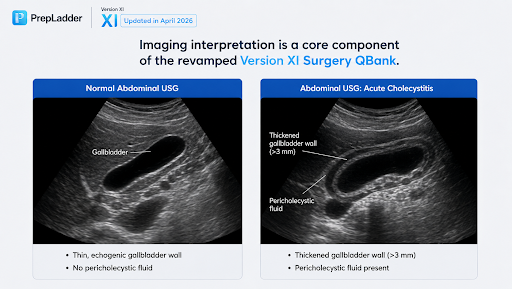
4. The Surgical RUQ Pain: Acute Cholecystitis
Surgery vignettes are now almost entirely built around Next Best Step logic.
- The Story: A 45-year-old obese female has severe RUQ pain radiating to the right shoulder after a fatty meal. On deep palpation, her inspiration is suddenly arrested.
- The Hidden Signal: Arrest of inspiration on palpation = Positive Murphy’s Sign.
- The Real Question:
- Initial Investigation: Ultrasound (USG) Abdomen.
- Gold Standard: HIDA Scan.
- Expert Tip: If the USG is mentioned as inconclusive in the stem, the next best step is always the HIDA scan.
5. The Endocrine Crisis: Diabetic Ketoacidosis (DKA)
Medicine examiners love DKA because it forces you to manage electrolytes and fluids simultaneously.
- The Story: A 19-year-old Type 1 Diabetic is brought in drowsy. He has rapid, deep breathing and a fruity odor on his breath. Blood sugar is 480 mg/dL.
- The Hidden Signal: High sugar + Acidosis + Fruity odor = DKA.
- The Management Rule:
- Step 1: Normal Saline (aggressive fluids).
- The Potassium Rule: You must check Potassium before starting insulin. If K+ is low, you hold the insulin and replace Potassium first, or the patient will crash.
6. The Blistering Skin: Pemphigus vs. Pemphigoid
Dermatology is now heavily image-based, but the story is what helps you differentiate the Big Two.
- The Story: An elderly patient has multiple large, tense blisters on the limbs. The oral mucosa is spared.
- The Clinical Fork:
- Pemphigus Vulgaris: Flaccid bullae, Nikolsky Sign Positive; oral involvement is common. (Memory: Pemphigus is Vulgar-it hits the mouth).
- Bullous Pemphigoid: Tense bullae, Nikolsky Sign Negative, oral involvement is rare.
- Investigation: Direct Immunofluorescence (DIF). Pemphigus shows a lace-like pattern; Pemphigoid shows a linear pattern.
7. The Trauma Patient: Tension Pneumothorax
This case tests your ability to prioritize Life over Imaging.
- The Story: A 30-year-old male arrives after a chest injury. He is in respiratory distress, has distended neck veins, and his trachea is shifted to the right. Breath sounds are absent on the left.
- The Hidden Signal: Tracheal shift + Absent breath sounds + Distended neck veins = Tension Pneumothorax.
- The Real Question: What is the next best step?
- Answer: Immediate Needle Decompression (5th ICS, anterior to mid-axillary line).
- Trap: Do NOT pick Chest X-ray. Waiting for an X-ray in a clinical diagnosis of tension pneumothorax is a fatal mistake in NEET PG.
Also Read: Top 10 Most Demanding Branches of PG Medical Courses in India

Why Version XI of PrepLadder is a Game-Changer
Reading about these cases is a good start, but the NEET PG is an active exercise. You need to see how these cases are flipped by examiners to test the same concept from a different angle.
Released in April 2026, PrepLadder Version XI is specifically designed for the high-yield clinical reasoning required this year. Here is why our students dominate the top ranks:
1. Re-Engineered Contextual Questions
In Version XI, we have removed outdated, simple fact-only questions. MCQ in our revamped QBank is now context-driven. This means instead of asking "What is the dose of IVIG?", we present a Kawasaki case and ask you to pick the correct management protocol. This trains your brain to filter through distractors and find the signal faster.
2. Multi-Step Reasoning Modules
Recent papers require thinking ahead. Our April 2026 update includes questions that ask for the second or third step in a management algorithm. This mirrors the complexity of real-world clinical practice and the modern NBEMS pattern.
3. Integrated Subject Overlap
The 2026 exam doesn't respect subject boundaries. A Microbiology question might actually be a Medicine case about a specific antibiotic's side effects. Our revamped QBank integrates Path-Pharma-Micro with the clinical Big 3 (Medicine, Surgery, OBG) to reflect this continuum of care style.
Also Read: NEET PG 2026: Exam Dates, Syllabus, Pattern, Registration, Eligibility, Preparation Tips
Frequently Asked Questions
Q1. Are clinical vignettes more important than one-liners for NEET PG 2026?
Yes. While one-liners give you atomic facts, vignettes now determine the majority of your rank. You cannot hit the top 5,000 without a solid grip on long-form clinical cases.
Q2. How does the revamped QBank in Version XI help with these cases?
Our April 2026 update specifically removed outdated fact-only questions and replaced them with context-driven cases. This trains your brain to filter through distractors and find the signal faster.
3. Do these Big 7 cases actually repeat word-for-word?
Rarely. NBEMS repeats the clinical concept, not the text. They might change the patient's age or the specific lab value, but the Next Best Step logic remains the same.
4. How many clinical cases should I practice daily?
Our team recommends doing at least 50 mixed-subject clinical MCQs daily on the PrepLadder app. This builds the switching ability needed to jump between OBG and Surgery on the real exam.
5. Is the Last Line First technique applicable to every question?
It is most useful for vignettes longer than 4 lines. It immediately tells you if you are looking for a diagnosis, a treatment, or a complication, which focuses your reading of the case history.
6. What is the most common mistake students make in clinical vignettes?
Overthinking. Students often ignore a pathognomonic sign (like a strawberry tongue) because they get distracted by a minor lab value that is slightly off. Trust the signals.

Clinical Pearl
In the exam hall, your greatest enemy is not a difficult question, but the 'noise' that distracts you from the signal. Find the key, and the case unlocks.
Over our 10 years of experience, we’ve seen that the difference between an average score and a dream rank is simply Exposure. The more patients you meet in the PrepLadder Version XI QBank, the fewer surprises you will face on exam day.
Download the app today, dive into the revamped April 2026 QBank, and let’s secure that rank.

PrepLadder
Access all the necessary resources you need to succeed in your competitive exam preparation. Stay informed with the latest news and updates on the upcoming exam, enhance your exam preparation, and transform your dreams into a reality!
Navigate Quickly
The Anatomy of a Modern NEET PG Vignette
The Repeated Clinical Scenarios
1. The Obstetric Emergency: Ruptured Ectopic Pregnancy
2. The Pediatric Fever: Kawasaki Disease
3. The Overheated Patient: NMS vs. Serotonin Syndrome
4. The Surgical RUQ Pain: Acute Cholecystitis
5. The Endocrine Crisis: Diabetic Ketoacidosis (DKA)
6. The Blistering Skin: Pemphigus vs. Pemphigoid
7. The Trauma Patient: Tension Pneumothorax
Why Version XI of PrepLadder is a Game-Changer
1. Re-Engineered Contextual Questions
2. Multi-Step Reasoning Modules
3. Integrated Subject Overlap
Frequently Asked Questions
Q1. Are clinical vignettes more important than one-liners for NEET PG 2026?
Q2. How does the revamped QBank in Version XI help with these cases?
3. Do these Big 7 cases actually repeat word-for-word?
4. How many clinical cases should I practice daily?
5. Is the Last Line First technique applicable to every question?
6. What is the most common mistake students make in clinical vignettes?