NEET PG 2026 Expected Topics Based on Recent Exam Trends
Jul 1, 2026
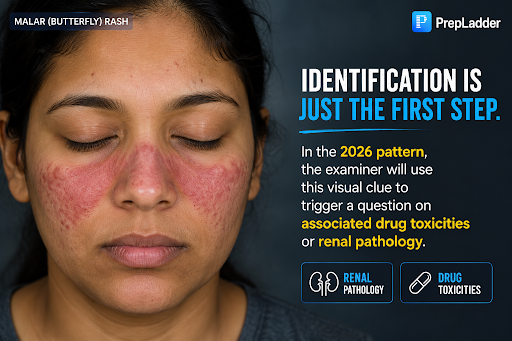
You are sitting in the exam hall. You open a question describing a 45-year-old woman with a butterfly rash and joint pain. She has a history of two miscarriages. You have already diagnosed SLE and Antiphospholipid Syndrome in your head.
You feel like you have this one in the bag. But then you read the very last line of the question. It doesn’t ask for the diagnosis. It doesn’t even ask for the investigation of choice.
It asks: Which of the following drugs, if added to her regimen, would most likely increase the risk of tendon rupture?
So, what just happened? You used Medicine to diagnose, OBG to recognize the obstetric history, and Pathology to understand the disease. But the actual mark was hidden in a Pharmacology fact about Fluoroquinolones.
This is the reality of the 2026 exam. This is not the NEET PG of five years ago, where you could memorize a list of one-liners and secure a rank. The examiners are now obsessed with clinical integration. If you are preparing for 2026, you have to stop trying to be a textbook and start trying to think like a clinician on duty.
Our team has spent 10 years analyzing the shifts in the NBEMS pattern. The 2025 paper confirmed that the trend toward multi-subject reasoning is now permanent. With the launch of PrepLadder Version XI, we have completely re-engineered our QBank to map these high-yield clusters.
Download Free NEET PG PYQs PDF – Limited-Time Access
|
|
|
|
|
|
|
|
|
|
|
|
High-Yield Subject Clusters for 2026
To help you focus your revision, our team has identified the specific areas that are currently being repeated across multiple paper sessions. We have translated these into the language of the ward so you can see the signal in the noise.
1. General Medicine: The Master Pillar
Medicine is the heaviest subject, but recent trends show that examiners are focusing on acute management rather than chronic pathophysiology.
- The Crashing Cardiac Patient: Focus relentlessly on Acute Coronary Syndrome (ACS) management. You must know the exact timing for fibrinolysis versus PCI. ECG interpretation for arrhythmias like Atrial Fibrillation and WPW syndrome is now a standard requirement.
- The Endocrine Crisis: Diabetic Ketoacidosis is likely the most tested topic in the entire paper. You must understand fluid management, the potassium trap, and the closure of the anion gap.
- Neurology Localization: Expect questions on stroke localization. You should be able to tell the difference between various types of tremors and Parkinsonian syndromes.
- The Renal Workup: Focus on the KDIGO 2024 updates. Glomerular diseases like Minimal Change Disease and FSGS are being tested through integrated vignettes with light microscopy images.
2. General Surgery: The ATLS Revolution
Surgery has moved away from traditional surgical techniques and toward emergency protocols.
- Trauma Management: Every single paper will test the ATLS protocols. You must know the primary survey (ABCDE) cold. Expect scenarios where you have to prioritize between a blocked airway and a massive bleed.
- The Acute Abdomen: Intestinal obstruction, mesenteric ischemia, and the differential diagnosis of RUQ pain are guaranteed. You will likely see an erect abdominal X-ray and be asked for the next best surgical step.
- Breast and Thyroid Staging: TNM staging is a perennial favorite. Focus on the management algorithm for a solitary thyroid nodule and the triple assessment of a breast lump.
3. Obstetrics and Gynaecology: The Rank Decision-Maker
OBG consistently provides the highest volume of clinical questions. If you dominate this section, your rank will jump by thousands.
- Labour Room Emergencies: Eclampsia, Postpartum Haemorrhage (PPH) management using the 4Ts, and Partograph interpretation.
- Gynae-Oncology: Staging of Cervical and Endometrial cancers is a top priority. Also, lock down the Rotterdam criteria for PCOS.
- The Contraception Trap: The WHO Medical Eligibility Criteria (MEC) are being tested through complex vignettes of women with comorbidities like Migraine with aura or a history of DVT.
4. The Pre-Clinical Core (Anatomy, Physio, Biochem)
The pre-clinical subjects are no longer about rote memorization; they are being tested as the “Why” behind the clinical signs.
- Anatomy: Focus on Clinical Anatomy and Relations. Instead of just naming a nerve, the exam will describe a fracture or a surgical approach and ask which structure is at risk. Nerve injuries of the upper and lower limbs are non-negotiable.
- Physiology: Focus on the Cycles. The Cardiac Cycle, the Respiratory Pressure-Volume loops, and Renal clearance mechanisms are favorites. You need to know how these graphs shift in disease states.
- Biochemistry: This is the era of Clinical Biochemistry. Focus on rate-limiting enzymes of major cycles and their associated metabolic disorders. Inborn errors of metabolism (like G6PD or PKU) are almost always asked via a pediatric vignette.
5. Para-Clinical Logic (Patho, Pharma, Micro)
These subjects provide the bridge between the lab and the bedside.
- Pharmacology: Autonomic receptors, Antiarrhythmics, and drug-drug interactions (Cytochrome P450 modulators). Expect questions on the adverse effects of newer drugs like SGLT2 inhibitors and GLP-1 agonists.
- Pathology: Cytogenetics of leukemias and lymphomas. Tumor markers and the morphology of reversible versus irreversible cell injury are recurring trends.
- Microbiology: Focus on the Culture and Stain logic. Instead of identifying a bug, you’ll be shown a Gram stain or a culture plate and asked for the drug of choice for that specific patient.
Also Read: NEET PG Exam Pattern 2026 - Marking Scheme, Question Types, Exam Mode
6. The Specialized Short Subjects
- PSM (Community Medicine): Biostatistics is the king here. You must be able to solve a 2x2 table for PPV/NPV and sensitivity/specificity in under 60 seconds. Also, know the latest NTEP (Tuberculosis) targets and immunization updates.
- Ophthalmology: Focus on the Fundus. Diabetes and Hypertension changes in the eye are classic image-based questions. Also, know the management of Glaucoma and Cataract surgery complications.
- Pediatrics: Neonatal resuscitation (NRP 8th edition), developmental milestones, and Kawasaki disease are the top three clusters.
- Dermatology: Blistering disorders (Pemphigus vs Pemphigoid) and STIs. The examiners love using images of primary lesions to trigger a diagnostic thought.
- Radiology: Focus on the Investigation of Choice (IOC). If you see a head injury, pick NCCT. If you see a gallstone, pick USG.
Also Read: NEET PG Previous Year Question Papers of Last 8 Years
The 2026 Integrated Version: How Subjects Connect
The biggest secret of the modern pattern is that the boundaries between subjects have vanished. You will not get 20 pure Pharmacology questions. Instead, you will get a Medicine case where the mark depends on your Pharmacology knowledge.
The Integrated Clusters to Watch:
- The Chest Pain Case: This cluster combines Anatomy (Blood supply to the heart), Pathology (MI morphology over time), and Medicine (ECG changes and immediate treatment).
- The Fever with Rash Case: This combines Microbiology (Bug identification), Pediatrics (Clinical diagnosis of exanthems), and Pharma (The drug of choice).
- The Trauma Case: This combines Surgery (Primary survey), Radiology (FAST scan interpretation), and Anatomy (Surface landmarks for needle decompression).

How Version XI Maps to These Trends
Our April 2026 update was a ground-up rebuild. We analyzed thousands of student reports from recent sessions to ensure our content is predictive.
1. Re-Engineered Clinical QBank
We have removed the old one-liners that no longer appear on the paper. Every question in the Version XI QBank is now a clinical story. This trains your brain to find the signal in the noise and ignore the distractors.
2. Spaced Repetition Flashcards
Our new Flashcards are designed for the volatile data points that the 2026 exam loves, like the new NTEP drug regimens and the latest cancer staging cut-offs.
3. Image-Based Mini Tests
Since nearly 20 percent of the paper is now visual, we have added dedicated image-only modules. These build your visual muscle memory so you can recognize a "double bubble sign" or a psammoma body instantly without overthinking.
Also Read: Top AIIMS Colleges in India 2026: Ranking, Seats, Cut-Off & Courses
Frequently Asked Questions
Q1. Is the NEET PG 2026 expected to be harder than previous years?
It is not necessarily harder, but it is certainly more clinical. Success now depends on your clinical application rather than just your ability to memorize facts.
Q2. How much weightage should I give to image-based questions?
A lot. Images now account for roughly 18 to 20 percent of the marks. In our April 2026 update, we have made sure that every high-yield clinical case is paired with its corresponding radiological or pathological image.
Q3. Which subject should I start with for my 2026 prep?
Our team always recommends starting with Pathology or Pharmacology. These are the bridge subjects. Once you understand the mechanism of a drug or the morphology of a disease, the clinical subjects become much easier to navigate.
Q4. How does the revamped QBank help with integrated questions?
We have introduced a feature that groups questions by clinical system rather than just by subject. For example, you can solve a cluster of questions on the Respiratory System that includes Anatomy, Physiology, Pathology, and Medicine all in one go.
Q5. Are the latest 2024-2025 guidelines included?
Yes. The 2026 exam will heavily test recent updates in the National Tuberculosis Elimination Programme and the latest cardiovascular guidelines.
Q6. What is the best way to use the new Flashcards?
Use them for the volatile facts you keep forgetting, like drug doses or developmental milestones. Spend 20 minutes every morning on them to ensure they stay in your short-term memory.

Final Clinical Pearl
The secret to cracking NEET PG 2026 is simple: Stop trying to be a textbook and start trying to be a doctor. When you read a topic, ask yourself what the most dangerous mistake a clinician could make is. That is usually exactly where the examiner is hiding the question.
Over our 10 years of experience, we have seen that the topper is simply the student who has seen the most clinical patterns. Trust your 20th Notebook, use the Version XI revamped QBank, and focus on the trends. We will see you on the rank list.

PrepLadder
Access all the necessary resources you need to succeed in your competitive exam preparation. Stay informed with the latest news and updates on the upcoming exam, enhance your exam preparation, and transform your dreams into a reality!
Navigate Quickly
High-Yield Subject Clusters for 2026
1. General Medicine: The Master Pillar
2. General Surgery: The ATLS Revolution
3. Obstetrics and Gynaecology: The Rank Decision-Maker
4. The Pre-Clinical Core (Anatomy, Physio, Biochem)
5. Para-Clinical Logic (Patho, Pharma, Micro)
6. The Specialized Short Subjects
The 2026 Integrated Version: How Subjects Connect
How Version XI Maps to These Trends
1. Re-Engineered Clinical QBank
2. Spaced Repetition Flashcards
3. Image-Based Mini Tests
Frequently Asked Questions
Final Clinical Pearl
Top searching words
The most popular search terms used by aspirants
- Medical PG Preparation
- NEET PG Preparation Strategy
- NEET PG Preparation Tips