NEET PG Paper Attempt Strategy: Sequence for Highest Scores
Jul 9, 2026

You are thirty minutes into the NEET PG exam. You have attempted forty-five questions. You have marked twenty-eight questions for review. Your confidence is really shaking now. A biochemistry question that you skipped a while back is bothering you. Was it the Cori cycle or the Rapoport-Luebering shunt? This confusion in your mind is costing you more marks than not knowing something.
The difference between getting a rank of 600 and a rank of 650 often does not depend on what you know about the NEET PG it depends on how you attempt the questions that you know about the PG.
QUICK REPLY
When you are trying to answer questions, it is a good idea to have a plan. This plan is called a paper attempt strategy. It helps you answer questions correctly and avoid losing marks.
The best way to do this is to start with the questions you're really sure about. Then you do the questions you're sort of sure about. You should not do the questions you are not sure about at all.
You should do the questions in this order: first look at all the questions for each subject, then pick the ones you're sure about, and finally review them carefully.
The goal of the paper attempt strategy is to answer more than 180 questions correctly. You should also try to get at least 85 percent of the questions right.
NEET PG RELEVANCE
Your NEET PG score is more strongly impacted by your paper attempt plan than by last-minute revision. You have about 63 seconds for each of the 200 questions in 210 minutes. Top scorers attempt 175–190 questions with an accuracy rate of 82–88%. A poor approach results in more than 150 attempts with 65% accuracy, which is a rank difference of more than 10,000.

What is the technique for attempting a paper?
- Your way of doing the PG question paper is like a plan. Think of it like a doctor doing surgery. The doctor does not do things without thinking. The doctor thinks and looks at what needs to be done. Then it does. You do the thing when you take the NEET PG exam.
- You plan how you will answer the questions you look at the questions. Think about what you need to do, and then you do it. This is your paper attempt strategy for the NEET PG question paper.
- The NEET PG interface lets you move around in a way that's not linear. You can do things like switch between questions, mark them for review, and change your answers. This flexibility has two sides to it. If you do not have a plan, it can be really bad because it can get very messy.
- If you use a good strategy with the NEET PG interface this flexibility can actually work in your favor with the NEET PG interface.
- During a test, your brain functions in two different ways: System 1 (quick and intuitive) and System 2 (slow and analytical). System 1 is activated by high-confidence queries; you can see the answer right away.
- System 2 is needed for challenging problems, which take more time and mental effort. You can catch all System 1 responses before System 2 tiredness sets in by using strategic sequencing.
|
|
|
|
|
|
|
|
|
|
|
|
Why is sequence really important when it comes to the NEET PG exam?
NEET PG is an exam, and the sequence of questions can make a big difference. So the sequence in PG is crucial because it can affect how well you do on the test.
The order in which you try to answer questions is really important. It can affect your score more than how well you have prepared for the test. Here is why:
Our brains get really tired. The quality of our decisions goes down after we focus hard for one to two hours. If we try to answer questions in an hour, we are more likely to get them wrong. It does not matter if they are easy or hard. If we try to answer questions when we are tired, we will probably lose marks that we should have gotten. Cognitive depletion is real.
Negative marking really hurts when you guess. If you get something, they take away one point. So if you just guess randomly, you will probably end up with a score. To make up for one answer, you need to get four other answers right. That is a lot of pressure. It is smarter to skip some questions to keep your score safe. Negative marking is tough, so skipping some questions can protect your score from getting too low. Negative marking is a deal, so you have to be careful.
Time gets wasted when you have to answer hard questions. If you spend four minutes on one question that's very tough, that means you are taking time away from three easy questions that you will have to answer quickly later. The thing that is really bad about this is that you are losing the chance to do those questions properly. Time theft, by questions, is a big problem because it makes you rush through the easy questions.
Momentum in the mind is important. It boosts confidence to start with questions you can respond to. Anxiety is created by starting the exam with challenging questions, and this anxiety lasts the whole test.

Subject-Wise Sequencing: What to Attempt First
Not all subjects deserve equal priority during your first pass. Sequence based on your personal strength pattern.
| Priority | Subject Type | Rationale | Time Allocation |
| First | Your strongest subject | Maximum confidence, fastest attempts | Start here always |
| Second | High-yield recall subjects | Anatomy, Biochem, Micro—you either know or don't | 50-60 seconds/question |
| Third | Clinical subjects | Medicine, Surgery, pediatrics—need reading | 70-80 seconds/question |
| Fourth | Calculation-heavy | Biostatistics, Pharmacology doses | Medicine, Surgery, and pediatrics—need reading |
| Last | Your weakest subject | Minimize time wastage | Strict 45-second limit |
Most students score 10-15 marks higher simply by attempting their strongest subject first instead of following the paper's sequence.
Also Read: Crafting a NEET PG Study Plan for Working Professionals
The Three-Pass Strategy for NEET PG
This battle-tested approach has helped thousands of students maximize their NEET PG scores.
First Pass: The Harvesting Round (70-80 minutes)
Go through all 200 questions sequentially. For each question, make a snap decision within 15-20 seconds:
- Green light: You know the answer with 90%+ confidence. Attempt it. Move on.
- Yellow light: You can solve it, but you need time. Mark for review. Move on.
- Red light: No clue or pure guess. Leave unmarked. Move on.
Do not stop to think. Do not second-guess. This pass should yield 100-130 attempted questions. Your accuracy in this round should exceed 90%.
Second Pass: The Analytical Round (60-70 minutes)
Return to marked questions only. Now engage System 2 thinking:
- Read the question carefully
- Eliminate obviously wrong options
- Apply clinical reasoning or first principles
- If you reach 70%+ confidence, attempt
- If still uncertain after 90 seconds, skip
This pass adds 40-60 more attempts. Expected accuracy: 75-80%.
Third Pass: The Salvage Round (40-50 minutes)
Review the attempted questions where you felt uncertain. Check for:
- Misread questions
- Calculation errors
- Changed clinical scenarios you missed
For remaining unattempted questions, apply educated elimination. If you can confidently eliminate 2 options, the 50% chance of a correct answer makes attempting worthwhile mathematically.
Also Read: Beginner Roadmap and Study Plan | NEET PG 2026

Time Management Formula
Here's the mathematical framework for your attempt:
Total time: 210 minutes (3.5 hours) Total questions: 200 Average time per question: 63 seconds
Realistic breakdown:
- First pass: 75 minutes (22 seconds/question average)
- Second pass: 70 minutes (70 seconds/question for 60 questions)
- Third pass: 45 minutes (review + strategic attempts)
- Buffer: 20 minutes (toilet break, technical issues, final check)
The 80-80-40 rule: Attempt 80 questions in the first 80 minutes with 90%+ accuracy. This establishes your floor score. Everything after is built on a solid foundation.
Common Mistakes That Cost Ranks
The Perfectionist Trap
Give yourself 120 seconds, that is two minutes, to try and solve the question. If you cannot solve the question within that time, just mark it. Move on to the next one. Do not waste much time on one question during your first try. The strategy is to mark it and come back to it later. This way, you can make sure you have time to try to solve all of the questions
- Set a hard time limit of 120 seconds for each question
- Try to solve the question in that time
- If you cannot solve it, mark the question. Move on
- Come back to the marked questions later if you have time
Also Read: Why Brilliant Students Fail NEET PG: Psychological Insights
The Sequence Slavery
Trying to do questions 1 through 200 in order is not a good idea. The exam does not get harder as you go along. For example, question 180 might be easier than question 15. This is because the exam questions are not arranged from easy to hard. Question 180 is one of the exam questions, and it might be easier to answer than some of the earlier questions, like question 15. The exam questions, including question 180 and question 15, are mixed up in terms of how hard they are.
The Review Spiral
Marking more than 100 questions for review can be really overwhelming. It is better to be selective. Only mark the questions where you really need time to think about them. Do not mark the questions that you just hope to get later. Mark the questions where more time will really help you understand the questions better, like the math problems or the questions that need a lot of reading. This way, you can use your time wisely. Focus on the questions that really need your attention, the questions that you are marking for review.
The Last-Minute Change
Changing answers in the final 10 minutes without a strong reason typically hurts scores. Your first instinct on well-prepared topics is usually correct. Only change if you find concrete evidence of error.
Also Read: Top 10 Most Demanding Branches of PG Medical Courses in India
The Ultimate 5-Section Attempt Strategy
Imagine a mass casualty incident in your ER. A massive highway pileup. Fifty patients arrive simultaneously. You have a young male with a tension pneumothorax. A female with a simple Colles fracture. An elderly man in cardiac arrest showing asystole. If you spend 40 minutes doing CPR on the asystole patient, the tension pneumothorax patient dies. You have to triage. You fix the immediate life threats first. You stabilize the fractures later. You leave the dead.
Taking the NEET PG 2026 exam is exactly like this. The new time-bound format forces you to triage questions. Spending five minutes on an impossible genetic defect means you miss three easy PSM questions. You need a ruthless system.
Our team has 10 years of experience building strategies for top rankers. And this year, the rules have changed completely. Let us break down the exact strategy you need to survive and dominate the new time-bound sections.
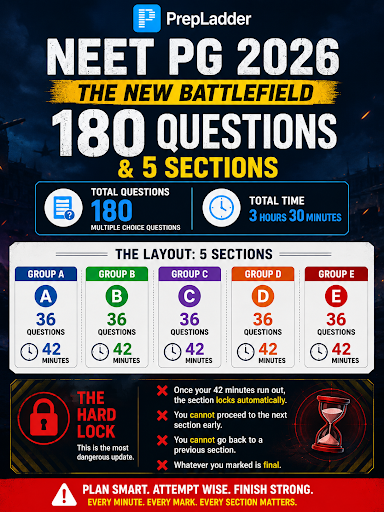
The New Battlefield: 180 Questions & 5 Sections
NBEMS radically shifted the exam pattern in the latest 2026 Information Bulletin. The old format is dead. You are no longer managing a massive block of questions over 210 minutes.
- Total Questions: 180 Multiple Choice Questions.
- Total Time: 3 hours 30 minutes.
- The Layout: 5 Sections known as Group A, B, C, D, and E.
- Questions Per Section: Exactly 36 questions in each block.
- Time Per Section: Exactly 42 minutes.
- The Hard Lock: This is the most dangerous update. Once your 42-minute run is over, the section locks automatically. You cannot proceed to the next section early. You cannot go back to a previous section. Whatever you marked is final.
Section-Wise Time Plan
You have 42 minutes for 36 questions. That gives you roughly 70 seconds per question. Traditional time management will fail here. You need a micro-strategy for every single 42-minute block.
- Minutes 0 to 20 (The First Pass): Triage the easy ones. Hunt for one-liners. If you know the answer instantly, mark it. If it is a massive vignette, skip it entirely.
- Minutes 20 to 35 (The Second Pass): Tackle the lengthy clinical scenarios you skipped. Read carefully, but watch the clock.
- Minutes 35 to 42 (The Review Buffer): Look at the questions you marked for review. Make your final calculated guesses. When the clock hits 42, the screen forces you to the next group.
The Skip Strategy
You have to drop your ego. If you see a brutal Biochemistry question about an obscure enzyme defect, skipping it is a strategic victory. Do not let one question eat three minutes.
Subject-wise application matters heavily here. In Pharmacology, if you do not know the mechanism of a new monoclonal antibody, staring at the screen will not magically reveal the answer. Skip it immediately. But in OBGYN, a complex partograph question might just need 40 seconds of careful analysis. Mark it for the second pass.
The Review Strategy
Since sections lock, you cannot save all your reviews for the end of the exam. You must close out your reviews within that specific 42-minute block.
Only mark a question for review if you have eliminated at least two options. Do not mark questions where you are totally clueless. It just clutters your review panel and creates panic.
Deploy the Last Line First technique during your review. When returning to a 15-line clinical vignette, do not start reading from the top. Your brain will fatigue. Read the very last sentence first. Then look at the four options. Now your brain knows exactly what disease or drug it is hunting for. Scan the bulky text specifically for vital signs, lab abnormalities, and unique clinical markers. This hack saves precious minutes per section.
Attempt Accuracy Table
How many questions should you actually attempt? With the +4 and -1 marking scheme, playing it too safe will destroy your rank. You need serious attempts. Here is a calculated breakdown for a top-tier rank.
| Question Type | Target Volume | Attempt Strategy | Expected Accuracy |
|---|---|---|---|
| Sure Shots | 80 to 90 | Attempt All | 95 percent |
| 50-50 Guesses | 50 to 60 | Attempt All | 50 percent |
| Educated Guesses | 20 to 30 | Attempt Most | 30 percent |
| Totally Clueless | 10 to 15 | Leave Blank | 0 percent |
| Total Attempts | 165 to 175 |
Frequently Asked Questions (FAQs)
Q1. Can I submit a section early if I finish before 42 minutes?
No. The 2026 Information Bulletin explicitly states that you are restricted from proceeding to the next section until the allotted time for the previous section is complete. You must sit and wait.
Q2. Will I know which subjects are in Section A versus Section E?
No. NBEMS does not disclose the exact subject breakdown per section. The 180 questions are distributed across the 5 sections, so expect a random mix of pre-clinical, para-clinical, and clinical subjects in every block.
Q3. If I leave a question blank, can I go back to it later?
Only if you are still within that specific 42-minute section. Once the timer for that section hits zero, you can never go back to those 36 questions.
Q4. Is it better to attempt more questions or focus strictly on accuracy?
Math favors more serious attempts. With a +4 for correct and -1 for incorrect marking scheme, attempting 50-50 guesses is mathematically advantageous. Aiming for 165 to 175 attempts is the standard strategy for top rankers.
Q5. Will the Mini Tests on PrepLadder exactly mimic this new lock system?
Yes. The PrepLadder Version XI Mini Tests are hardcoded with the exact 42-minute hard lock. If you do not finish in time, the test forces you forward, exactly like the real NEET PG exam.
Q6. How should I manage rough work since pens and paper are banned?
You must practice doing calculations mentally. Whether it is calculating the Anion Gap, the Parkland formula for burns, or simple pharmacological dosages, do it in your head during your daily QBank practice.
High-Yield Points for NEET PG Paper Strategy
- The first 20 minutes determine psychology — start with your strongest subject regardless of paper sequence
- 90-second rule: No question deserves more than 90 seconds in the first pass
- Mark for review strategically — only questions where time investment will help, not hopeless guesses
- Negative marking math: At -1 penalty, don't attempt unless you can eliminate at least 2 options confidently
- Ideal attempt range: 175-190 questions with 80-85% accuracy beats 195 attempts with 70% accuracy
- Cognitive peak: Your sharpest thinking occurs in minutes 20-90; save difficult calculations for this window
- The 150-question floor: Ensure 150 high-confidence attempts before touching uncertain questions
- Physical basics matter: Use the toilet before the exam; dehydration and discomfort impair cognition
- Mock exam strategy = real exam strategy: Practice your sequence in every mock test; exam day isn't for experiments
- Last 15 minutes: Review flagged answers only; avoid attempting new questions unless obviously easy
Frequently Asked Questions
What is the best sequence to attempt the NEET PG paper?
The best sequence is confidence-based, not question-number-based. Start with your strongest subject, harvest all high-confidence answers across subjects in the first pass (70-80 minutes), then return to medium-confidence questions in the second pass. Never waste early cognitive energy on difficult questions.
How many questions should I attempt in NEET PG?
Aim for 175-190 attempts with 80-85% accuracy. This yields approximately 140-160 correct answers and 15-35 incorrect, giving a net score of 540-620+. Attempting all 200 with lower accuracy typically produces worse results due to negative marking accumulation.
Should I guess in NEET PG if I don't know the answer?
Only guess if you can confidently eliminate at least 2 options. With 4 options and -1 negative marking, random guessing has a negative expected value (-0.25 per question). But 50-50 guessing after eliminating 2 options has positive expected value (+0.5 per question).
How much time should I spend on each question in NEET PG?
Average 63 seconds per question across the exam. During the first pass, spend a maximum of 30-45 seconds on clear questions and move on. During the second pass, allocate up to 90 seconds for analytical questions. Never exceed 120 seconds on any single question.
Is it better to attempt all questions or leave some unattempted?
Leaving genuinely unknown questions unattempted protects your score. An unattempted question costs 0 marks. A wrong answer costs -1 and requires 4 correct answers to recover. Selective skipping of 10-25 questions is strategically optimal for most students.
When should I change my answer in NEET PG?
Change answers only when you find concrete evidence of an error — a misread question, calculation mistake, or recalled fact that contradicts your initial answer. Never change based on vague unease. Studies show that first instincts on well-prepared material are correct 70-80% of the time.
CLINICAL PEARL
Your NEET PG rank is decided more by the questions you skip than the questions you attempt. The discipline to walk away from a tempting but uncertain question separates top rankers from the rest. Protect your score ruthlessly — every negative mark needs four correct answers to neutralize.
Download the PrepLadder app now and unlock a 24-hour FREE trial of premium high-yield content. Access Smarter Video Lectures also in हिंglish, Game Changing Qbank, Audio QBank, Structured Notes, Treasures, Mock test for FREE to ace your NEET PG preparation. Elevate your study experience and gear up for success. Start your journey with PrepLadder today!

PrepLadder
Access all the necessary resources you need to succeed in your competitive exam preparation. Stay informed with the latest news and updates on the upcoming exam, enhance your exam preparation, and transform your dreams into a reality!
Navigate Quickly
What is the technique for attempting a paper?
Why is sequence really important when it comes to the NEET PG exam?
Subject-Wise Sequencing: What to Attempt First
The Three-Pass Strategy for NEET PG
First Pass: The Harvesting Round (70-80 minutes)
Second Pass: The Analytical Round (60-70 minutes)
Third Pass: The Salvage Round (40-50 minutes)
Time Management Formula
Common Mistakes That Cost Ranks
The Perfectionist Trap
The Sequence Slavery
The Review Spiral
The Ultimate 5-Section Attempt Strategy
The New Battlefield: 180 Questions & 5 Sections
Section-Wise Time Plan
The Skip Strategy
The Review Strategy
Attempt Accuracy Table
Frequently Asked Questions (FAQs)
High-Yield Points for NEET PG Paper Strategy
Frequently Asked Questions
What is the best sequence to attempt the NEET PG paper?
How many questions should I attempt in NEET PG?
Should I guess in NEET PG if I don't know the answer?
How much time should I spend on each question in NEET PG?
Is it better to attempt all questions or leave some unattempted?
When should I change my answer in NEET PG?
CLINICAL PEARL
Top searching words
The most popular search terms used by aspirants
- NEET PG Preparation Strategy
- NEET PG Preparation Tips