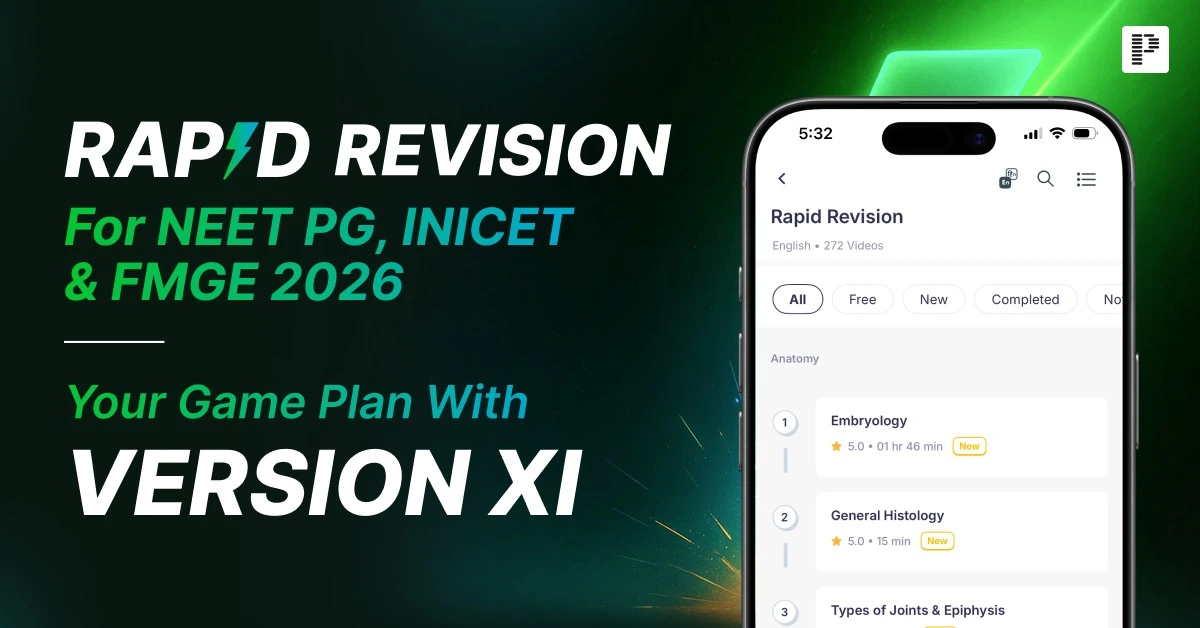
Rapid Revision for NEET PG, INICET & FMGE 2026: Your Game Plan With Version XI
Mar 7, 2026

The Clock Is Already Ticking — Here's Exactly How Much Time You Have
One of the most common challenges students face is that they study a lot, but at the end, they don’t remember anything. This one concern is the essence of the biggest problem in postgraduate medical exam preparation today.
You might have spent hundreds of hours watching lectures. You might have marked half the pages of your book as important. Yet, when your clinical vignette shows up, it's a 55-year-old diabetic patient with sudden onset atrial fibrillation, your head becomes totally empty.
The problem was never whether you studied enough or not. The problem was that you hadn't revised in a way that your brain would remember.
Given the fact that NEET PG 2026 is going to be held on August 30, 2026, INI-CET July 2026 on May 16, 2026, and FMGE June 2026 on June 28, 2026, and PrepLadder's Version XI Rapid Revision set to be live on April 12, 2026, you now have a finite, indubitable period.
Each hour counts. This article precisely explains how to get the most out of those 280 hours of Rapid Revision material for your exams one by one, week by week.
In Version XI, Rapid Revision is a 280-hour collection of videos for exams that have been designed to help students prepare for Previous Year Questions (PYQs) from NEET PG, INI-CET, and FMGE.
Every single video has been linked to error files, which show the common errors of students. Given a well-thought-out timetable, 2 hrs/day for NEET PG, 3.6 hrs/day for FMGE, or 8 hrs/day for INI-CET, it enables one to provide 80% of the content which has the greatest impact on one's exam result.
|
|
What Is Rapid Revision in Version XI?
Rapid Revision is a 280-hour video series that covers the final stage of PG medical exam preparation thoroughly. All the lectures are aligned with PYQs of NEET PG, INI-CET, and FMGE; therefore, you won't be revising topics in an abstract way. You will be revising precisely what is being asked.
Throughout 25 years of teaching Pathology, Medicine, and Pharmacology, I have recognized targeted repetition of high-yield material as a very powerful revision strategy. Cognitive psychology has confirmed through the Ebbinghaus forgetting curve that without proper review, one forgets up to 70% of the learned material within 48 hours. Rapid Revision is developed to counter this. Each video comes with error files that point out the exact mistakes students make when answering related MCQs. During my ward rounds, I have seen interns incorrectly identify ulcerative colitis with Crohn's disease, not because they didn't study, but because they just didn't revise the distinguishing features under exam pressure. Error files address this issue by exposing your blind spots.
The material is offered both in English and Hinglish and includes pre-clinical, para-clinical, and clinical topics of all 19 MBBS disciplines.

Your Exam Countdown — Exact Days and Study Hours From April 12, 2026
Here is the reality check every aspirant needs. The table below calculates available study days and realistic study hours from the day Rapid Revision goes live.
| Exam | Date | Days From April 12 | Study Hours (10 hrs/day) | Study Hours (8 hrs/day) | RR Hours Needed | RR Hours/Day (10-hr schedule) |
| INI-CET July 2026 | May 16, 2026 | 34 days | 340 hrs | 272 hrs | 280 hrs | ~8.2 hrs/day |
| FMGE June 2026 | June 28, 2026 | 77 days | 770 hrs | 616 hrs | 280 hrs | ~3.6 hrs/day |
| NEET PG 2026 | August 30, 2026 | 140 days | 1,400 hrs | 1,120 hrs | 280 hrs | ~2.0 hrs/day |
These numbers tell you something powerful: even for INI-CET — the nearest exam — 280 hours of Rapid Revision can be completed if you dedicate 8+ hours per day to it. For NEET PG and FMGE aspirants, the schedule is far more comfortable, leaving significant time for QBank practice and Grand Tests.
Week-By-Week Plan for NEET PG 2026 (140 Days Available)
NEET PG candidates have a really fantastic advantage! They have 140 days from April 12 to August 30, so why not plan two complete cycles of Rapid Revision, one for the initial understanding and the other for reinforcement?
Phase 1, First Pass (Weeks 1, 10, April 12, June 20): Go through the complete 280 hours of the Rapid Revision library at the pace of 4 hours/day. After this, you will have 6 hours daily for QBank practicing and subject-wise Grand Tests. Concentrate on high-weightage subjects first: Medicine, Pharmacology, Pathology, Surgery, and Obstetrics & Gynaecology. It has been seen that these five subjects contribute to over 55% of NEET PG questions, according to recent exam analyses.
Phase 2, Targeted Replay + QBank (Weeks 11, 16, June 21, August 2): Go over your 8, 10 weakest subjects with the help of error files as a guide. Dedicate 2 hours/day for Rapid Revision replays and 8 hours/day for QBank. When I was in clinical practice, I always told students that the difference between a 500-rank and a 5, 000-rank is not the number of topics covered, it is the accuracy on topics you've already studied. This phase is all about that accuracy.
Phase 3, Final Sprint (Weeks 17, 20, August 3, August 29): Completely focus on Grand Tests + error file review. Only Rapid Revision segments that correspond to your weakest QBank performance should be watched. Try to have 2, 3 full-length mock tests each week.

Week-By-Week Plan for INI-CET May 2026 (34 Days Available)
This is a sprint at a very high intensity level. Since the time gap between the launch and the exam on May 16 is only 34 days, aspirants must rely heavily on Rapid Revision as their main source of study during this period.
Week 1, 2 (April 12, April 25): Study clinical subjects, Medicine, Surgery, OBG, Paediatrics, Ophthalmology, ENT. The INI-CET exam leans heavily towards clinical subjects. Plan to spend 8 hours/day doing Rapid Revision and 2 hours do QBank.
Week 3, 4 (April 26, May 9): Study pre-clinical and para-clinical subjects, Anatomy, Physiology, Biochemistry, Pathology, Pharmacology, Microbiology, Forensic Medicine, Community Medicine. Together they comprise the remaining 40-45% of the exam. Keep the 8+2 split going.
Final Week (May 10, May 15): Only error file review. Watch flagged segments from your weakest areas. Solve 2 Full-length Tests. Concentrate on image-based questions; INI-CET is famous for heavy image use. On the wards, I always remind my students: if you cannot identify a finding on a peripheral smear in 10 seconds, you are not yet ready. Error files will help you develop that instant recognition.
A Special note for INI-CET aspirants: The 280 hours cannot be done in 34 days at a leisurely pace. Give priority to the most important things without pity. Study 200 hours of the highest-yield subjects and use the Printed Summary Charts (also part of Version XI) for the other topics.
Week-by-Week Plan for FMGE June 2026 (77 Days Available)
FMGE candidates are given a light yet efficient time frame to prepare. Since the exam date is June 28, you actually have 11 full weeks from launch day. FMGE's format is quite different from NEET PG. Besides the absence of negative marking, the test consists of 300 questions, and you need at least 50% (150/300) to pass. The modus operandi here is coverage rather than depth.
Phase 1, Broad Coverage (Weeks 1, 6, April 12, May 23): You should work through the whole 280-hour Rapid Revision at a rate of about 6.5 to 7 hours/day. Do not neglect any subject, FMGE is more strict in regards to gaps than NEET PG because here, there's no negative marking, and each skipped question is definitely a lost mark.
Phase 2, QBank + Weak Subject Replay (Weeks 7, 9, May 24, June 13): Gradually reduce your time to 4 hours/day for QBank and 3 hours/day for error-file-guided Rapid Revision replay. Concentrate on subjects where FMGE repetition rates are highest, Pharmacology (drug doses and side effects), Microbiology (vaccines and organisms), and Community Medicine (epidemiology and national health programmes).
Phase 3, Mock Test Week (Weeks 10, 11, June 14, June 27): Take two full-length 300-question mock tests per week. After each mock, use Rapid Revision error files as targeted correction. On my first teaching of FMGE batches, students who score 150, 170 in mocks often bump up to 190+ only by rectifying their top 30 recurring mistakes.
Rapid Revision vs Traditional Revision — Comparison Table
Feature Rapid Revision (Version XI) Traditional Revision (Re-reading notes) Total hours required 280 hours (structured) 400–600 hours (unstructured) PYQ mapping Every video tagged to NEET PG, INI-CET, FMGE PYQs No systematic PYQ alignment Error identification Built-in error files flagging common MCQ mistakes Self-identification only (unreliable) Exam pattern alignment Updated to current framing and trends Based on when notes were originally made Retention mechanism Designed for spaced review and active recall Passive re-reading (low retention) Coverage All 19 MBBS subjects, both English & Hinglish Depends on personal notes (often incomplete) NEET PG pearl PYQ-tagged videos let you spend time proportional to exam weightage Equal time wasted on rarely tested topics
How to Combine Rapid Revision With QBank Practice
Over my 25 years of teaching medicine, I have never seen a more efficient revision cycle than this one:
Watch → Solve → Review errors → Re-watch flagged segments
Here's a working example of how to implement this cycle with Version XI's Rapid Revision and the Revamped QBank (also including 5, 000 new MCQs in Version XI):
Step 1: Choose and watch a Rapid Revision module, e.g. Pharmacology: Anti-hypertensives. It will take around 2 to 3 hours.
Step 2: Directly after, try 30, 50 QBank questions on the same topic. As the QBank is updated to the latest NEET PG format, you are testing the material that you have just studied.
Step 3: Go over your mistaken answers. Use the error files from this Rapid Revision module to cross-check. You will discover the same mistakes again and again. For example, many students mix up the mechanism of ACE inhibitors (inhibiting Angiotensin Converting Enzyme) with that of ARBs (directly blocking the AT1 receptor). The error file pinpoints this exactly.
Step 4: Only watch again the flagged 10-15 minute segments again. Such a focused replay hardly takes any time, but brings you up
Practice related MCQs with the PrepLadder QBank to make this loop a part of your daily life.
High-Yield Strategy Points for Using Rapid Revision
280 hours of Rapid Revision are mapped with previous years' questions, so every minute you spend is aligned with what the examiners are really looking for. Your error files will be your secret weapon; they will reveal the 20 or 30 types of mistakes that students keep making and lose 15 or 25 marks in each exam
- NEET PG (140 days): Target doing 2 full cycles for 2, 4 hrs/day first, which will leave you enough time for QBank and Grand Tests
- INI-CET (34 days): First do subjects related to clinics, then do the rest of the syllabus (200+ hrs) at a stretch (8 hrs/day)
- FMGE (77 days): To get a good grasp of all 280 hours, attend classes 6 weeks a 6.5 hrs/day; FMGE requires a wide knowledge of different topics
- The four-step process of watch-solve-review-rewatch will require 4, 5 hours per subject block, and it is by far the most effective revision technique
- One of the main areas that the examiners are known to test what drug doses, diagnostic cutoffs, and one-liner differentiators, in Rapid Revision these are presented with exact numbers and not with general descriptions
- One of the most common traps that examiners use is to confuse students by giving conditions that have many overlapping features, the error files deal with these overlaps which include Crohn's vs UC, SLE vs Rheumatoid Arthritis, and Type 1 vs Type 2 MI
- Several students who have managed to complete a full cycle of Rapid Revision before their exam have shared that they were able to recall the information far better during the timed situation
- If you want to do topic-wise QBank practice along with Rapid Revision, try the PrepLadder app
Frequently Asked Questions
Q1: What is Rapid Revision in PrepLadder Version XI?
Rapid Revision is a 280-hour video library covering all 19 MBBS subjects, with every lecture mapped to PYQs from NEET PG, INI-CET, and FMGE. Each video includes error files that flag the most common MCQ mistakes. It goes live on April 12, 2026.
Q2: Can I complete 280 hours of Rapid Revision before INI-CET on May 16, 2026?
With 34 days available, completing all 280 hours requires approximately 8.2 hours/day of focused viewing. Aspirants who cannot maintain this intensity should prioritise clinical subjects first, as INI-CET skews heavily toward clinical questions, and cover remaining subjects using Summary Charts.
Q3: How is Rapid Revision different from re-watching regular lectures?
Regular lectures are designed for first-time learning and run 600+ hours across subjects. Rapid Revision condenses the exam-relevant content into 280 hours, tags every segment to PYQs, and includes error files — making it a targeted second pass rather than a repeat of the first.
Q4: Which subjects should FMGE aspirants prioritise in Rapid Revision?
FMGE has no negative marking, so coverage matters more than depth. Prioritise Pharmacology, Microbiology, Pathology, and Community Medicine — these four subjects carry high repetition rates. Complete all 280 hours if time permits, as every unattempted question is a lost mark.
Q5: How should I use Rapid Revision alongside the QBank?
Follow the watch-solve-review-rewatch loop. After each Rapid Revision module, solve 30–50 QBank questions on the same topic. Review incorrect answers against the module's error files. Re-watch only flagged segments. This builds accuracy without wasting time on already-mastered content.
Q6: For NEET PG, what role does Rapid Revision play as a test method, and is the technique really efficient?
NEET PG 2025, for instance, included a very large portion of the questions which were repeated from the previous years. Those students who had been very regularly revising the PYQ-mapped material content told that they felt more sure of themselves and could remember things more quickly during the exam. That is exactly why we designed Rapid Revision, to give students repeated practice of the types of questions that examiners really want, rather than the ones that are emphasised by the textbooks.

PrepLadder
Access all the necessary resources you need to succeed in your competitive exam preparation. Stay informed with the latest news and updates on the upcoming exam, enhance your exam preparation, and transform your dreams into a reality!
Navigate Quickly
The Clock Is Already Ticking — Here's Exactly How Much Time You Have
What Is Rapid Revision in Version XI?
Your Exam Countdown — Exact Days and Study Hours From April 12, 2026
Week-By-Week Plan for NEET PG 2026 (140 Days Available)
Week-By-Week Plan for INI-CET May 2026 (34 Days Available)
Week-by-Week Plan for FMGE June 2026 (77 Days Available)
Rapid Revision vs Traditional Revision — Comparison Table
How to Combine Rapid Revision With QBank Practice
High-Yield Strategy Points for Using Rapid Revision
Frequently Asked Questions
Top searching words
The most popular search terms used by aspirants
- medical pg version x
- Rapid Revision