Fertility Indicators in a Population
Jul 15, 2024

We have to monitor the well-being of the general population. Different indicators are used for this. In this blog, you will read about fertility indicators. Fertility indicators help us estimate the number of people reproducing and the quality of the offspring.
Let us read them one by one:
CBR (Crude Birth Rate)
- CBR is the total number of live births in a year per 1000 estimated mid-year population.
- The mid-year population is measured on 1st July every year.
- According to India's latest SRS (sample registration system), the CBR currently has a mid-year population of 19.5/1000.
- It is the simplest measure of fertility, without any specifications.
- Not everyone in the denominator is exposed to childbirth.

GFR (General Fertility Rate)
- GFR is the total number of live births in an area in a year per 1000 women in the reproductive age group (15-49 years) in a year.

- Not everyone in the reproductive age group is exposed to the risk of childbirth.
GMFR (General Marital Fertility Rate)
- GMFR is the number of live births in a year per thousand married women in the reproductive age group (15 to 49 years).

ASFR (Age-Specific Fertility Rate)

Advantages of ASFR:
- As a measure of the age pattern of fertility, that is, the relative frequency of a child being among different ages.
- As an intermediate computation in the derivation of TFR. Unlike CBR, ASFR is unaffected by:
- Differences
- Changes in population age composition
- ASFR gives fertility trends of a country.
- ASFR is more useful in comparing:
- Different populations
- Sub-groups of the same population.
- Measuring changes in fertility over time in the same population.
Also Read: NEET PG High Yield Questions for PSM
ASMFR (Age Specific Marital Fertility Rate)

TFR (Total Fertility Rate)
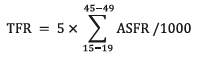
- TFR is computed by summing age-specific fertility rates for all ages.
- TFR gives the average/ total number of children a woman will have throughout her reproductive age (15-49 years), bearing children at the same rate as the women in each age group.
- TFR is an indicator of complete family size.
- Family size is the number of children a woman has at a particular age in her reproductive age (15-49 years).
- TFR is computed by the age-specific fertility rates for all ages. If 5-year age groups are used, then the sum of rates is multiplied by 5.
- For the population of a country to stabilize, a TFR of 2.1 is required.
- It explains that every couple is giving birth to 2 children.
- For TFR to be 2.1, NRR (Net Reproduction Rate) must equal 1.
- NRR equals 1 when the contraceptive prevalence rate is >60%.
GRR (Gross Reproduction Rate)
- GRR is the average number of girls a woman will have throughout her reproductive age, considering the current age-specific fertility pattern and with no mortality.
- GRR is given by TFR for girl children.
NRR (Net Reproduction Rate)
- NRR is the number of daughters or girls a newborn will bear or have throughout her reproductive lifespan, considering the current age-specific fertility patterns and mortality rates.
- NRR is a mortality-dependent fertility indicator.
Also read: Prevention Strategies: Levels of Prevention

Interpretation and Public Health Importance of NRR
- Replacement-level fertility:
- It is the average number of children a woman would need to replace herself with a daughter who survives to childbearing age.
- It corresponds to an NRR of 1, which corresponds to TFR=2.1
- If replacement level fertility is sustained over a sufficiently long period, each generation will exactly replace itself in the absence of migration.
- The population is stabilized if NRR=1.
- To achieve an NRR of 1, the contraceptive prevalence rate should be >60%.
- If NRR>1, the population is increasing.
- If NRR<1, the population is decreasing.
- According to NFHS-5, for India
- TFR=2
- Couple protection rate/ Contraceptive prevention rate (CPR)=66.7%
- This doesn't mean the population has been stabilized; it has to be sustained over a period of time.
Other Related Indicators
- Child-woman ratio: The number of children 0-4 years per 1000 women of childbearing age (15-49 years).
- Pregnancy rate: Ratio of the number of pregnancies in a year to married women aged 15-49.
- Abortion rate: Number of all types of abortions per 1000 women of childbearing age.
- Abortion ratio: Ratio of the number of abortions during a particular period to the number of live births during the same period.
- Marriage rate: Number of marriages in the year per 1000 mid-year population.
- Child-woman ratio: Number of children 0-4 years per 1000 women in 15-49 years.
These are very important parameters that were previously asked about in the NEET-PG and FMGE examinations.
Also read: Family Planning/Contraception Methods
Sign up to our PrepLadder app today to learn more about this. Access Video Lectures, digital notes, QBank, and Mock Tests for FREE to ace your NEET PG preparation. Elevate your study experience and gear up for success. Start your journey with PrepLadder today!

Dr. Jaschandrika Rana
Dr. Jaschandrika Rana is a dedicated Medical Academic Content Writer with over 5 years of experience. She creates insightful and motivating content for medical aspirants preparing for the FMG Exam, Medical PG Exam, Residency courses, and the NEET SS Exam. Dr. Rana’s work inspires future medical professionals to achieve top ranks and excel in their careers.
Navigate Quickly
Interpretation and Public Health Importance of NRR
Other Related Indicators
Top searching words
The most popular search terms used by aspirants
- NEET PG PSM Preparation