20 High Yield PSM Flashcards NEET PG 2026
Jul 1, 2025


Flashcard 1
Tools of Measurement in Epidemiology
- Rate
- Ratio
- Proportion
- To express the frequencies
- Each of these has a numerator and a denominator.
- In rate - the numerator is part of the denominator.
- Multipliers can be 1000 or 10,000 or one lakh.
- Proportion - numerator is part of the denominator.
- Multiplier in proportion is always 100.
- Ratio - numerator is not a part of the denominator.
- Sex ratio = Number of females per 1000 number of males
- So, the numerator is not a part of the denominator.
Flashcard 2
Incidence Vs Prevalence
Incidence Prevalence Definition New cases New cases + Old cases (total caseload) Expressed as Rate Proportion Calculated as Cohort study Cross-sectional study Effect of duration No effect Increases with duration Purpose For prevention and control of disease Administrative and planning purposes 
Flashcard 3
Types of Cohort Study
- Prospective cohort study
- Concurrent - moving forward with time.
- Retrospective cohort study
- Non- concurrent study.
- We are moving at the opposite time.
- Mixed cohort study
- Both retrospective + prospective.
- A group of nurses who do not have Cancer or CVD - cohort.
- A cohort study always compares exposed with non-exposed.
- Obesity is exposed – a high-risk factor.
- Lean - non-exposed
- The study is going forward → This is a prospective cohort study.

Flashcard 4
The measure of Strength of the Association of Cohort Study
- Relative risk (Risk Ratio)
- Attributable risk
- Population Attributable Risk - PAR
Relative risk
- Association between smoking and CVD
- 2*2 table
- Relative risk or risk ratio = incidence among exposed / incidence among non-exposed.
- Incidence among exposed = a / a+b
- Incidence among non-exposed = c / c+d

Interpretation of relative risk
- Relative risk
- > 1 - positive association (risk factor)
- = 1 - no association
- < 1 - negative association
- Suppose the relative risk is 4.5 - that means those who smoke are at 4.5 times higher risk of developing CVD.
- Positive association means it is a risk factor.
- Negative association means an inverse association, or it is a protective factor.
- In a study, the association between herbal tea and diabetes was studied, and the risk ratio was found to be 0.8. RR < 1 → This means herbal tea is a protective factor for diabetes.
Attributable risk
AR = (incidence among exposed - incidence among non-exposed) / incidence among exposed * 100
- Expressed as a percentage.
- Suppose AR is 75% in a study of smoking and lung cancer, that means 75% of lung cancers are attributed to smoking.
- Of use to epidemiologists
Population Attributable Risk - PAR

PAR = incidence among the total population - incidence among exposed / incidence among total population * 100
- Total population = a+b+c+d
- incidence among total population = a +c / a+b+c+d
- incidence among non-exposed = c / c+d
PAR = [(a+c/a+b+c+d)-(c/c+d)]/(a +c/a+b+c+d)* 100

Flashcard 5
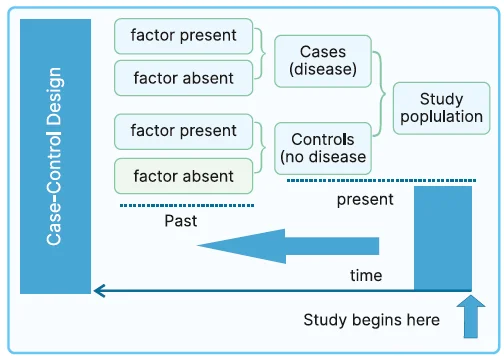
Case-Control Study
- Type - observational analytical study.
- Basic design: comparison between diseased vs non-diseased.
- Start at present time
- Cases - diseased
- Controls - non- diseased
- Study proceeds retrospectively i.e. backward
- In the retrospective cohort study also, we start at the present time and move backward, but there, we were comparing exposed and nonexposed.
- In case-control, study is started at present time, compare diseased v/s non diseased at present time
Flashcard 6
Measure of Strength of Association of Case-Control Study
- Odds ratio or cross-product ratio
Odds ratio = ad/bc
- > 1 - positive association (risk factor)
- = 1 - no association
- < 1 - negative association (protective factor)
Example
- Odds ratio = ad/bc = 30*30/ 20*20 = 9/4 = 2.5
- Here, odds ratio = 2.5 which is > 1, so positive association
- OR : provides an estimate of relative risk.
Flashcard 7
Meta-analysis
- One step ahead and perform quantitative analysis: Meta-Analysis.
- It is a quantitative approach for systematically combining previous research to arrive at conclusions about the body of research.
Steps of Systematic review
Step 1 Defining the review question and eligibility criteria
Step 2 Searching for studies
Step 3 Selecting the studies
Step 4 Data extraction
Step 5 Data synthesis
Step 6 Interpretation of the results
Steps of Meta-Analysis

Flashcard 8
Errors
Non-random errors Random errors Bias Sampling error Doesn't occur by chance Occurs by chance Cannot be eliminated by increasing sample size Can be eliminated by increasing sample size More serious Less serious
Flashcard 9
Types of Blinding
Single Blinding Double Blinding Triple Blinding Subject is unaware of intervention
The investigator and analyzer know the intervention being given.Both the subject and the investigator are unaware of intervention given.
Most common form of blindingThe subject, investigator and analyzer are unaware of the intervention given.
The best form of blinding.
Flashcard 10
Steps of investigation of an epidemic
- Verification of diagnosis
- Most important step
- Confirmation of the existence of an epidemic
- Define the population at risk.
- Rapid search for all cases and their characteristics
- Data analysis
- Formulation of hypothesis
- Work of descriptive epidemiology
- Testing of hypothesis
- Analytical study
- All of those who have suffered have become the cases and compare them with those who have not become the cases to answer why and how.
- Analytical study
- Evaluation of etiological factors
- Further investigation of the population at risk
- Writing a report
Flashcard 11
Isolation vs Quarantine
Isolation Quarantine Done for cases Done for healthy contacts Done for a period of communicability or transmissibility of a disease or till the person recovers. Done for a maximum incubation period of the disease. Known as absolute Quarantine.
Modified quarantine: partial limitation in freedom of movement. Exclusion of children from school. Health authorities can also apply the term quarantine for any ship or vehicle supposed to be the carrier of a disease.
Flashcard 12
Difference between PQLI and HDI
PQLI HDI Mnemonic: ILL Mnemonic: KIL
Given by the United Nations Developmental Program (UNDP)1. Infant mortality rate - > 0 - 100 1. Income: Gross National income per capita in purchasing power parity US dollars. 2. Literacy rate 2. Knowledge index / Education index 3. Life expectancy is one year. 3. Life expectancy at birth. Score: 0- 100
Current score: 65
Not used nowadaysScore: 0-1
Current score: 0.644
Rank (India): 134
Flashcard 13
Iceberg Phenomenon of Disease

Flashcard 14
Live Vaccine
- A live organism is injected into the body in attenuated form.
- Attenuated form: Reduced the organism's virulence (killing power), but antigenicity (antibody-producing capacity) is maintained.
- Single vaccine doses are sufficient to produce the required immunity. Except for the Oral polio vaccine. In OPV other than primary, booster doses are required to produce sufficient immunity.
Killed Vaccine
- Organisms are injected in killed forms
- Killed by
- Heat
- Chemicals (formalin)
- Major antigen persists, minor antigen destroyed.
- Given as multiple doses, booster doses
Flashcard 15
Open Vial Policy
It states that vaccine vials opened in session sites can be used in more than one immunization session upto 4 weeks/ 28 days. Four conditions needed to be fulfilled:
- The Expiry date has not passed
- Vaccines are stored strictly under an appropriate temperature (+2 to +8°C) range during transportation and storage at cold chain point
- Aseptic technique has been used to withdraw all doses.
- Vaccine vial monitor has not reached the discard point
- Vaccine vial septum is not contaminated
Vaccines following Open Vial Policy: All are Liquid vaccines (All t series vaccine + PIO + Jenvac)
- Hepatitis B
- DPT
- Pentavalent
- Td, Tt
- Rotavac
- PCV
- IPV
- OPV
- Jenvac – killed JE
Vaccines that do not follow open vial policy are known as reconstituted vaccines.
- BCG, Measles, MR, JE (Live), Yellow fever, covid vaccine
Flashcard 16
Storage of Vaccines in Cold Chain
- The vaccines must be maintained at proper temperatures and conditions from the point of manufacture to the point of use.
- Cold chain temperature in India is +2° to +8°
- OPV (long-term storage) and yellow fever vaccine in freezing conditions: –15° to – 25°
- The maximum chance of failure of the cold chain is seen at the subcenter and Village levels; thus, vaccines are not stored.
Flashcard 17
- Ring Immunization: Any suspected case in the center, vaccine the susceptible children within a 100-yard radius of the infected case
- Herd Immunity: Break in the chain of disease transmission.
- Threshold cut off: Measles, Pertussis, Chickenpox >90%
- Polio, Mumps: 80-85%
- No role of herd immunity in tetanus and rabies.
- Fully immunized: A child who has completed all due vaccines till 1 year of age among 12-23 months
- Completely immunized: A child who has completed all due vaccines till 2 years of age among 5-year-olds.
- BCG: No protection from pulmonary TB
- Measles:
- >90% with one dose
- >99% with two doses (India adopted the 2 doses of measles vaccine strategy called Accelerated Measles Mortality Reduction Strategy)
- Rubella >95% (Vaccine with highest efficacy with single dose)
Flashcard 18
First Generation IUD
First generation IUD (Non medicated): Inert - No longer used.

Second Generation IUDs
- Second generation IUDs (medicated)
- Copper-containing IUDs
- CuT 380 A or Ag, NOVA T, multiload (ML-Cu-250, ML-Cu-375)

The two copper devices that are freely available under the National Family Welfare Programme: CuT 380 A and CuT 375. 380, 375 means the area of copper wire that is wound around the stem in mm2.
Flashcard 19
DIFFERENCE BETWEEN COW’S MILK, BUFFALO MILK AND BREAST MILK
| Components | Cow’s milk | Buffalo milk | Breast milk |
| Protein (gm) | 3.2 | 6.5 | 1.1 |
| Fat (gm) | 4.1 | 4.3 | 3.4 |
| Lactose (gm) | 4.4 | 5.1 | 7.4 |
| Calcium (mg) | 120 | 210 | 28 |
| Energy (kcal) | 67 | 117 | 65 |
WHO Classification of Xerophthalmia


- Chlorine also oxidizes Iron, Manganese and Hydrogen sulfide and controls algae, slime organisms, and AIDS coagulation.
- Most common presenting symptom: Night blindness.
- Most common presenting manifestation: Night blindness.
- First symptom of vitamin A deficiency: Night blindness.
- Most common indicator for Vitamin A deficiency: Bitot's spots
- Most common clinical sign for screening: Bitot's spots
- Most sensitive screening test: Serum Retinol level
- First clinical sign: Conjunctival xerosis
- Most specific presentation: Bitot spot
- Reversible till which stage: X2
- Irreversible stage: X3A and X3B
Flashcard 20
Ariboflavinosis Triad
As in the first image, the Magenta red Tongue is seen in vitamin B2 Deficiency. Also known as Geographical Tongue/Glossitis. As in the second image, it also presents cheilosis. As in the third image, it also presents Angular Stomatitis. This is the most specific presentation. This is Vitamin B3 deficiency (Niacin deficiency). Niacin deficiency presents with Pellagra
6 D's
- Diarrhea
- Dermatitis
- Dementia
- Depression
- Delirium
- Death


Download the PrepLadder App and get the best NEET PG online coaching with world-class video lectures also in हिंglish, QBank, Mock Tests and more!
Download PrepLadder's best app for neet pg preparation for Android
Download PrepLadder's best app for neet pg preparation for ios

PrepLadder
Access all the necessary resources you need to succeed in your competitive exam preparation. Stay informed with the latest news and updates on the upcoming exam, enhance your exam preparation, and transform your dreams into a reality!
Navigate Quickly
Flashcard 1
Tools of Measurement in Epidemiology
Flashcard 2
Incidence Vs Prevalence
Flashcard 3
Types of Cohort Study
Flashcard 4
The measure of Strength of the Association of Cohort Study
Relative risk
Interpretation of relative risk
Attributable risk
Population Attributable Risk - PAR
Flashcard 5
Case-Control Study
Flashcard 6
Measure of Strength of Association of Case-Control Study
Flashcard 7
Meta-analysis
Steps of Systematic review
Steps of Meta-Analysis
Flashcard 8
Errors
Flashcard 9
Types of Blinding
Flashcard 10
Steps of investigation of an epidemic
Flashcard 11
Isolation vs Quarantine
Flashcard 12
Difference between PQLI and HDI
Flashcard 13
Iceberg Phenomenon of Disease
Flashcard 14
Live Vaccine
Killed Vaccine
Flashcard 15
Open Vial Policy
Flashcard 16
Storage of Vaccines in Cold Chain
Flashcard 17
Flashcard 18
First Generation IUD
Second Generation IUDs
Flashcard 19
WHO Classification of Xerophthalmia
Flashcard 20
Ariboflavinosis Triad