Sampling and Probability in NEET PG PSM
Aug 28, 2025
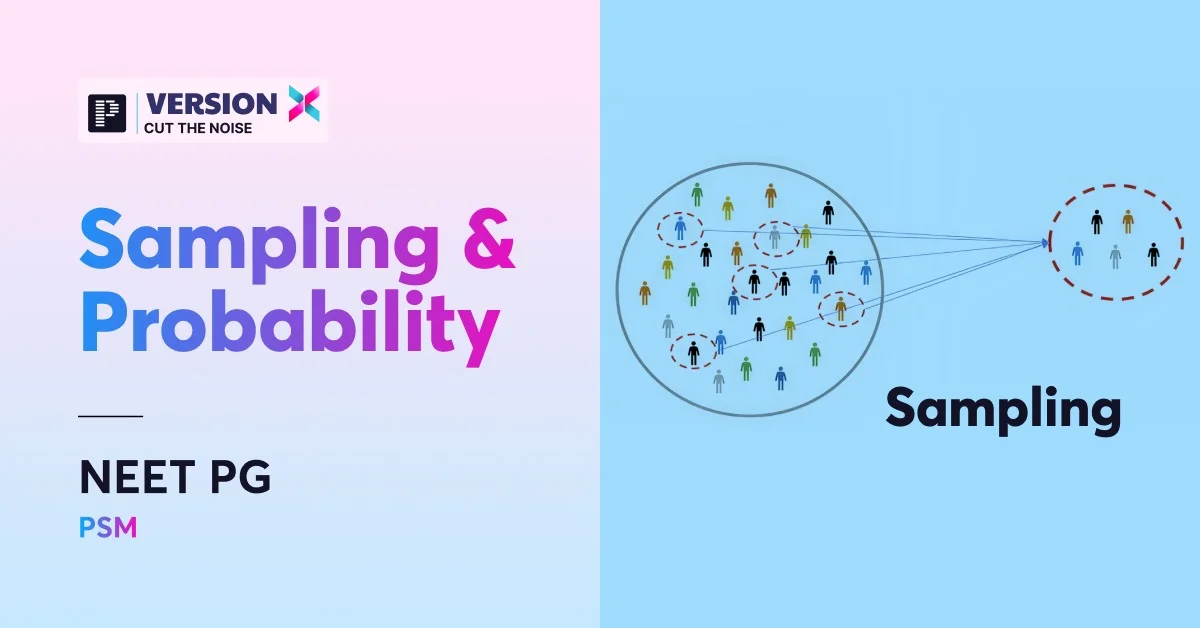

Sampling
Done when the population is large. The sample should be representative of the entire population.
Types of Sampling
- Random - Probability (every participant will get an equal and known chance)
- Simple random sampling
- Systematic random sampling
- Stratified random sampling
- Cluster random sampling
- Multi stage sampling
- Multi phase sampling
- Non-Random - Non Probability
Convenient Sampling
- It is suitable for you/ convenient to you.
- Selected for your convenience
- Source of Selection bias
- Ex: If there are 200 students, we need 10 students selected, we select students sitting in the front row because it is convenient to us.
Purposive sampling
- Hidden intention.
- Purposefully we select.
- Ex: Selecting houses in a village where a pneumonia case was found.
Quota sampling
- Like a strata.
- Ex: If there are 200 students we need 10 students selected, we separated them into 2 sets (left and right).
Snowball sampling
- This is done for the hidden population (Difficult to catch)
- Ex: Commercial sex workers, Homeless people, Migrants.

Random Sampling Methods
Every participant will get an equal and known chance
Simple Random Sampling
- Randomly selected from an entire list.
- Using a randomization technique like lottery, flipping a coin, a chit method or table of random numbers
- Most commonly adopted method.
- Best method- table of random numbers.
Systematic Random Sampling
- Adopted for a heterogeneous population.
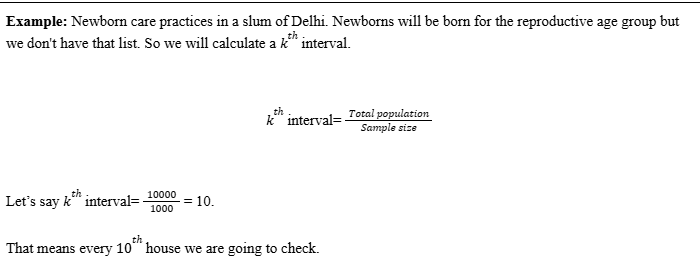
- Based on sampling interval technique- Kth or nth interval.
- After enumerating the units, they are selected at a predetermined interval.
- Simple and convenient
- Need less time and work.
- Easily administered.
- Population is large and scattered.
- No sampling frame is required.
Stratified Random Sampling
- Strata based on a predetermined criteria.
| Example: let us assume that we need to do a study on diabetes or TB of a certain population. , So we divide the entire population to Lower socio economic class Middle socio economic class Higher socio economic class |
- Here we are converting a heterogeneous population to homogeneous.
- Within a strata we use simple random techniques which is based on PPS (Probability proportional to sample size)
| PPS Example: Let's say there are 2 groups of people. One with 6 people and 9 people respectively. Then we select them in a ratio of 2:3. |
- Gives different population subgroups an equal chance of being selected.
- Prespecified number of individuals is given adequate representation (reduces bias and none is under or over reported)
- Best done for non homogeneous population
- Ideal for heterogeneous populations with respect to,
- Characteristic under study
- Characteristics influenced by different sections of population.
- Ex: Religion and age groups
Cluster Random Sampling
- Naturally created groups
- Clusters can differ among themselves
- But we have to remove heterogeneity among clusters
- Done for evaluation of health care services.
- Ex: Control evaluation of Immunization service or antenatal coverage etc.
- Population divided into already existing groups
- Then a sample is selected in a random manner from the cluster
- Natural heterogeneous clusters: Between 2 clusters we should remove inter cluster variation by using Design Effect
- 2 stages
- 1st stage: Clusters selected
- 2nd stage: Households within the clusters selected by a random technique.
- Sampling frame is a list of clusters with size of population
- Advantages
- Easy
- Cheap
- Rapid
- Simple
- Disadvantages
- High sampling error
- Uses
- Evaluation of immunization coverage
- Diarrheal disease survey
- Leprosy elimination monitoring service
Sample Size Calculation
- Sample size= 4pqd2
- 4= 95% CI (confidence interval)
- p= prevalence given
- q= 100-p
- d or l= absolute error

Probability
- Probability: Chance of an event to happen
- Odds: Chance of an event to not to happen
- Example:
- Probability: Chance of 6 by rolling a die first time: 16
- Odds: Chance of not getting 6 on first time: 56
- Given by p/1-p
Important Questions
Q. What is the best for Evaluation of immunization coverage?
Answer: Cluster
Q. What is the sample size that you are going to select to do a study on hypertension in an urban slum considering 50% prevalence from previous research studies?
- Absolute error is 5
- Sample size = 4pqd2
- Ss = 4x50x505x5 = 400
Q. What is the sample size you would take to find out about diabetes considering the prevalence of previous research study to be 50%. Relative precision/ error as 10%.
- Absolute error = 10% of p = 10% of 50 = 10100 × 50 = 5
- Sample size= 4pqd2 = 4×50×505×5 = 400
Q. In the WHO recommended EPI cluster sampling for assessing primary immunization coverage, the age group of children to be surveyed is
- 0- 12 months
- 6-12 months
- 9-12 months
- 12-23 months
Answer: 12-23 months
Q. Simple random sampling ideal for?
- Vaccinated people
- Heterogeneous population
- Homogeneous population
- All of the above
Answer: Homogeneous population
Q. What is chance to find 2 individuals and both of them with blood group B
Answer: Probability of finding 2 persons both with blood group B is P(B) x P(B)
Q. What is the chance to find 2 people with blood group A and B
Answer: Now in this case, events are mutually exclusive. This means that there is no chance that both can occur in the same individual. So chance of finding 2 persons with blood group A and B is P(A) + P(B).
Download the PrepLadder app now and unlock a 24-hour FREE trial of premium high-yield content. Access Smarter Video Lectures also in हिंglish, Game Changing Qbank, Audio QBank, Structured Notes, Treasures, Mock test for FREE to ace your NEET PG preparation. Elevate your study experience and gear up for success. Start your journey with PrepLadder today!
Download PrepLadder's NEET PG app for Android
Download PrepLadder's NEET PG app for iOS

PrepLadder Medical
Get access to all the essential resources required to ace your medical exam Preparation. Stay updated with the latest news and developments in the medical exam, improve your Medical Exam preparation, and turn your dreams into a reality!
Navigate Quickly
Sampling
Types of Sampling
Random Sampling Methods
Simple Random Sampling
Systematic Random Sampling
Stratified Random Sampling
Cluster Random Sampling
Sample Size Calculation