Otitis Media : Types, Causes, Symptoms and Treatment
Mar 29, 2024

Otitis media is basically a disease of young ones which is more prevalent in the ages of 6-24 months of age. Younger children are more susceptible to otitis media due to the presence of a shorter and more horizontal eustachian tube which accumulates fluid more easily than in older children and adults. Moreover, toddler’s immune systems are still developing which further increase their susceptibility to infections like otitis media.
Acute otitis media is a painful type of ear infection. It is a bacterial or viral infection that affects the mucosal lining of the middle ear and mastoid ear cells. It is more common in children and infants because the eustachian tube is shorter, straighter, and more horizontal. This leads to easy reflux of the contents from the nasopharynx to the middle ear, which results in ear infection.
Pathophysiology of Acute Otitis Media
- It starts with any pathology in the nose, nasopharynx, and palate.
- This leads to inflammation and it causes eustachian tube dysfunction or occlusion.
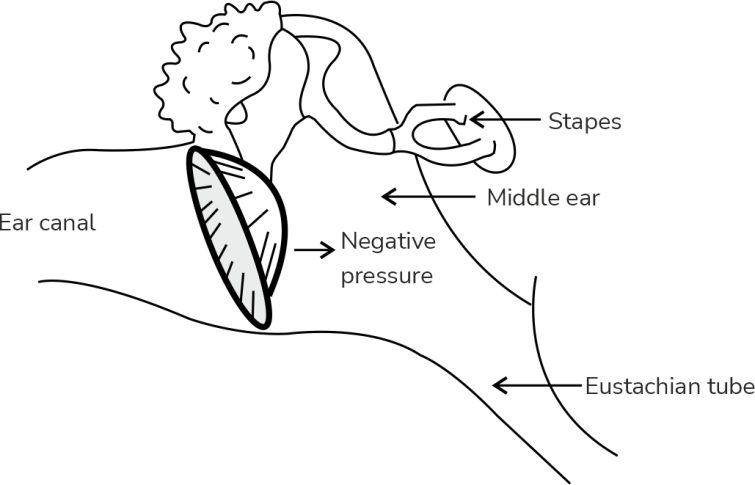
- It creates negative pressure in the middle ear cleft and it hurts the mucosal cells of the middle ear. This leads to exudate formation in the middle ear.
- If the exudate becomes infective it is called suppurative otitis media and if the exudate is not infected then it will be called Non-suppurative otitis media.
Bulging of Tympanic Membrane
Acute Suppurative Otitis Media
- It is defined as inflammation of the middle ear cleft by pyogenic organisms. The word suppurative means infective disease and otitis media means that the middle ear is involved.
- The duration of acute suppurative otitis media is less than four weeks. If the duration of the infection becomes more than 12 weeks then it is called chronic suppurative otitis media.
- As it is an infectious disease, the most common infective agents in infants and children are streptococcus pneumonia and Haemophilus influenza.
Routes of Infection
- The most common root is Eustachian Tube and the second most common route is an external auditory canal.
Predisposing Factors/ Risk factors
- Recurrent attacks of common cold and upper respiratory tract infections.
- Exanthematous fever like diphtheria, measles, and whooping cough.
- Nasal allergy
- Nasal packing in patients with epistaxis.
- Chronic rhinitis and chronic sinusitis.
- Nasopharyngeal causes like nasopharyngeal tumors and enlarged adenoids.
- Cleft palate

Stages of Acute Separative Otitis Media
- Stage of Tubal Occlusion:
- It starts with the occlusion of the eustachian tube.
- This causes mild retraction of the tympanic membrane further.
- The patient will present with symptoms like mild pain with slight hearing loss.
- Stage of Pre-Suppuration
- After Eustachian Tube blockage the infection will move towards the middle ear.
- Hyperemia of the walls of the middle ear appears and the pathology will lead to the production of exudate in the middle year.
- Now the classic cartwheel appearance of the tympanic membrane is seen. This is due to gross retraction of the tympanic membrane.
- The patient will present with symptoms of severe pain and hearing loss.
- Stage of suppuration
- In this stage, there will be an ascent of pathological Organism.
- This serous exudate will become infected and suppurates containing WBC and pass cells.
- The tympanic membrane will be bulging with pus.
- The patient will present with symptoms like excruciating ear pain, fever, and severe hearing loss.
- Stage of resolution
- In this stage the pus will be pointing and will lead to perforation of the tympanic membrane.
- The release of pus from the middle year will lead to the alleviation of all symptoms.
- The fever and pain will fall.
- The pus reflects light in alternate visualization and it is called a lighthouse sign.
- Due to the pressure, the pus will come out in a pulsatile fashion, it is called pulsatile otorrhea.
Treatment of Acute Suppurative Otitis Media
- Antibacterial Therapy
- The antibiotics are given till the fever subsides, the tympanic membrane appears normal, and normal hearing. The minimum duration of antibiotic therapy is 10 days.
- Ampicillin or amoxicillin is mostly used for the treatment of otitis media.
- Inadequate therapy can lead to the conversion of acute suppurative otitis media to serous otitis media.
- In severe cases myringotomy is the treatment of choice. The indications of myringotomy are:
- Severe pain with a bulging drum.
- Persistent effusion beyond 12 weeks of period.
- Incomplete resolution despite antibiotic therapy.
- Acute suppurative otitis media with facial palsy.
- Supportive therapy
- Nasal decongestants are given to relieve the eustachian tube edema and hence it will help to relieve the occlusion.
- Oral decongestants
- Analgesics and antipyretics
- Ear toilet
- Dry local heat
Types of Otitis Media
- Acute Otitis Media
It is an acute inflammation of middle ear caused by pyogenic organsims. It is mostly caused by viral upper respiratory tract infection which causes edema and inflammation of the nasopharynx and eustachian tube, collection of fluid and infection by bacteria colonizing the nasopharynx. The bacteria most commonly isolated are Streptococcus pneumonia, nontypeable Haemophilus influenza and Moraxella catarrhalis. Most common viruses include respiratory syncytial virus, rhinoviruses , enteroviruses, coronaviruses , influenza virus and adenovirus. Eustachian tube dysfunction predisposes to the development of acute otitis media.
- Otitis Media with Effusion
Otitis media with effusion has serous or mucoid fluid in the tympanic cavity in the absence of infection lasting for >3 months. It most commonly affects children less than 2 years of age. It occurs most commonly as a sequela of a viral infection which causes acute otitis media. It can also be caused by allergies. Other predisposing factors include craniofacial abnormalities, GERD and enlarged adenoids.
- Chronic Otitis Media
Chronic otitis media is a long standing infection of the middle ear cleft characterized by ear discharge and a permanent perforation. Its incidence is higher in developing countries because of poor socioeconomic standards, poor nutrition and lack of health education. It is the most important cause of hearing impairment in the rural population.
Causes/Risk Factors of Otitis Media
- Recurrent attacks of common cold, upper respiratory infections
- Young age
- Infections of tonsils and adenoids
- Chronic rhinitis and sinusitis
- Eustachian tube features- shorter and more horizontal eustachian tube in younger children predisposes them to otitis media.
- Tumors of Nasopharynx , packing of nose or nasopharynx for epistaxis
- Nasal allergies
- Craniofacial abnormality
- GERD
- Cleft palate
Symptoms/Physical Examination Findings
- Acute Otitis Media
- Ear Pain
- Fever
- Irritability
- Otorrhea
- Anorexia
Physical Examination Findings Include-
- Bulging tympanic membrane with tympanic membrane inflammation.
- Obscured landmarks
- Immobility of membrane on pneumotoscopy, valsalva maneuver.
- Otitis Media with effusion
- Decreased Hearing
- Impaired language development or communication difficulties
- Ear fullness
- Ear ache
- Tinnitus
- Balance problems
Physical Examination Findings Include
- Tympanic membrane is translucent or gray with fluid, air fluid levels or bubbles behind the membrane.
- Decreased mobility or pneumatic otoscopy
- Loss of the light reflex
- Chronic Otitis Media
- Chronic >6 week of purulent otorrhea
- Hearing loss
- Absence of ear pain
Physical Examination Findings Include
- Tympanic membrane perforation
- Otorrhea with normal appearing external auditory canal.
Complications of Otitis Media
- Hearing impairment when recurrent
- Tympanic membrane perforation- Especially due to shifts in barometric pressure which causes stretching of Tympanic membrane leading to ear pain and hearing loss causing rupture of the membrane which relieves the pain and results in minor bleeding.
- Facial nerve palsy
- Mastoiditis- Infection of the mastoid air cells
- Labyrinthitis
- Tympanosclerosis
- Cholesteatoma- Retraction pocket in the tympanic membrane which fills with granulation tissue and debris that can enlarge, perforate the tympanic membrane, envelope the ossicles or destroy surrounding tissue.
Treatment of Otitis Media
- Acute Otitis media
- Pain is treated with NSAIDs or acetaminophen. Benzocain, procaine or lidocaine may provide additional benefit.
- Antibiotics are indicated in specific situations
- First line is Amoxicillin
- Indications include infants <6 months and >6 months if there is a high fever, sever pain and bilateral manifestations.
- Second line is Amoxi-clav. Indications include refractory AOM after 2-3 days of antibiotic therapy or recurrent AOM after anibiotic therapy.
- Otitis media with Effusion
- Resolves within weeks and does not require treatment.
- Observed and followed up after 3 months because it causes speech delays and long term hearing loss in children.
- Tympanostomy tube placement warranted for associated hearing loss.
- Chronic Otitis Media - Ototopical Fluoroquinolone drops. (Ofloxacin)
Hope you found this blog helpful for your ENT Residency Otology Preparation. For more informative and interesting posts like these, keep reading PrepLadder’s blogs.
Propel your ENT Residency Preparation! Access conceptual video lectures, QBank, Mock Tests, and premium study resources on the PrepLadder App. Download it today!

PrepLadder Medical
Get access to all the essential resources required to ace your medical exam Preparation. Stay updated with the latest news and developments in the medical exam, improve your Medical Exam preparation, and turn your dreams into a reality!
Navigate Quickly
Pathophysiology of Acute Otitis Media
Acute Suppurative Otitis Media
Routes of Infection
Predisposing Factors/ Risk factors
Stages of Acute Separative Otitis Media
Treatment of Acute Suppurative Otitis Media
Types of Otitis Media
Causes/Risk Factors of Otitis Media
Symptoms/Physical Examination Findings
Physical Examination Findings Include-
Physical Examination Findings Include
Physical Examination Findings Include
Complications of Otitis Media
Treatment of Otitis Media
Top searching words
The most popular search terms used by aspirants
- ENT Residency Otology