FMGE Last 7 Days Strategy 2026
Jun 22, 2026
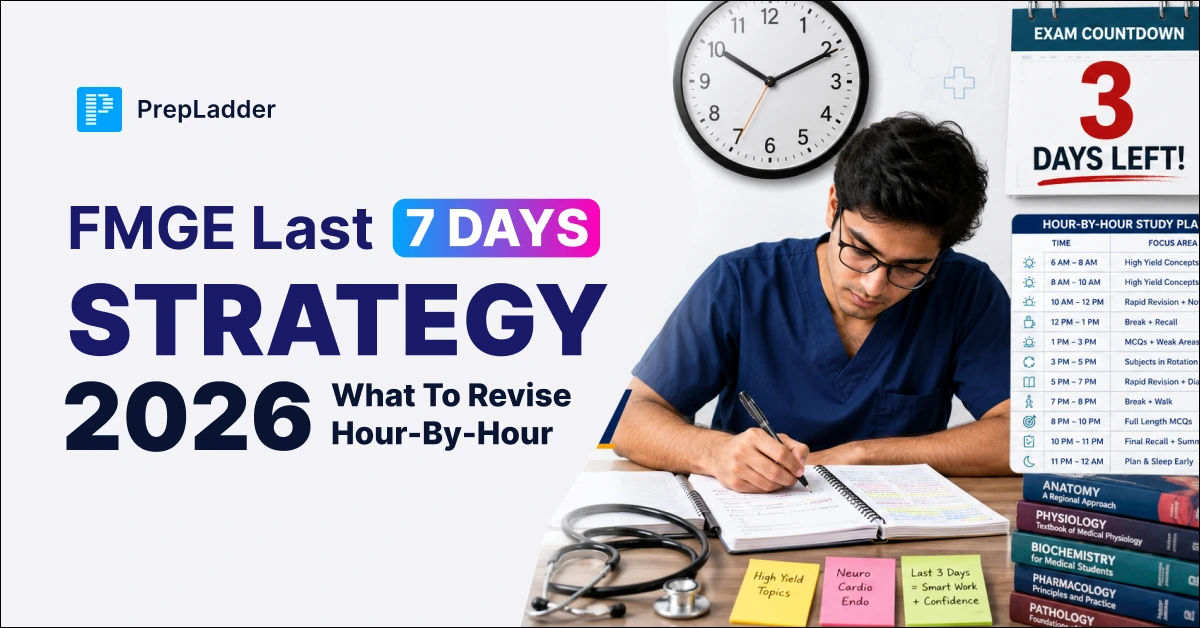
At last, the moment has arrived. It's finally time to face the challenge of finishing this medical marathon, as the FMGE June 2026 exam is scheduled for June 28, 2026.
The final seven days are not for learning difficult topics and subjects, nor is it for completing parts of your syllabus which remain pending. These seven days are only for damage control, psychological preparations, and perfecting instant recall abilities. Everything you do during these 7 days will determine if all those months of hard work will pay off in the form of your much-desired score of 150+.
As an aspiring FMGE candidate, your mind may be tricking you into thinking that you have forgotten everything you learned. Do trust yourself and believe in all the hard work you've done; you haven't forgotten anything. This comprehensive guide will show you the way forward to prepare for the last week of your exam.

The Golden Rules of the Final Week
Before diving into your day-by-day itinerary, anchor your mind to these non-negotiable mental rules:
- Strictly No New Material: Do not open a fresh textbook, do not download a new PDF compilation, and do not start a new video lecture series now. If you haven't read a topic by this point, let it go. Focus 100% of your energy on consolidating what you already know.
- Taper Your Daily Study Hours: Now is not the time for desperate 14-hour study sessions. On exam day, your brain must function at its highest level. As the week goes on, gradually cut back on your study time to six to seven hours to avoid mental exhaustion and burnout.
- Fix Your Sleep-Wake Cycle Immediately: If you have been studying late into the night, you must break that habit right now. The FMGE is a long, two-shift exam. Your brain needs to be fully awake, focused, and active during both morning and afternoon shifts of the exam.
Download FMGE Previous Year Question Papers PDF For Free
Day-by-Day Final Revision Roadmap
This approach focuses on focusing your attention on highly volatile, factual concepts and image-based pattern recognition instead of large, complex clinical subjects.
Days 7 to 5 Before Exam: The High-Yield Volatile Topics
Spend these three days studying the most volatile, factual concepts across basic and para-clinical subjects that easily slip out of memory.
- The Volatile Core: Rapidly revisit Pharmacology drug classifications and acute toxic antidotes; Microbiology bacterial culture media and viral properties; Biochemistry rate-limiting enzymes and inherited metabolic disorders; and PSM immunisation schedules alongside basic biostatistics formulas.
- Anatomy & Pathology Review: Spend a dedicated block reviewing high-yield, highly repetitive exam zones like cranial nerve lesions, upper/lower limb nerve injuries (e.g., wrist drop vs. claw hand), and essential chromosomal translocations (e.g., leukemias and lymphomas).
- The Error Notebook: Utilize your personalized High-Volatility Diary / Error Notebook if you have been maintaining one throughout your journey. Read through the specific raw facts, numbers, and one-liners that you historically marked as incorrect during your QBank sessions.
Days 4 & 3 Before Exam: Visual Conditioning & PYQ Dominance
Your visual cortex plays a major role in the NBEMS's clinical question pattern. These two days are entirely devoted to understanding question trends and locking down quick visual marks.
- The 3-Hour Daily Image Blitz: Dedicate 2 to 3 hours a day to scrolling through exclusively high-yield images. Focus on classic Dermatology rashes and lesions, Radiology systemic X-ray/CT scans, Microbiology Gram stains, diagnostic Pathology histopathology slides, and essential Surgical/Obstetric instruments.
- Previous Year Questions (PYQs): Read through the last 3 to 5 sessions of official FMGE papers. Do not solve them as a timed mock test; simply read the question stem, look directly at the correct answer, and understand the recurring high-yield topics. The NBEMS frequently repeats core clinical themes, even if they tweak the introductory presentation of the clinical case.
Also Read: FMG June Exam Date ‘26–Eligibility Criteria, Exam Pattern and Preparation Tips
Day 2 Before Exam: The Soft Landing
Two days before the exam is all about light, stress-free review and logistical preparation.
- Rapid Revision Scanning: Flip through PrepLadder Treasures or your ultra-short revision notes. Look only at high-yield summary charts, diagnostic flowcharts, and 2x2 calculation matrices (like Sensitivity/Specificity tables).
- Pack Your Exam Day Required Documents: Eliminate last-minute morning panic by organizing your documents early. Print a clear copy of your Admit Card, double-check your valid Government ID (Passport/Aadhaar), and carefully review the official dress code instructions provided by the NBEMS to avoid any hassle at the center security gates.
Day 1 Before Exam: Brain Standby Mode
On the final day before the exam, stop studying entirely by 5:00 PM. Your long-term memory is already locked in. Forcing extra reading at this stage only triggers acute panic and false anxiety that you've forgotten basic details.
Go for a relaxing walk, talk to family, eat a light dinner that won't upset your stomach, and hit the bed early. Your single most important asset tomorrow is a well-rested, completely clear, and calm mind.

How to Optimize Your Last 7 Days with PrepLadder
- Leverage the PrepLadder Treasures: Do not flip through bulky, multi-page main notes. Open the Treasures section in your app to rapidly scan curated visual summaries of complex metabolic pathways, tumour staging criteria, and classic drug side effects.
- Review "Bookmarked" Questions Only: Instead of attempting new custom modules, filter your PrepLadder QBank to show only your previously bookmarked questions and past mistakes. Reviewing these ensures you won't repeat the exact same errors on the real paper.
- Watch Rapid Image Sessions: Spend your evening relaxation blocks watching short, rapid-fire image review videos to reinforce your instant pattern recognition.
Also Read: FMG June Exam Date ‘26–Eligibility Criteria, Exam Pattern and Preparation Tips
Exam Day Strategy: Navigating the Test Paper
When you sit in front of the computer on June 28th, tactical execution is everything:
- Do Not Overthink Simple Questions: The FMGE requires a 150 out of 300 to pass. A massive chunk of the paper consists of straightforward, direct questions. Don't look for hidden traps or secondary complications where there are none. If a question feels simple, accept the direct answer and move forward.
- Manage Time Aggressively: If a clinical case question is excessively long, read the final line of the question first to understand what is actually being asked, then scan the four options before tackling the main stem of the question. If a question leaves you completely blank, mark it for review, make a guess immediately, and move on. Do not let one difficult question ruin your entire pacing.
- Protect Your Mid-Exam Break: After Paper 1 concludes, do not stand outside the test centre gate discussing answers, controversies, or missed questions with friends. This breeds immediate psychological anxiety and destroys your confidence for Paper 2. Eat a light snack, hydrate, reset your mind, and treat Paper 2 as a completely fresh start.
Also Read: FMGE Last 3 Days Strategy 2026: What to Revise Hour-by-Hour
Frequently Asked Questions (FAQs)
Q1: I feel like I am forgetting very basic things like drug names, matching structures, and simple criteria. Is this normal?
Ans. Absolutely, 100% normal. This is a common phenomenon known as psychological amnesia, and it happens to almost every single medical student before a major exam. Your brain has successfully stored the information in its long-term memory bank. When you see the actual question stem and its four distinct options on the screen on exam day, the visual cues will instantly trigger your recognition pathways, and the correct answer will come rushing back to you. Trust your hard work.
Q2: Should I try to take one final Grand Test (GT) during the last 7 days to see where I stand?
Ans. No, definitely avoid this. Taking a Grand Test this close to the final exam is a high-risk, low-reward move. If you score well, it adds very little value; if you score poorly or hit an uncharacteristically difficult paper, it can completely shatter your confidence and trigger intense anxiety right before the real exam. Your valuable time is much better spent reviewing high-yield factual points, image sets, and past PYQs.
Q3: How many hours should I study daily during this final week?
Ans. You should aim for a structured, "tapering" approach. On Days 7 to 5, you can safely study for 8-9 hours to finish your volatile subject sweeps. By Days 4 to 2, drop this down to 5-6 hours of light reading, diagnostic matrix reviews, and image scanning. On Day 1, before the exam, stop completely by late afternoon. Your priority is optimal execution, not physical exhaustion.
Q4: What should I do if I discover a high-yield topic that I completely skipped during my standard preparation?
Ans. Leave it alone. Trying to learn a completely new, unfamiliar medical concept in the last week takes up a massive amount of mental energy, steals your critical revision time, and breeds unnecessary panic. Focus entirely on ensuring that you do not make silly mistakes on the topics you have studied thoroughly. You do not need a perfect 300/300; you need a solid, respectable 150.
Q5: Is there negative marking in the FMGE June 2026 exam?
Ans. No, there is no negative marking in the FMGE. This means you must absolutely attempt all 300 questions across both papers. If you run out of time or find a question completely alien to you, eliminate the obviously wrong options, make your best educated guess, and make sure every single question bubble is filled before the digital timer runs out.
Final Words
The deep anxiety you are feeling right now is not a reflection of poor preparation or weakness; it is simply a reflection of how much you care about this exam and your future medical career. You have spent years training for this exact moment across your medical school journey. Trust your preparation, trust your clinical instincts, and go claim your prefix.
Doctor, your white apron is waiting for you.

PrepLadder
Access all the necessary resources you need to succeed in your competitive exam preparation. Stay informed with the latest news and updates on the upcoming exam, enhance your exam preparation, and transform your dreams into a reality!
Navigate Quickly
The Golden Rules of the Final Week
Download FMGE Previous Year Question Papers PDF For Free
Day-by-Day Final Revision Roadmap
Days 7 to 5 Before Exam: The High-Yield Volatile Topics
Days 4 & 3 Before Exam: Visual Conditioning & PYQ Dominance
Day 2 Before Exam: The Soft Landing
Day 1 Before Exam: Brain Standby Mode
How to Optimize Your Last 7 Days with PrepLadder
Exam Day Strategy: Navigating the Test Paper
Frequently Asked Questions (FAQs)
Q1: I feel like I am forgetting very basic things like drug names, matching structures, and simple criteria. Is this normal?
Q2: Should I try to take one final Grand Test (GT) during the last 7 days to see where I stand?
Q3: How many hours should I study daily during this final week?
Q4: What should I do if I discover a high-yield topic that I completely skipped during my standard preparation?
Q5: Is there negative marking in the FMGE June 2026 exam?
Final Words
Top searching words
The most popular search terms used by aspirants
- FMGE Preparation Strategy
- FMGE Preparation Tips