Amino Acid And Protein Metabolism: Important Questions In Biochemistry
Feb 28, 2025

Q1. The amino acid that does not undergo transamination is:
- Serine
- Cysteine
- Threonine
- Tryptophan
Q2. Aspartate on transamination forms:
- Pyruvate
- a Ketoglutarate
- Alanine
- Oxaloacetate
Also read: Nonsteroidal Anti-Inflammatory Drugs (NSAIDs): Uses and Side Effects
Q3. Alanine on transamination forms:
- Pyruvate
- a Ketoglutarate
- Alanine
- Oxaloacetate
Q4. All are true about amino acid oxidase except:
- FAD is used as a coenzyme
- Linked to ATP production
- Source of Oxidative Stress
- Release toxic ammonia.
Q5. The most common non-toxic form of ammonia is:
- Alanine
- Glutamine
- Glutamate
- Alpha keto glutarate
Q6. The most common non-toxic form of ammonia formed in neuron is:
- Alanine
- Glutamine
- Glutamate
- Alpha keto glutarate
Also read: Solved Important Questions On LIPID Chemistry
Q7. The most common non-toxic form of ammonia formed in muscle is:
- Alanine
- Glutamine
- Glutamate
- a keto glutarate
Q8. Urea cycle and citric acid cycle are linked through
- Aspartate
- Fumarate
- Malate
- Pyruvate
Q9. What is true about CPS 1?
- Present in cytoplasm
- Involved in Pyrimidine synthesis
- Stimulated by NAG
- Glutamine is the nitrogen source
Q10. A 6 months old female infant began to vomit occasionally and ceased to gain weight. The child became habitually drowsy, temperature raised and her liver was enlarged. The EEG was abnormal. When the milk feeding was avoided and was started on glucose, the condition improved. Urine analysis showed abnormally high glutamine, uracil, orotic acids. Blood showed high ammonium concentration. Citrulline levels were normal. The child has defective:
- CPS I
- CPS II
- Ornithine transcarbamoylase
- Arginino succinate synthase
Explanation:
In hyperammonemia there will be abnormal changes in EEG with characteristic slowing of waves. CNS depression so slowing of waves will be observed. It is not type one hyper ammonia. The defect was before citrulline. If CPS 1 was defective, the uracil, and orotic acid value would have been less. CPS 2 enzyme on being defective uracil, the orotic acid value would have been less. For option d, the citrulline level will be elevated.
Also read: Pituitary Hypothalamic System in Pharmacology
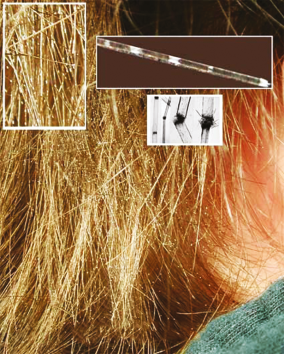
Q11. A 14-year-old child presents with coarse, brittle hair, variable degrees of irritability and behavioral or psychomotor retardation. Previous history of lethargy, poor feeding with vomiting, hypothermia and hyperventilation have been recorded. The hair showed characteristic nodules and brittle nature as shown in the image. Blood investigation revealed high ammonia, glutamate, orotic acid, Citrulline and Argininosuccinic acid.
- CPS I
- OTC
- Arginosuccinate synthetase
- Arginosuccinate lyase
There is tufting of hair. Blood investigation showed high ammonia, glutamate, orotic acid, citrulline, and argininosuccinic acid. When argininosuccinate lyase is defective, there is accumulation of argininosuccinic acid causing argininosuccinic aciduria.
Q12. All of the following are aminoacids required for creatine synthesis except
- Glycine
- Alanine
- Arginine
- Methionine
Q13. All of the following act as sources of atoms of purine ring except:
- Glycine
- THFA
- Arginine
- Aspartate
Also read: Lipoprotein Metabolism: An Overview
Q14. All of the following are specialized products of Glycine except:
- Collagen
- Creatine
- Glutathione
- Pyrimidine
Q15. Tryptophan acts as a source of:
- N10 formyl THFA
- N5 , N10 methylene THFA
- N5 , N10 Metheny! THFA
- N5 formyl THFA
Q16. FIGLU test is done after a load of:
- Tyrosine
- Tryptophan
- Histidine
- Glycine
Q17. Glycine acts as a source of:
- N5 , N10 methylene THFA
- N5 , N10 methenyl THFA
- N10 formyl THFA 10
- Formimino THFA
Also read: Hyperlipoproteinemia & Fatty Liver: An Overview
Q18. All the following amino acids take part in one carbon pool except
- Glycine
- Tryptophan
- Histidine
- Proline
Q19. An 8-month-old boy was admitted because of paleness. Laboratory studies disclosed microcytic and hypochromic anemia. Serum iron and ferritin were high. Examination of bone marrow revealed prominent erythroid hyperplasia; 18% of the erythroblasts were distinct ringed sideroblasts. Electron microscopic studies found intramitochondrial iron deposits in the erythroblasts. Sideroblastic anemia was diagnosed. A point mutation in SLC25A38 (mitochondrial transporter) was found in this patient. What is the mode of inheritance of this condition?
- X linked recessive
- X linked dominant
- Autosomal recessive
- Autosomal dominant
Explanation
- Glycine reacts with succinyl CoA in the presence of ALA synthase to form ALA in mitochondria.
- When there is a defect in ALA synthase2, a protoporphyrin ring will not be formed.
- No protoporphyrin ring, iron cannot be chelated.
- So that iron accumulates in the mitochondria surrounding the nucleus (looks like sideroblast)
- Hence it is called sideroblastic anemia.
- If ALA2 synthase defect the inheritance is X linked recessive sideroblastic anemia.
- Sideroblastic anemia can also occur due to the defect of a transporter SLC25A38. Therefore, glycine is not able to enter the mitochondria because of the mutation in the transporter. The gene is present in Autosomal chromosome→Autosomal recessive inheritance.
Q20. Nitisinone treats all except?
- Type I Tyrosinemia
- Type II Tyrosinemia
- Alkaptonuria
- Hawkinsinuria
Also read: Amino Acids And Proteins Chemistry Solved Question
Q21. Type II Tyrosinemia is characterized by all except:
- Palmar hyperkeratosis
- Corneal ulcer
- Porphyria
- Oculocutaneous syndrome
Q22. All the following are specialized products obtained from tyrosine except:
- A. Dopamine
- B. Melanin
- C. Epinephrine
- D. Serotonin
Explanation:
Serotonin obtained from Tryptophan
Q23. A 6-year-old boy presents with periodic aggressive behavior. His urinary ALA is elevated. On examination, he is icteric. A mild hepatomegaly is observed. Blood examination revealed massive elevation of AFP. HPLC and TMS examination revealed an elevation of succinyl acetone. The probable diagnosis is.
- Type II Tyrosinemia
- ALA Dehydratase deficiency Porphyria
- Type 1 Tyrosinemia
- Type III Tyrosinemia
Q24. A 6-year-old boy presented with spontaneous corneal erosion. On examination, his palms were found to be hyperkeratotic HPLC with TMS revealing a high Tyrosine peak and absence of Succinyl acetone peak. The most probable diagnosis is?
- Type II Tyrosinemia
- Alkaptonuria
- Hawkinsinuria
- Type 1 Tyrosinemia
Explanation
- Type I: Succinyl acetone will be elevated.
- Type II: No elevation of Succinyl acetone
Also read: Genetics Questions Solved for NEET PG Biochemistry Preparation
Q25. 20-year-old boy with severe mental retardation, mousy odor in body fluids, and hypopigmentation. The patient has frequent episodes of seizures & aggressive behavior. What is your diagnosis?
- Tyrosinemia
- Albinism
- Maple Syrup Urine Disease
- Untreated PKU (Phenylketonuria)
Explanation
- Albinism: Hypopigmentation
- Tyrosinemia: Type-I - Hepatorenal syndrome and Type-II - Oculocutaneous syndrome
- MSUD: Burnt sugar odor of urine
Important One-liners
- The most common non-toxic form of ammonia is Glutamate.
- The most common non-toxic form of ammonia formed in neurons is Glutamine.
- The most common non-toxic form of ammonia formed in muscles is Alanine.
- The urea Cycle and TCA cycle are linked through the intermediate, Fumarate.
- The urea and TCA cycle are linked through the amino acid, Aspartate.
- The step in which urea is released is catalyzed by Arginase.
- The amino acid necessary for heme synthesis is Glycine
- The most common inhibitory neurotransmitter of brain is GABA
- The most common inhibitory neurotransmitter of spinal cord is Glycine
- N N methylene THFA is used for the formation of Thymidine 5 10
- C2 of purine ring is formed from N formyl THFA 10
- C8 of purine ring is formed from N , N methenyl THFA
- Phenylketonuria is caused by the defect of Phenylalanine hydroxylase.
- Type 1 Tyrosinemia is caused by the defect of Fumarylacetoacetate hydrolase.
- Type II Tyrosinemia is caused by the defect of Tyrosine transaminase.
- Gain of function mutation of pHPP dioxygenase causes Hawkinsinuria
- Oast house odor is caused by Methionine malabsorption
- Cabbage odor is a feature of Type-1 Tyrosinemia
Also read: Important Questions On Carbohydrate Metabolism
Download the PrepLadder app now and unlock a 24-hour FREE trial of premium high-yield content. Access Video Lectures, digital notes, QBank, and Mock Tests for FREE to ace your NEET PG preparation. Elevate your study experience and gear up for success. Start your journey with PrepLadder today!

PrepLadder Medical
Get access to all the essential resources required to ace your medical exam Preparation. Stay updated with the latest news and developments in the medical exam, improve your Medical Exam preparation, and turn your dreams into a reality!
Navigate Quickly
Important One-liners
Top searching words
The most popular search terms used by aspirants
- NEET PG Biochemistry
- NEET PG Biochemistry Preparation