Important Questions On Carbohydrate Metabolism
Feb 17, 2025


Glut Transporters
Q. In which form is the glucose trapped in the cell?
Ans. In the form of glucose-6 phosphates.
Q. Which is the most active form of glucose?
Ans. It is UDP glucose.
Also read: Biochemistry Important Questions For NEET PG/FMG Exams
Q. Which is the most common physiological form of glucose?
Ans. Beta D glucopyranose.
Q. In what form is glucose trapped inside the cell?
Ans. Glucose 6 Phosphate.
Q. What is the purpose of hexokinase or glucokinase?
Ans. To trap the glucose inside the cell.
Q. Between liver and muscle, which has the highest glycogen content/concentration?
Ans. Liver (expressed in g/kg).
Q. Which tissue has the highest glycogen mass?
Ans. Muscle (due to high skeletal muscle mass).
Important MCQs
Q. Insulin Dependent Glucose Uptake takes place in all except?
- Skeletal Muscles
- Cardiac Muscles
- Hepatocytes
- Endothelial
Ans. 4) Endothelial
Q. GLUT transporters present in skeletal muscle is:
- GLUT 1
- GLUT 2
- GLUT 3
- GLUT 4
Ans. 4) GLUT 4
Q. Fructose absorption along the apical side of enterocytes is by:
- Simple passive diffusion
- Facilitated passive diffusion.
- Primary active transport
- Secondary active transport
Ans. 4) Facilitated passive diffusion
Also read: Important Topics in Biochemistry for NEET-PG
Q. Pentose absorption along the apical side of enterocytes is by:
- Simple passive diffusion
- Facilitated passive diffusion.
- Primary active transport
- Secondary active transport
Ans. 1) Simple passive diffusion
Q. Glucose is trapped inside cells in the form of:
- b D glucopyranose
- UDP glucose
- Glucose 6 phosphate
- Fructose 6 phosphate
Ans. 3) Glucose 6 phosphate
Q. Following an early morning run, a 29-year-old man consumes a carbohydrate-rich south Indian breakfast. Which of the following will most likely be activated in his liver after breakfast?
- Cytoplasmic PEPCK
- Membrane GLUT4 transporter
- Cytoplasmic PFK2
- Cytoplasmic Glycogen Phosphorylase
Ans. 3) Cytoplasmic PFK2
Also read: Last 5 Year PYQs in Biochemistry for NEET PG
Q. After a 5-month-old baby girl failed to respond well to breastfeeding, she was switched to a cow's milk formula at the age of four weeks. She was taken to the hospital several times over the next three weeks for symptoms of screaming after eating, but she was released since no specific diagnosis was made. Suspecting it to be lactose intolerance, her parents tried to eliminate milk from her diet, but it did not improve her condition. It was then found that screaming bouts were initiated after the child drank juice which caused the formation of gas and a distended abdomen. No enzyme deficiencies were found in the intestinal needle biopsy, and no abnormal growth findings were reported on physical examination. The biopsy of intestinal tissue from this patient would most likely reveal deficiencies or defective.
- GLUT 2
- Lactase
- Sucrase
- GLUT 5
Ans. 4) GLUT 5
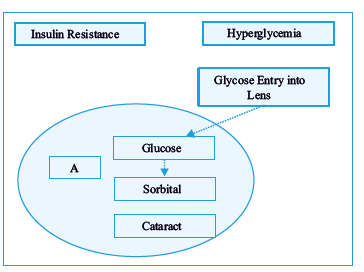
Q. Identify enzyme A
- Sorbitol dehydrogenase
- Sorbitol reductase
- Ketose dehydrogenase
- Aldose reductase
Ans. 4) Aldose reductase
Q. Which of the following is a product of anaerobic glycolysis?
- 2 Pyruvate 10
- 2NAD
- 7 ATP
- 2 ATP
Ans. 4) 2 ATP
Also read: Last 5 Years PYQs INI-CET Biochemistry
Q. All of the following cells are dependent on glycolysis except?
- Neurons
- RBC
- Renal medulla
- Red muscle fibres
Ans. 4) Red muscle fibres
Q. Glucose is trapped inside the cells as
- bD glucopyranose
- UDP glucose
- Glucose 6 phosphate
- Fructose 6 phosphate
Ans. 3) Glucose 6 phosphate
Q. The irreversible steps of glycolysis are all except
- Pyruvate kinase
- Phosphoglycerate kinase
- Hexokinase
- Phosphofructokinase
Ans. 2) Phosphoglycerate kinase
Q. The steps in which oxidative phosphorylation occurs in glycolysis are:
- A. Pyruvate kinase
- B. Phosphoglycerate kinase
- C. PFK
- D. Glyceraldehyde 3 Phosphate Dehydrogenase
Ans. 4) Glyceraldehyde 3 Phosphate Dehydrogenase
Also read: Amino Acid Protein Chemistry
Q. In anaerobic glycolysis, lactate is formed.
- A. For the generation of ATP
- B. For the regeneration of lactate
- C. For the regeneration of pyruvate
- D. For the regeneration of NAD
Ans. 4) For the regeneration of NAD
Q. The significance of Rapoport Leubering Shunt is
- A. ATP production
- B. Lactate formation
- C. Source of fatty acids
- D. 2, 3 BPG production
Ans. 4) 2, 3 BPG production
Q. The enzyme involved in Rapoport Leubering Shunt is
- Phosphoglycerate kinase
- Bisphosphoglycerate kinase
- Bisphosphoglycerate mutase
- Phosphoglycerate mutase
Ans. 3) Bisphosphoglycerate mutase
Q. All the following are examples of oxidative phosphorylation step enzymes except:
- Isocitrate Dehydrogenase
- Alpha Ketoglutarate Dehydrogenase
- Succinyl Thiokinase
- Succinate Dehydrogenase
Ans. 3) Succinyl Thiokinase
Also read: Recombinant DNA Technology
Q. The rate-limiting enzyme of the Citric acid cycle is:
- Isocitrate Dehydrogenase
- Alpha Ketoglutarate Dehydrogenase
- Succinyl Thiokinase
- Succinate Dehydrogenase
Ans. 1) Isocitrate Dehydrogenase
Q. All the following are stimulators of Isocitrate Dehydrogenase except:
- NAD
- FAD
- ATP
- Calcium
Ans. 3) ATP
Q. Oxidative decarboxylation reactions are catalyzed by all, except:
- PDH
- Isocitrate Dehydrogenase
- Alpha Ketoglutarate Dehydrogenase
- Malate Dehydrogenase
Ans. 4) Malate Dehydrogenase
Q. The total number of ATPs produced by the complete oxidation of Pyruvate through the Citric acid cycle:
- 15
- 8
- 12.5
- 32
Ans. 3) 12.5
Q. The total number of ATPs generated during one full cycle of the TCA cycle is:
- 10
- 15
- 8
- 2
Ans. 1) 10
Q. The number of ATPs produced by the complete oxidation of 1 molecule of glucose is:
- 7
- 14
- 22
- 32
Ans. 4) 32
Also read: Properties of Genetic Code Mutation
Q. In 1970, fluoroacetate mixed meat bait was used as a rodent poison in a field, and it was accidentally consumed by a flock of birds. Fluoroacetate inhibits which of the following enzymes:
- Enolase
- Pyruvate Dehydrogenase
- Alpha Ketoglutarate Dehydrogenase
- Aconitase
Ans. 4) Aconitase
Q. In 1970, fluoroacetate mixed meat bait was used as a rodent poison in a field and it was accidentally consumed by a flock of birds. Which of the following statements is true about fluoroacetate's inhibition
of aconitase:
- It is an example of reversible inhibition.
- Fluoroacetate is a substrate analog of aconitase
- Fluoroacetate interacts with aconitase through non-covalent linkages.
- It is an example of competitive Inhibition.
Ans. 2) Fluoroacetate is a substrate analog of aconitase
Q. The organ with maximum glycogen concentration:
- Liver
- Skeletal muscle
- Cardiac muscle
- Neuron
Ans. 1) Liver
Q. The active form of glucose is:
- ß D-Glucopyranose
- α D-Glucopyranose
- UDP glucose
- Glucose 6-phosphate
Ans. 3) UDP glucose
Q. The branching enzyme in glycogen synthesis is:
- α (1,4) → α (1,4) glucan transferase
- α (1,4) → α (1,6) glucan transferase
- α (1,6) → α (1,4) glucan transferase
- α (1,4) → ß (1,4) glucan transferase
Ans. 2) α (1,4) → α (1,6) glucan transferase
Also read: Hartnup Disease and Glycine Metabolic Effects
Q. The enzyme which gets activated by dephosphorylation is:
- Glycogen synthase
- Glycogen phosphorylase
- Fructose 1,6-bisphosphatase
- Hormone sensitive lipase
Ans. 1) Glycogen synthase
Q. Assertion: Muscle glycogenolysis cannot increase blood glucose Reason: Muscle lacks glucose 6-phosphatase
- A. Both assertion and reason are true, and reason is the correct explanation for assertion.
- B. Both assertion and reason are true, and reason is not the correct explanation for assertion.
- C. Assertion is true, but the reason is false.
- D. Assertion is false, but the reason is true.
Ans. 1) Both assertion and reason are true, and reason is the correct explanation for assertion.
Q. Glucagon stimulates:
- A. Liver glycogen phosphorylase
- B. Muscle glycogen phosphorylase
- C. Both
- D. None
Ans. 1) Liver glycogen phosphorylase
Q. Epinephrine stimulates:
- Liver glycogen phosphorylase
- Muscle glycogen phosphorylase
- Both
- None
Ans. 3) Both
Q. Glycogen phosphorylase a is converted to b by:
- Insulin
- Calcium
- cAMP
- Phosphorylase kinase a
Ans. 1) Insulin
Also read: INI-CET High Yield Questions For Biochemistry
Q. The no. of ATP produced from complete oxidation of glucose obtained from muscle glycogenolysis is:
- 32
- 33
- 7
- 8
Ans. 2) 33

Important One-liners
- The transporter responsible for insulin-mediated glucose uptake is GLUT4.
- Glucose uptake along the apical side of the enterocyte is by Secondary active transport or by
- Sodium-Glucose Cotransporter I
- The alcohol responsible for diabetic cataracts is Sorbitol.
- GTP is produced by: Succinyl Thiokinase (liver and kidney)
- Odd chain fatty acids on oxidation forms: Succinyl CoA (majority would be Acetyl CoA plus one Propionyl CoA which enters TCA by forming Succinyl CoA)
- The rate-limiting enzyme of the Citric Acid Cycle is: Isocitrate Dehydrogenase
- The number of ATPs produced in the TCA cycle is: 10.
- Glucose on complete oxidation forms: 32 ATPs
- The rate limiting enzyme of Glycogen synthesis is Glycogen synthase.
- The active form of Glucose is UDP glucose.
- The number of high energy phosphates required for attaching a molecule of glucose is 3.
- The branching enzyme is α (1,4) to α (1,6) glucan transferase.
- The rate limiting enzyme of glycogenolysis is Glycogen phosphorylase.
- Glycogen phosphorylase activated by Phosphorylation.
- The immediate product of glycogenolysis is Glucose 1-phosphate.
- Liver glycogenolysis is stimulated by Glucagon and Epinephrine.
- Muscle glycogenolysis is stimulated by Epinephrine and Calcium.
- Gluconeogenesis occurs in Liver and Kidney
- The rate limiting enzyme of gluconeogenesis is Fructose-1,6-bisphosphatase
- Pyruvate carboxylase is present in Mitochondria
- Microsomal enzyme marker is Glucose-6-phosphatase
- The common allosteric regulator which regulates glycolysis and gluconeogenesis is Fructose-2, 6- bisphosphate
- Fructose-2, 6-bisphosphate is a stimulator of PFK-1 (Glycolysis)
- Fructose-2,6-bisphosphate is an inhibitor of Fructose-1, 6-bisphosphatase (Gluconeogenesis)
- PFK2 activity is stimulated by dephosphorylation.
Also read: Mucopolysaccharides : Exceptions, Important Facts
Download the PrepLadder app now and unlock a 24-hour FREE trial of premium high-yield content. Access Video Lectures, digital notes, QBank, and Mock Tests for FREE to ace your NEET PG preparation. Elevate your study experience and gear up for success. Start your journey with PrepLadder today!

PrepLadder Medical
Get access to all the essential resources required to ace your medical exam Preparation. Stay updated with the latest news and developments in the medical exam, improve your Medical Exam preparation, and turn your dreams into a reality!
Navigate Quickly
Glut Transporters
Important MCQs
Important One-liners
Top searching words
The most popular search terms used by aspirants
- NEET PG Biochemistry
- NEET PG Biochemistry Preparation