Important Questions On Carbohydrate Chemistry
Dec 9, 2025

Explore important questions on carbohydrate chemistry, covering key topics like monosaccharides, disaccharides, polysaccharides, and their biological significance. These questions will help reinforce essential concepts for NEET PG preparation, providing a solid foundation in carbohydrate structure, classification, and metabolic functions critical for medical studies and exams.
Q. How to classify the simple carbohydrate where only carbohydrate units are present?
Ans. The classification of simple carbohydrates is based on the number of carbohydrate units—into three types:
- Monosaccharides— single carbohydrate unit in them
- Oligosaccharides — 2 to 10 units of carbohydrates. E.g., disaccharides
- Polysaccharides — these have more than 11 units of polysaccharides
Q. In glucose, how many functional groups do you find?
Ans. Only one functional group is present in glucose, and that is a monosaccharide. The functional group that presents in glucose is aldehyde. Therefore, glucose is an Aldose.
- Glucose is a hexose → glucose has 6 carbon atoms.
- Quick tips:
- Based on the no. of carbon atoms, glucose is a hexose
- Based on the functional group, glucose is an aldehyde
Q. In fructose, how many functional groups do you find?
Ans. In Fructose, only one functional group is present, that is monosaccharide because it has only one sugar unit. The functional group that is present in fructose is the Ketone group – makes fructose a ketose.
- Quick tips:
- Based on the no. of carbon atoms – 6 carbon atoms – fructose is a hexose
- Based on the functional group, one sugar unit makes it a ketose – ketone group.
- Glucose and fructose share the same molecular formula – C6 H12 O6
Also read: Amino Acid Protein Chemistry
Q. Why are glucose and fructose known as reducing sugars?
Ans.
- Because it has reduced sugar, both have free carbonyl groups.
- Glucose — free carbonyl group in first carbon atom
- Fructose — free carbonyl group in second carbon atom
|
|
Q. Why is sucrose non-reducing?
Ans. Because sucrose is obtained by linking the 1st carbon atom of glucose & the 2nd carbon atom of fructose, the linkage present in sucrose alpha (1,2)
Q. Which one will be the branch among these two?
Ans.
- Storage will be branched – then only it will accommodate more molecules in limited space.
- Structural homopolysaccharides will be unbranched.
Q. Identify the Structure:
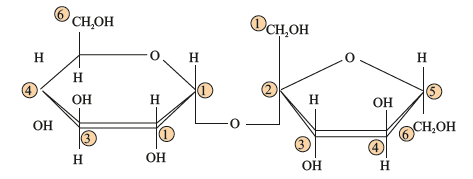
- Sucrose
- Lactose
- Maltose
- Isomaltose
Also Read: Oxidative Phosphorylation & Electron Transport Chain Explained: Steps, Complexes & ATP Formation
Explanation:
How many carbon atoms are in the ring?
- 4 carbon atoms - Fructose
- 5 carbon atoms - Glucose /Mannose /Galactose
How to know which of the three it is?
- Check 2nd & 4th carbon atoms.
- If in both 2nd & 4th carbon atoms, OH lies below the plane, it is Glucose.
- If in the 2nd carbon atom, if OH lies above the plane of the ring, it is Mannose.
- If in the 4th carbon atom, if OH lies above the plane of the ring, it is Galactose.
Q. Which Mucopolysaccharides are present in the glomerular basement membrane?
Ans: Heparan Sulphate
Also read: Recombinant DNA Technology

MCQs on Carbohydrate Chemistry
Q. All the following are trioses except
- Maltotriose
- Glycerose
- Dihydroxyacetone
- Glyceraldehyde
Q. The linkage present in lactose is:
- ɑ (1,4)
- β (1,4)
- ɑ (1,2)
- β (1,2)
Q. The linkage present in isomaltose is:
- ɑ (1,4)
- β (1,4)
- ɑ (1,6)
- β (1,6)
Q. All the following are aldoses except
- Glucose
- Galactose
- Ribose
- Ribulose
Also read: Properties of Genetic Code Mutation
Q. All the following are components of mucopolysaccharides except?
- Uronic acid
- Amino sugar
- Sulphate
- NANA
- NANA (N-Acetylneuraminic acid) is a Component of Glycolipid, specifically ganglioside.
Q. The mucopolysaccharide with galactose is?
- Hyaluronic acid
- Heparin
- Heparan sulphate
- Keratan sulphate
Q. The mucopolysaccharide with glucuronic acid is?
- Hyaluronic acid
- Heparin
- dermatan sulphate
- Heparan sulphate
Also Read: Glycolysis vs Gluconeogenesis: Key Differences, Enzymes & Regulatory Steps Explained
Q. The mucopolysaccharide present in the cornea is?
- Keratan sulphate II
- Heparan sulphate
- Dermatan sulphate
- Keratan sulphate I
Q. The mucopolysaccharide with glucosamine acid is?
- Hyaluronic acid
- Chondroitin sulphate
- Dermatan sulphate
- Keratan sulphate
Also read: Hartnup Disease and Glycine Metabolic Effects
Q. An 18-month-old female child presented with a flat nasal bridge, big lips, macroglossia, gingival hypertrophy, abdominal distension, short stature, and delayed milestones. On the examination, hepatosplenomegaly and an inguinal hernia were observed. Chest X-ray shows cardiomegaly, and Urinary MPS were elevated. WBC L-iduronidase activity was low. Which of the following would accumulate?
- Heparan sulphate
- Keratan sulphate
- Hyaluronic acid
- Chondroitin sulphate
Q. In O-linked glycoproteins, the carbohydrate side chains are attached to which amino acids of the core proteins?
- Serine
- Cysteine
- Asparagine
- Proline
Q. Which of the following is true about proteoglycans?
- They are receptor proteins
- They are uncharged
- They hold excess water
- They have lesser carbohydrate content than glycoproteins
Q. Which of the following is true about glycoproteins?
- The side chains provide them with negative charges.
- They are present in extracellular membranes.
- They hold excess water.
- Plasma proteins are glycoproteins.
Q. Glucose and fructose are examples of ?
A. Optical isomerism
B. Functional isomerism
C. Stereoisomerism
D. Epimerism
Q. Ribose and arabinose are examples of ?
- Optical isomerism
- Diastereoisomerism
- Enantiomerism
- Epimerism
Q. Ribose and Xylose are examples of ?
- Optical isomerism
- Diastereoisomerism
- Enantiomerism
- Epimerism
Q. D- Glucose and L- Glucose are examples of ?
- Optical isomerism
- Diastereoisomerism
- Enantiomerism
- Epimerism
Also read: Mucopolysaccharides : Exceptions, Important Facts
Q. An intern lab technician prepared a fresh glucose solution (100mg/dL). She estimated the concentration of the same using the glucose oxidase peroxidase method and found the concentration to be 10mg/dL. The probable cause is:
- The glucose oxidase used was ineffective.
- The weighing balance is defective.
- Glucose oxidase acts only on the beta form.
- Glucose oxidase acts only on the alpha form.
Q. All the following answer Benedict's test positively except?
- Ribose
- Vitamin C
- Homogentisic acid
- Trehalose
Explanation: Ribose is a pentose, Vitamin C is an antioxidant, and Homogentisic acid is a reducing substance. All three answer Benedict's test, whereas Trehalose is a non-reducing disaccharide made of 2 residues of Glucose (a1-1 linkage).
Q. Barfoed's test is not answered by?
- Maltose
- Glucose
- Fructose
- Ribose
Explanation: Maltose is a disaccharide made of 2 glucose residues with a 1-4 linkage.
Q. Foulger's test is not answered by?
- Erythrose
- Ribulose
- Fructose
- Sedoheptulose
Explanation: Foulger's test is positive for ketose, whereas erythrose is an aldose.
Also read: All About Vitamins - Important Information and Diseases
Image Based MCQ
Q. Identify the structure.
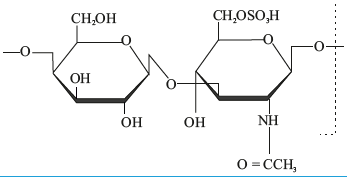
- Heparan sulphate
- Chondroitin sulphate
- Dermatan sulphate
- Keratan sulphate
Q. Identify the Image
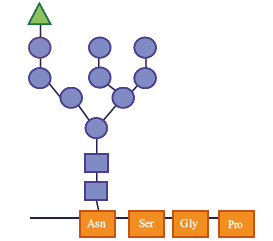
- N-linked Glycoprotein
- O -linked Glycoprotein
- Proteoglycan
- GPI anchored Glycoprotein
Q. Identify the structure.
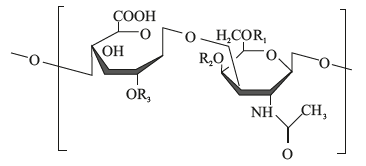
A. Heparan sulphate
B. Chondroitin sulphate
C. Dermatan sulphate
D. Keratan sulphate
Q. A person gives her urine sample for the routine screening test. Benedict's test result is as follows. All of the following can be a cause except.
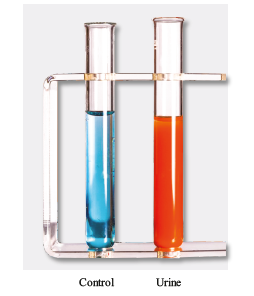
- Multiple Myeloma
- Pregnancy
- Fanconi's syndrome
- Galactosemia
Explanation: Multiple Myeloma is plasma cell neoplasia, the monoclonal proliferation of plasma cells and excess production of antibodies, a disproportionate product of light chains. In this case, light chains will be excreted through urine, called Bence Jones protein (non-reducing)
Also read: Heme Synthesis Disorders
Q. A person's urine answers Benedict's test. The biochemist runs a battery of urine tests to detect the reducing sugar present in urine. Based on the images provided below find out the substance found in urine. Which of the following is the most probable cause?
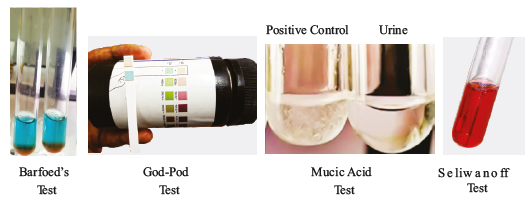
- Diabetes Mellitus
- Fructosuria
- Fanconi's syndrome
- Galactosemia
Q. Name a chemical that inhibits the enzyme, which is shown in the red square in the given picture.

- Iodoacetate
- Arsenate
- Arsenite
- Fluoride
Explanation
- It is related to the 9th step of glycolysis.
- This step is catalysed by enolase to remove water molecules.
- Fluoride inhibits enolase.
Q. Enzymes 1,2,3 are:

- Propionyl CoA carboxylase, Methyl Malonyl CoA Mutase, Methyl Malonyl CoA racemase
- Propionyl CoA Mutase, Methyl Malonyl CoA Mutase, Methyl Malonyl CoA racemase
- Propionyl CoA Mutase, Methyl Malonyl CoA racemase, Methyl Malonyl CoA Mutase
- Propionyl CoA carboxylase, Methyl malonyl CoA racemase, Methyl malonyl CoA mutase
Q. Identify the enzyme A marked in the image:

- Hexokinase
- Glucokinase
- Glycogen synthase
- Glycogen phosphorylase
Q. Identify the enzyme A marked in the image:

- α (1,4) → α (1,6) glucan transferase
- α (1,4) → α (1,4) glucan transferase
- α (1,6) → α (1,4) glucan transferase
- α (1,6) → α (1,6) glucan transferase

Integrated Clinical Case-Based MCQS
Q. A 21-year-old man presents with diarrhea, bloating, flatulence, and frothy stools every time he consumes milk and ghee butter. The probable enzyme detects in this condition is:
- Aldolase B
- Fructokinase
- Galactose-1-phosphate uridyl Transferase
- Lactase
Q. Neonate presents with diarrhea, incessant cry, and frothy stools. Perianal rashes are prominent. The neonate responded well when the child was given rice porridge. What is the test that can be performed to diagnose this condition?
- Schilling's test
- Guthrie's test
- Methane Breath test
- Stool acidity
Q. A 45-year-old man presents with multiple joints pain, intervertebral disc bulges, and prolapses. On enquiry, he gives a history of urine turning dark on standing. Which of the following screening tests will be positive in the condition?
- Ferric Chloride test
- Guthrie's test
- Cyanide nitroprusside test
- Benedict's test
Explanation:
- Urine turning dark indicates alkaptonuria (alkapton means black)
- Ferric chloride test and Guthrie's test is a screening test for Phenylketonuria.
- Cyanide nitroprusside test is done to detect Homocystinuria.
Also read: Glycogen Storage Diseases
Q. A neonate presented with hemolytic anaemia. A peripheral smear revealed that it's a case of nonspherocytic hemolytic anemia. Pyruvate kinase activity was remarkably low (0.675 U/g Hb). Which of the following explains haemolytic anaemia in this condition?
- High 2,3 BPG production
- Low 2,3 BPG production
- High ATP production
- Failure of Sodium Potassium ATPase pump
Explanation:
Hemolytic Anaemia falls into
- G3PD deficiency (classical history)
- Hemolytic anaemia following exposure to oxidative stress.
- Examples
- After intake of Primaquine.
- After intake of fava beans.
- Glycolytic enzyme defect
- Skeletal muscles are involved.
- Represented by.
- Increased levels of CK MM.
- Intolerance to anaerobic exercises.
Q. A 4-month-old baby visited the OPD with abnormal LFTs. There were no neurologic symptoms or signs. Abdominal ultrasound showed hepatosplenomegaly with periportal thickening and ascites. Transthoracic echocardiogram revealed no abnormal findings. A liver biopsy was performed, revealing micronodular cirrhosis with marked intracytoplasmic glycogen deposits. He was diagnosed with a defect of branching enzymes. The name of the disorder is:
- Cori's disease
- Anderson's disease
- McArdle's disease
- Tarui's disease
Explanation:
AB: Branching enzyme - Anderson's disease
CD: Debranching enzyme - Cori's disease
Q. A neonate presents hypoglycemia and elevation of CK MM. Hence the IEM suspects debranching enzyme defects. The name of the disorder is:
- Cori's disease
- Anderson's disease
- McArdle's disease
- Tarui's disease
Q. A 19 year old boy is influenced by Sylvester Stallone's "Rocky" body and consumes 6 raw eggs every day. On one of those days, he suddenly complained of giddiness, palpitation and sweating and was taken to the ER. His capillary plasma glucose was 50 mg/dL. Name the enzyme, low activity of which is the explanation for hypoglycemia in this condition. What would be expected to be elevated in this person's blood?
- Acetyl CoA carboxylase, methyl malonyl CoA
- Acyl CoA dehydrogenase, Propionyl CoA
- Pyruvate Carboxylase, Methyl Malonyl CoA
- Pyruvate carboxylase, Propionyl CoA
Explanation:
- Person is suffering with hypoglycemia (50 mg/dL) (counter regulatory hormones released:
- glucagon, growth hormone, norepinephrine, cortisol)
- Raw egg has avidin that has more affinity for biotin (biotin malabsorption)
- Biotin is a coenzyme for carboxylases (pyruvate carboxylase)
- In biotin deficiency pyruvate carboxylase will be inactive and result in hypoglycemia.
- Other enzymes dependent on biotin: propionyl carboxylase. Accumulation of propionyl CoA in case of deficiency.
One Liners
- Glucose and fructose are functional isomers.
- Inulin is a homopolysaccharide made up of fructose.
- Chitin is made up of N- Acetyl Glucosamine.
- Non-reducing disaccharides are sucrose and trehalose.
- In starch, amylose is unbranched, and amylopectin is branched.
- The Mucopolysaccharide with galactose is Keratan sulphate
- Mucopolysaccharide with Iduronic acid are Heparan sulphate and Dermatan sulphate.
- Mucopolysaccharides with galactosamine are Chondroitin sulphate and Dermatan sulphate.
- The Mucopolysaccharide present in the Glomerular Basement membrane is Heparan sulphate.
- The urine test to detect the presence of a reducing substance is Benedict's test.
- The test done to detect the presence of reducing monosaccharides is Barfoed's test.
- Galactose can be detected by the Mucic Acid test.
- Seliwanoff's test is answered by ketoses (urine sugar- fructose).
- Bial's test is answered by pentoses.
Also Read: Amino Acid Protein Chemistry
Download the PrepLadder app now and unlock a 24-hour FREE trial of premium high-yield content. Access Video Lectures, digital notes, QBank, and Mock Tests for FREE to ace your NEET PG preparation. Elevate your study experience and gear up for success. Start your journey with PrepLadder today!

PrepLadder Medical
Get access to all the essential resources required to ace your medical exam Preparation. Stay updated with the latest news and developments in the medical exam, improve your Medical Exam preparation, and turn your dreams into a reality!
Navigate Quickly
MCQs on Carbohydrate Chemistry
Q. All the following are components of mucopolysaccharides except?
Q. The mucopolysaccharide present in the cornea is?
Q. Which of the following is true about glycoproteins?
Image Based MCQ
Q. Name a chemical that inhibits the enzyme, which is shown in the red square in the given picture.
Q. Enzymes 1,2,3 are:
Q. Identify the enzyme A marked in the image:
Q. Identify the enzyme A marked in the image:
Integrated Clinical Case-Based MCQS
Q. A 45-year-old man presents with multiple joints pain, intervertebral disc bulges, and prolapses. On enquiry, he gives a history of urine turning dark on standing. Which of the following screening tests will be positive in the condition?
Q. A neonate presented with hemolytic anaemia. A peripheral smear revealed that it's a case of nonspherocytic hemolytic anemia. Pyruvate kinase activity was remarkably low (0.675 U/g Hb). Which of the following explains haemolytic anaemia in this condition?
Q. A 4-month-old baby visited the OPD with abnormal LFTs. There were no neurologic symptoms or signs. Abdominal ultrasound showed hepatosplenomegaly with periportal thickening and ascites. Transthoracic echocardiogram revealed no abnormal findings. A liver biopsy was performed, revealing micronodular cirrhosis with marked intracytoplasmic glycogen deposits. He was diagnosed with a defect of branching enzymes. The name of the disorder is:
Q. A neonate presents hypoglycemia and elevation of CK MM. Hence the IEM suspects debranching enzyme defects. The name of the disorder is:
Q. A 19 year old boy is influenced by Sylvester Stallone's "Rocky" body and consumes 6 raw eggs every day. On one of those days, he suddenly complained of giddiness, palpitation and sweating and was taken to the ER. His capillary plasma glucose was 50 mg/dL. Name the enzyme, low activity of which is the explanation for hypoglycemia in this condition. What would be expected to be elevated in this person's blood?
One Liners
Top searching words
The most popular search terms used by aspirants
- NEET PG Biochemistry