Lipid Metabolism Important Questions NEET PG 2026
Jun 20, 2025

Q. Why do we say a carbohydrate-rich diet is lipogenic?
Ans. A carbohydrate-rich diet will provide the fuel that will get converted to fat. Insulin is released and stimulates all the phases of fatty acid synthesis.
Q. What is the basis of a ketogenic diet?
Ans. It is based on a zero-carbohydrate high-fatty diet. You do not have glucose which is a precursor and without insulin no anabolism. A high-fat diet causes high availability of acyl coA, and this endogenous fatty acid synthesis is suppressed. So, taking in polyunsaturated fatty acid suppresses it.
Q. The difference between mitochondrial oxidation and peroxisomal oxidation.
Ans. When oxidation happens in Mitochondria, we remove the hydrogen atom from ꞵ carbon atom and give it to NAD and FAD, which further forms NADH and FADH2. When NADH and FADH2 go through an electron transfer chain, they give rise to ATP. When oxidation happens in the peroxisome, we remove the hydrogen atom from ꞵ carbon atom and give it to the oxygen
Molecule. This then forms hydrogen peroxide (H2 O2 ). To detoxify hydrogen peroxide, the peroxisome is equipped with catalase enzymes.
Q. Where does fatty acid get oxidized?
Ans. Mitochondria
Q. How many carbon atoms are there in acetyl CoA.
Ans. There are two carbon atoms. If there is n carbon containing fatty acid which undergoes ꞵ oxidation will always give n/2 Acetyl CoA because acetyl CoA contains 2 Carbon atoms. Product of ꞵ oxidation of fatty acid is always acetyl-CoA molecules. Peroxisome - the hydrogen peroxide generation due to ꞵ oxidation is peroxisome
Q. The difference between mitochondrial oxidation and peroxisomal oxidation.
Ans. When oxidation happens in Mitochondria, we remove the hydrogen atom from ꞵ carbon atom and give it to NAD and FAD, which further forms NADH and FADH2. When NADH and FADH2 go through an electron transfer chain, they give rise to ATP. When oxidation happens in the peroxisome, we remove the hydrogen atom from ꞵ carbon atom and give it to the oxygen molecule. This then forms hydrogen peroxide (H2 O2 ). To detoxify hydrogen peroxide, the peroxisome is equipped with catalase enzymes.
Q. Will you oxidize the fatty acid if the cell's energy status is already high?
Ans. No we will store the fatty acid in Triacylglycerol or cholesterol ester for further use.
Q. Will you oxidize the fatty acid if the cell's energy status is low?
Ans. Yes, then the fatty acid must be oxidized.
Q.Which carrier carries fatty acid across the inner mitochondrial membrane?
Ans. Carnitine
Q. How is carnitine acyl transferase 1 linked to an increase in blood glucose?
Ans: Gluconeogenesis increases blood glucose. Fatty acid oxidation is mandatory for gluconeogenesis, which is why glucagon stimulates carnitine acyl transferase 1.
Q. When are ketone bodies produced?
Ans. During starvation or hypoglycemia
Q. Why is ketosis in starvation or hypoglycemia? Give any three reasons.
Ans.
- Excessive peripheral lipolysis
- Excessive fatty acid oxidation
- Low availability of oxaloacetate
Q. What is the primary ketone body?
Ans. Acetoacetate
Q. What is the rate-limiting enzyme of ketone body synthesis?
Ans. HMG CoA lyase and HMG CoA Synthase
Q. Why can't the liver use ketone bodies?
Ans. Because it lacks an enzyme which is thiophorase.
Q. Why does ketone body synthesis?
Ans. Because acetyl CoA cannot go into the citric acid cycle. Odd chain fatty acid oxidation will give rise to propionyl CoA then, which will get converted into succinyl CoA then, which will go into the citric acid cycle and then it forms oxaloacetate with the help of succinyl thiokinase.
Q. Do we want a special transport system for lipids alone?
Ans.
- Lipids are nonpolar and immiscible in blood.
- Lipids float in blood and coalesce to form very large drops.
- Thereby, these large drops clog to small capillaries
- Amphipathic substance is used to transport any non-polar substance in a polar medium.
- Amphipathic substances contain both polar and nonpolar groups.
- Polar groups face to the exterior and help to be miscible in the polar medium.
- While nonpolar groups face the interior and help in holding the non-polar lipids within themselves.
Q. What are the functions of apoproteins?
Ans. They act as ligands for receptors.
Example
- Apo E which is accepted by remnant receptors.
- ApoB 100 is accepted by LDL receptors.
Q. Why do we call HDL as good cholesterol and LDL as bad cholesterol?
Ans. HDL reverses atherosclerotic changes in extrahepatic tissues as it collects phospholipids and cholesterol ester from extrahepatic tissues and dumps it in the liver.

Important MCQs
Q. The precursor of fatty acid is
A. Propionyl CoA
B. Malonyl CoA
C. Acetyl CoA
D. Methyl malonyl CoA
Ans. Acetyl CoA
Q. All the following are fates of acetyl CoA except
A. Co2
B. Ketone body
C. Cholesterol
D. Glucose
Ans. Glucose
Q. The rate-limiting enzyme of fatty acid synthesis is
A. HMG CoA reductase
B. HMG CoA Lyase
C. Acetyl CoA carboxylase
D. 7 alpha hydroxylases
Ans. Acetyl CoA carboxylase
Q. All the following are requirements of acetyl CoA carboxylase except
A. Bicarbonate
B. Biotin
C. ATP
D. NADH
Ans. NADH
Q. All are true about fatty acid synthesis except
A. It is dimer.
B. Acetyl CoA carboxylase is the first enzyme of the complex.
C. Pantothenic acid is a component of the enzyme.
D. It has 7 enzymes in each unit.
Ans. Acetyl CoA carboxylase is the first enzyme of the complex.
Q. The most synthesized fatty acid by fatty acid synthase complex is
A. Linoleic acid
b. Palmitic acid
C. Arachidoic acid
D. Stearic acid
Ans. Palmitic acid
Q. Lipogenic is stimulated by all except.
A. High fatty diet
B. High glucose diet
C. High fructose-based diet
D. Insulin
Ans. High fatty diet
Q. A 19-year-old moderately obese girl presents with menstrual irregularities. She is diagnosed with polycystic ovarian syndrome and is prescribed metformin. Metformin helps in avoiding weight gain because it inhibits it.
A. Complex II
B. ATP synthesis
C. Acetyl CoA carboxylase
D. Insulin
Ans. Acetyl CoA carboxylase
Q. Identify the enzyme A.
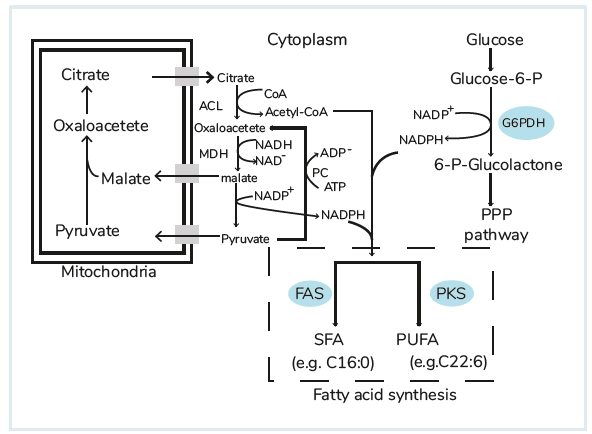
A. Malate dehydrogenase
B. SGOT
C. SGPT
D. Malic enzyme
Ans. Malic enzyme
Q. Rate limiting enzyme of fatty acid oxidation.
A. Carnitine acyl transferase I
B. Carnitine acyltransferase II
C. Acyl CoA dehydrogenase
D. Thiolase
Ans. Carnitine acyl transferase I
Q. How many cycles of ꞵ oxidation does palmitic acid go through
A. 7
B. 8
C. 9
D. 16
Ans. 7
Q. CPT1 is activated by all,except
A. Acyl CoA
B. Malonyl CoA
C. High ADP/ATP ratio
D. Glucagon
Ans. Malonyl CoA
Q. Number of ATP generated in the liver by complete oxidation of palmitate
A. 106
B. 33
C. 26
D. 16
Ans. 106
Q. Number of ATP generated in the liver by complete oxidation of stearic acid.
A. 106
B. 120
C. 26
D. 16
Ans. 120
Q. Ketosis is observed in diabetes because of:
A. Low availability of oxaloacetate
B. Excess oxaloacetate
C. Low energy
D. Low fatty acid oxidation
Ans. Low availability of oxaloacetate
Q. Fatty acid oxidation defects present with all except:
A. Hypoglycemia
B. Ketosis
C. Hyperammonemia
D. Dicarboxylic aciduria
Ans. Ketosis
Q. The main function of lipoprotein is to
A. Activate fatty acid synthesis.
B. Transport lipids to kidney for excretion
C. Stimulate lipolysis.
D. Transport lipids in blood between tissues
Ans. Transport lipids in blood between tissues
Q. Apo A1 activates.
A. Lipoprotein lipase
B. Lecithin Cholesterol Acyl Transferase
C. Hormone Sensitive Lipase
D. LRP
Ans. Lecithin Cholesterol Acyl Transferase
Q. Apo C2 activates.
A. Lipoprotein Lipase
B. Lecithin Cholesterol Acyl Transferase
C. Hormone Sensitive Lipase
D. LRP
Ans. Lipoprotein Lipase
Q. Chylomicron transports triacylglycerol from intestine to
A. Liver
B. Kidney
C. Extrahepatic tissues
D. Brain
Ans. Extrahepatic tissues
Q. The apoprotein which activates Lipoprotein lipase is
A. Apo B48
B. Apo B100
C. Apo C2
D. Apo A1
Ans. Apo C2
Q. The apoprotein present in nascent chylomicron is
A. Apo B100
B. Apo B48
C. Apo C2
D. Apo E
Ans. Apo B48
Download the PrepLadder App and get the best NEET PG online coaching with world-class video lectures also in हिंglish, QBank, Mock Tests and more!
Download PrepLadder's best app for neet pg preparation for Android
Download PrepLadder's best app for neet pg preparation for ios

PrepLadder Medical
Get access to all the essential resources required to ace your medical exam Preparation. Stay updated with the latest news and developments in the medical exam, improve your Medical Exam preparation, and turn your dreams into a reality!
Navigate Quickly
Important MCQs
Q. The precursor of fatty acid is
Q. All the following are fates of acetyl CoA except
Q. The rate-limiting enzyme of fatty acid synthesis is
Q. All the following are requirements of acetyl CoA carboxylase except
Q. All are true about fatty acid synthesis except
Q. The most synthesized fatty acid by fatty acid synthase complex is
Q. Lipogenic is stimulated by all except.
Q. A 19-year-old moderately obese girl presents with menstrual irregularities. She is diagnosed with polycystic ovarian syndrome and is prescribed metformin. Metformin helps in avoiding weight gain because it inhibits it.
Q. Identify the enzyme A.
Q. Rate limiting enzyme of fatty acid oxidation.
Q. How many cycles of ꞵ oxidation does palmitic acid go through
Q. CPT1 is activated by all,except
Q. Number of ATP generated in the liver by complete oxidation of palmitate
Q. Number of ATP generated in the liver by complete oxidation of stearic acid.
Q. Ketosis is observed in diabetes because of:
Q. Fatty acid oxidation defects present with all except:
Q. The main function of lipoprotein is to
Q. Apo A1 activates.
Q. Apo C2 activates.
Q. Chylomicron transports triacylglycerol from intestine to
Q. The apoprotein which activates Lipoprotein lipase is
Q. The apoprotein present in nascent chylomicron is
Top searching words
The most popular search terms used by aspirants
- NEET PG Biochemistry Preparation