Rapid Revision Reignite Pharmacology: Question-Answer Format
Sep 24, 2025

General Pharmacology
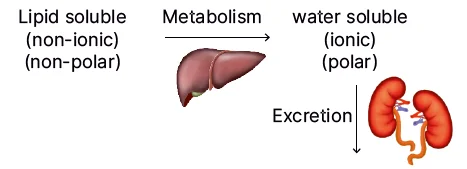
Big Question 1: What are the primary objectives of drug metabolism and the principal organ involved, and how does this process facilitate drug excretion?
Broad Answer: Drug metabolism primarily involves converting lipid-soluble/non-ionic compounds into water-soluble, ionic forms. The liver is the most common organ where this transformation occurs, which is crucial as water-soluble forms are then readily excreted from the body, predominantly via the kidneys through urine.
Detailed Questions
Q1.1: What is the main objective of drug metabolism, and which organ is most commonly involved in this process?
Answer:
- Converting lipid soluble/non-ionic/non-polar drug into water-soluble/ionic/polar form
- Liver is the most common organ of metabolism.
Q1.2: How do water-soluble drug forms facilitate elimination from the body, and what is the most common route of drug excretion?
Answer: Water soluble forms are easily excreted out of the body through saliva/urine/sweat. Most common route of Excretion - Urine by kidneys.
Q1.3 Describe the Activity of drug after metabolism with examples.
|
Examples of active drug to another active drug |
Examples of prodrug to active drug |
|
→ Treatment of Rheumatoid arthritis
→ Treatment of UC (ulcerative colitis)
|
Q1.4: Which ACE inhibitors are not prodrugs?
Answer:
- Captopril
- Lisinopril
Q1.5: Describe hepatic drug metabolism and phase reaction?
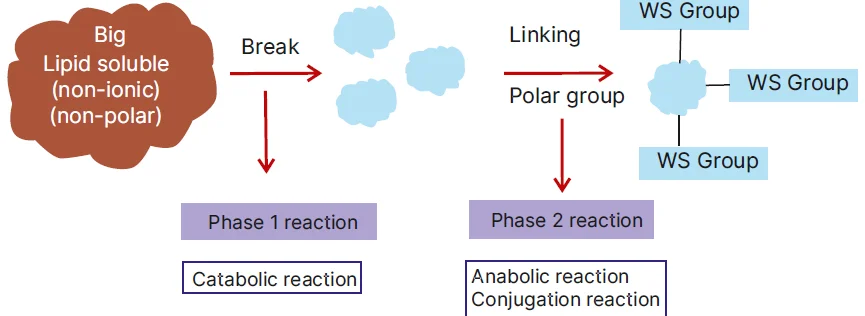
Answer: Hepatic (liver) metabolism transforms drugs into more water-soluble forms for excretion, mainly via urine or bile. It occurs in two phases: 2 chemical reactions are carried out
| - |
Phase 1 reaction |
Phase 2 reaction |
|
Activity of the drug |
|
|
|
Type of reaction |
|
|
|
Most common reaction |
Most drugs undergo oxidation and reduction |
Most drugs undergo Glucuronide conjugation |
|
Site of reaction |
|
|
Q1.6: What are the key characteristics of Cytochrome P450 enzymes?
Answer:
- Contains heme pigment
- Shows genetic variation/polymorphism in high/low amount
Q1.7: What are CYP enzyme inducers and inhibitors?
Answer:
| Category | Mnemonic | Drugs |
| CYP Enzyme Inducers | GRASS | Griseofulvin Rifampicin Alcohol (chronic) All antiepileptics (except valproate): Phenobarbitone Phenytoin Carbamazepine Smoking St John's Wort (plant product) |
| CYP Enzyme Inhibitors | COKE IVC GAR | Cimetidine Omeprazole Ketoconazole Erythromycin Isoniazid : Inhibits all CYP types, Except CYP2E1 which it induces Valproate Ciprofloxacin Grape-fruit juice Alcohol (acute) Ritonavir (HIV) |
Q1.8: Describe the Types of CYP and their substrates.
Answer:
|
CYP type |
Substrate (drugs metabolized by CYP) |
|
CYP1A2 |
Theophylline, Clozapine |
|
CYP2C9 (earlier known as CYP2C8)
|
Phenytoin, Warfarin
|
|
CYP2C19 |
|
|
CYP2D6 |
|
|
CYP2E1 |
|
|
CYP3A4 (maximum quantity in our body)
|
Most drugs are metabolized
|

Central Nervous System
Big Question 2: What are Atypical Benzodiazepines?
Broad Answer:
- Atypical benzodiazepines are drugs that act on benzodiazepine receptors (BZ1/BZ2 on GABA-A) but are structurally different from classical benzodiazepines.
- AKA Z drugs
Detailed Questions
Q2.1: What is the difference between normal and atypical Benzodiazepines?
Answer:
| Normal Benzodiazepines | Atypical benzodiazepine |
| Act on alpha and gamma subunits of GABA A receptors Alpha (a) 1: Produce sedation, used to treat insomnia Alpha (a) 2: Muscle relaxant, used to treat seizures | Act on alpha (a) 1 gamma (g) subunit Produce sedation-Treat insomnia Lack of muscle relaxant effect and anti-seizure activity |
Q2.2: What are the drugs included under atypical Benzodiazepines?
Answer:
- Zopiclone: Longest acting
- Zolpidem
- Zaleplon: Shortest acting
- Less sleep cycle distortion
Q2.3: What is the main use of atypical benzodiazepines?
Answer:
- Atypical Benzodiazepines are DOC in the treatment of Insomnia
- Chronic insomnia
- Transient insomnia
- Sleep onset insomnia
Q2.4: What is the DOC in treating Jet lag?
Answer: Ramelton is DOC in treating Jet lag, but atypical Benzodiazepines are also used. (off label use)
Q2.5: What are the side effects of atypical Benzodiazepines and what is the antidote used in its poisoning?
Answer:
- Side effect: Highly addictive
- Poisoning: Flumazenil (Antidote)
- Blocks alpha-gamma junction
Q2.6: What are the adverse effects of Barbiturates?
Answer:
- Barbiturates distort the sleep cycle (Not used in insomnia)
- Nightmare/night tremors
- Hangover
Big Question 3: What are the properties, mechanisms, uses and adverse effects of anti-epileptic drugs?
Broad Answer: Anti-epileptic drugs (AEDs) are a diverse group of drugs used to prevent or control seizures in patients with epilepsy or other seizure-related conditions. They act by inhibiting depolarization of neurons.
Detailed Questions
Q3.1: What are the first-line drugs used in the treatment of various types of epilepsy?
Answer:
| GTCS (Grand mal epilepsy) | V/L |
| Absence (Petit mal epilepsy) EEG: 3Hz wave spike pattern | E/V/L |
| Atypical absence Myoclonic Atonic Tonic seizures | V/L/T |
| Focal seizures | LOCPL |
- V: Valproate
- L: Lamotrigine
- E: Ethosuximide
- T: Topiramate
- O: Oxcarbazepine/Eslicarbazepine
- C: Carbamazepine
- P: Phenytoin
- L: Levetiracetam

Autacoids
Big Question 4: What are the roles, preparations, and clinical uses of prostaglandins?
Broad Answer: Autacoids are local hormones that produce local effects and include prostaglandins, leukotrienes, and other locally acting agents. Prostaglandins are a major class of autacoids that mediate inflammation, smooth muscle tone, and reproductive functions. Their synthetic analogs are clinically used in abortions, ductus arteriosus management, glaucoma, peptic ulcers, and pulmonary hypertension. The section also covers uterine stimulants and relaxants (tocolytics), along with prostaglandin synthesis pathways and medical abortion protocols. Understanding their mechanisms and applications is essential for therapeutic decision-making.
Detailed Questions
Q4.1: What are autacoids, and what kind of effects do they produce?
Answer: Autocoids are local hormones that produce local effects.
Q4.2: What are the synthetic preparations of prostaglandins and their clinical uses?
Answer:
|
Prostaglandins |
Synthetic Preparation |
|
PGE1 |
|
| - |
|
| - |
|
|
PGE2 |
|
|
PGF2 Alpha |
|
| - |
|
| - |
|
|
PGI2 (Prostacyclin)
|
|
Q4.3: What are the effects of prostaglandins on the uterus?
Answer:
| Uterine Stimulant | Uterine Relaxant (Tocolytics) |
| Oxytocin DOC: Induction and augment labour DOC: controls PPH Carbetocin: Longer-acting alternative of oxytocin. To control PPH in oxytocin resistance cases Contraindicated the induction of the labour as it can lead to fetal hypoxia ● Carboprost (PGF-2 alpha drugs) ● Ergometrine ● Methyl ergometrine | Used in premature labour Atosiban: Blocks oxytocin receptor -Safe for heart disease patients. Beta (b)-2 agonists: Ritodrine, isoxsuprine CCB: Nifedipine GA with maximum tocolytic effect: Halothane Avoid NSAIDS during labour pain: Due to tocolytic effects as it days child delivery |
Endocrine System
Big Question 5: What are the additional drugs used in Diabetes Mellitus beyond traditional hypoglycemics, their mechanisms, and the pharmacological management of diabetic complications?
Broad Answer: Several non-traditional drugs and specific therapies are used in diabetes mellitus to target complications or complement glycemic control:
- Colesevelam
- Bromocriptine
- Epalrestat
- Imeglimin
Detailed Questions
Q5.1. What are the additional oral drugs used in diabetes and their mechanisms?
Answer:
| Drug | Class/Mechanism | Notes |
| Colesevelam | Bile acid-binding resin → ↓ glucose absorption from GIT | Also used for hyperlipidemia |
| Bromocriptine | Dopamine D2 receptor agonist (hypothalamic-pituitary axis) | Taken early morning (< 3 hrs of waking) |
| Epalrestat | Aldose reductase inhibitor → ↓ conversion of glucose to sorbitol | Used in diabetic neuropathy |
| Imeglimin | Inhibits hepatic gluconeogenesis | Newer agent |
Q5.2. What are the drug treatments for specific diabetic complications?
Answer:
| Diabetic Complication | Treatment Drug | Mechanism / Use |
| Gastroparesis | Erythromycin | Stimulates motilin receptors in the stomach |
| Diabetic diarrhea | Clonidine | Stimulates α2a receptors in intestine |
| Diabetic retinopathy | Anti-VEGF agents: Bevacizumab, Ranibizumab, Aflibercept, Pegaptanib | Inhibit neovascularization via intravitreal injection |
| Diabetic neuropathy | Pregabalin | DOC for neuropathic pain |
| Anti-obesity in DM | Liraglutide, Semaglutide, Tirzepatide | GLP-1 analogues or dual agonists (GLP-1 + GIP) |
Q5.3. Which antidiabetic drugs are associated with an increased risk of fractures?
Answer:
- Canagliflozin
- Dapagliflozin
- Pioglitazone
Q5.4. Which drugs used in diabetes mellitus are known to cause hypoglycaemia?
Answer:
- Insulin
- Sulfonylureas
- Meglitinides
Q5.5. Which antidiabetic drug is associated with megaloblastic anaemia and lactic acidosis?
Answer:
- Metformin
- Causes ↓ Vitamin B12 absorption → Megaloblastic anemia
- Risk of lactic acidosis, especially in renal failure
If you’re looking to strengthen your final prep, don’t miss out on Rapid Revision Reignite in Question-Answer format by PrepLadder. It’s designed to help Medical PG aspirants cover the entire syllabus quickly with concise notes in a Question-Answer format, high-yield MCQs, and expert-led revision videos—perfect for last-minute reinforcement before the exam.
Download the PrepLadder app now and unlock a 24-hour FREE trial of premium high-yield content. Access Smarter Video Lectures also in हिंglish, Game Changing Qbank, Audio QBank, Structured Notes, Treasures, Mock test for FREE to excel in your NEET PG preparation. Elevate your study experience and gear up for success. Start your journey with PrepLadder today!

PrepLadder Medical
Get access to all the essential resources required to ace your medical exam Preparation. Stay updated with the latest news and developments in the medical exam, improve your Medical Exam preparation, and turn your dreams into a reality!
Navigate Quickly
General Pharmacology
Detailed Questions
Central Nervous System
Detailed Questions
Autacoids
Detailed Questions
Endocrine System
Detailed Questions
Top searching words
The most popular search terms used by aspirants
- NEET PG Pharmacology
- NEET PG Pharmacology Preparation
- NEET PG Preparation
- Rapid Revision