How to Create and Use a Mistake Notebook for NEET PG
Aug 10, 2026
Every NEET PG aspirant spends months studying standard resources, solving thousands of MCQs, revising notes, practising from QBank, and attempting Grand Tests (GTs). Yet even after extensive preparation, certain mistakes tend to recur.
Sometimes, you forget a fact you had already revised. Sometimes, two similar conditions get mixed up. At other times, you know the correct answer but misread a word such as except, incorrect, or most appropriate.
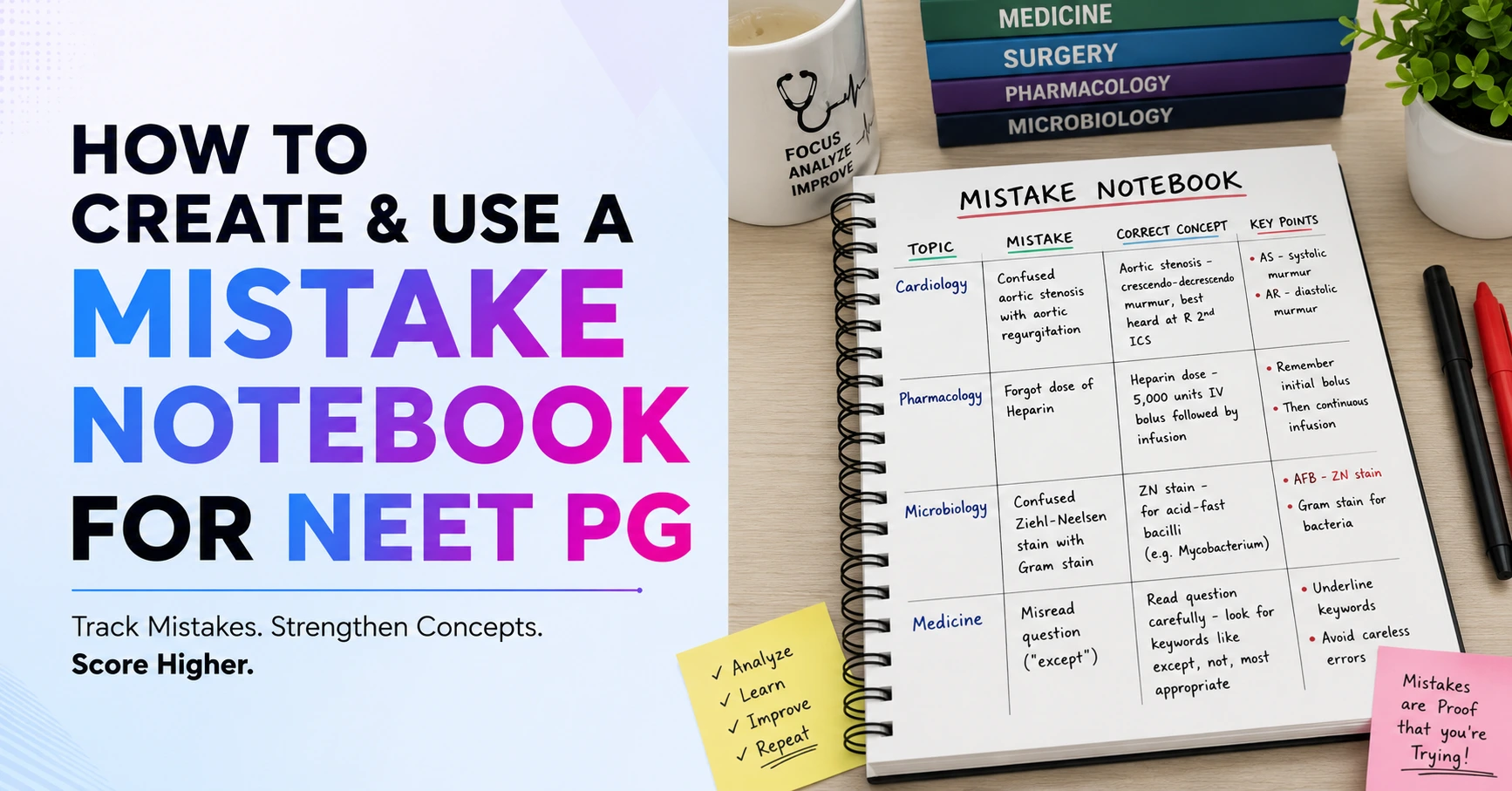
A mistake notebook for NEET PG is a personalized revision resource in which you record important learning points from repeated errors, incorrect MCQs, Grand Tests, QBank sessions, and commonly confused concepts.
Its purpose is not to collect every wrong answer. Instead, it helps you identify what you repeatedly forget, misunderstand, confuse, or misinterpret so that these areas can be revised more efficiently.
A well-maintained mistake notebook is therefore much more than a record of incorrect answers. It highlights conceptual gaps, memory lapses, confusing topics, misread questions, calculation errors, image-interpretation mistakes, and other patterns that may affect your accuracy.
Most importantly, it converts every meaningful error into something you can revise.
When analysing a Grand Test, simply checking the score is rarely enough. The greater learning opportunity lies in understanding why a question went wrong. Was the concept unclear? Did you forget a fact? Did you confuse two similar options? Or did you rush through a question you actually knew?
Recording only the most useful takeaway from such mistakes gradually creates a highly personalized revision resource.
This becomes especially valuable during the final month before NEET PG. At that stage, when rapid revision takes priority, revisiting an entire book for every weak topic may not be practical.
A mistake notebook lets you quickly return to frequently forgotten facts, confusing differentials, formulas, image-based concepts, clinical pearls, and other areas where you personally tend to lose marks.

Why Every NEET PG Aspirant Needs a Mistake Notebook
Making mistakes during NEET PG preparation is normal. In fact, an incorrect MCQ can be useful when it reveals a weakness before the actual examination.
The bigger problem is not making a mistake once. It is making the same mistake repeatedly.
A mistake notebook helps you identify concepts you repeatedly get wrong and understand the reasons behind those errors. Over time, this can make your revision more targeted because instead of treating every topic equally, you spend additional time on concepts that have already proved difficult for you.
It can help you:
- Identify concepts that you repeatedly answer incorrectly.
- Strengthen conceptual understanding instead of memorizing individual answers.
- Improve retention of volatile and high-yield information.
- Reduce avoidable mistakes caused by rushing or misreading questions.
- Track commonly confused diseases, drugs, investigations, formulas, and values.
- Create a personalized revision resource for the final weeks before NEET PG.
Unlike standard notes that cover a subject systematically, your mistake notebook contains information selected according to your own learning gaps. That personalization is what makes it particularly useful during rapid revision.
Download NEET PG Previous Year Question Papers PDF!
Benefits of Maintaining a Mistake Notebook for NEET PG
Benefit How It Helps Personalized Revision Focuses your revision on areas you personally find difficult instead of repeatedly covering the entire syllabus. Improves Recall Repeated revision helps reinforce concepts and facts you tend to forget. Reduces Repeated Mistakes Brings recurring errors to your attention before they appear again in another GT or MCQ session. Saves Revision Time Keeps important forgotten concepts in one place instead of requiring you to search through multiple resources. Improves Grand Test Analysis Turns incorrect answers into clear learning points that can guide future preparation. Builds Exam Confidence Regularly reviewing weak areas can reduce uncertainty when you encounter similar concepts again.
Also Read: NEET PG 2026: Exam Dates, Syllabus, New Pattern, Registration, Eligibility, Preparation Tips

What Should You Include in a NEET-PG Mistake Notebook?
The goal of a mistake notebook is not to copy every incorrect question from your Grand Tests or QBank sessions.
Instead, record concepts that are likely to be useful again, topics that you repeatedly find difficult, facts that you frequently forget, and mistakes that reveal an important weakness in your preparation.
Keep every entry concise and revision-friendly.
If revisiting an entry takes several minutes because you have copied an entire MCQ and its explanation, the notebook may eventually become too lengthy for rapid revision. Ideally, each entry should remind you of the mistake, explain the correct concept, and tell you what to remember next time.
| Include These | Why They're Important |
| Frequently repeated conceptual mistakes | Helps identify and strengthen weak concepts |
| High-yield facts you tend to forget | Makes repeated revision easier |
| Frequently confused concepts | Helps differentiate similar topics |
| Image-based questions | Supports revision of visual concepts |
| Clinical pearls from Grand Tests | Reinforces application-based learning |
| New concepts learned from QBank | Keeps useful new learning points accessible |
| Important formulas, values, and classifications | Useful during rapid revision |
| Frequently confused drug names or investigations | Helps reduce avoidable confusion |
Also Read: NEET PG 2026 Has Changed: Here's Everything You Need to Know
What Should You Avoid Writing in a Mistake Notebook?
One of the most common errors while maintaining a mistake notebook is allowing it to become another textbook.
The notebook should remain concise, practical, personalized, and easy to revise repeatedly.
You do not need to rewrite information that is already well organized in your standard notes unless that particular information repeatedly causes confusion.
| Avoid These | Reason |
| Copying entire MCQs | Makes revision unnecessarily lengthy |
| Long textbook explanations | Defeats the purpose of rapid revision |
| Every incorrect question | Many errors may be one-time mistakes that do not require separate notes |
| Topics you already know well | Your notebook should prioritize weaker areas |
| Rewriting complete class notes | Creates duplication and increases revision load |
A useful rule is simple: if the information will genuinely help you prevent the same mistake later, record it. If not, move on.
Also Read: Most Repeated Topics in NEET PG PYQs: Subject-Wise Guide for 2026

How Should You Structure Each Mistake Notebook Entry?
Each entry should be brief enough to revise quickly but clear enough to remind you exactly what went wrong.
A simple format is:
Suggested Format
Subject: Pharmacology
Topic: Organophosphate Poisoning
Mistake: Confused atropine with pralidoxime.
Key Learning Point: Atropine treats muscarinic symptoms, while pralidoxime reactivates acetylcholinesterase.
Another example:
Subject: Medicine
Topic: SIADH vs Cerebral Salt Wasting
Mistake: Confused the volume status.
Key Learning Point: SIADH is usually associated with a euvolemic state, whereas Cerebral Salt Wasting is associated with hypovolemia.
The important part is not the exact format. What matters is that every entry answers two questions immediately:
What did I get wrong?
What should I remember the next time I encounter this concept?
That makes the notebook significantly easier to use during rapid revision.
Also Read: How Many Years of PYQs Should You Solve for NEET PG 2026?
Common Categories of NEET PG Mistakes
Most incorrect answers can be grouped into a few common categories. Identifying the type of error matters because different mistakes require different solutions.
A conceptual gap may require returning to the underlying topic. A memory lapse may simply require spaced revision. A misread question may require greater attention to wording rather than additional studying.
| Mistake Type | Example |
| Conceptual Gap | You did not understand the underlying concept |
| Memory Lapse | You forgot a fact that you had previously studied |
| Frequently Confused Concepts | You mixed up similar diseases, drugs, investigations, or findings |
| Misread Question | You missed words such as except, incorrect, or most appropriate |
| Silly Mistake | You selected the wrong option despite knowing the answer |
| Guess Without Elimination | You selected an option without using logical elimination |
| Calculation Error | You used an incorrect formula or made a numerical error |
| Image Interpretation Error | You failed to correctly identify an image, instrument, or radiological finding |
Categorizing mistakes can also reveal patterns.
For example, if most of your errors are memory lapses, your preparation may need more frequent revision. If you repeatedly make conceptual errors within a particular subject, that subject may require deeper conceptual review.
If you frequently misread questions, the problem may lie more in your test-taking approach than in your knowledge.
This makes a mistake notebook useful not only for remembering facts, but also for understanding how you make mistakes.
When Should You Update Your Mistake Notebook?
A mistake notebook works best when it is updated consistently throughout NEET PG preparation rather than being created all at once just before the exam.
Useful opportunities to update it include:
- Grand Tests (GTs)
- QBank practice sessions
- Subject-wise mock tests
- Previous Year Question practice
- Revision sessions in which you identify commonly forgotten concepts
Ideally, add an important learning point soon after analysing the question.
At that moment, you still remember what you were thinking, why you selected the incorrect option, and what created the confusion. This makes it easier to record the actual reason behind the mistake rather than simply copying the correct answer.
For example, instead of writing:
Correct answer: Option C
Write: I confused the investigation of choice with the initial investigation. Remember the distinction.
That second entry is far more useful because it captures the reason the mistake happened.
Also Read: NEET PG Marks vs Rank—In-Depth Analysis & Career Impact
How to Revise Your NEET PG Mistake Notebook
Simply creating a mistake notebook is not enough.
Its real value comes from revisiting it regularly.
If you continue adding mistakes but never revise earlier entries, the notebook becomes a storage space rather than a revision tool.
A practical revision schedule can look like this:
| Preparation Phase | Revision Frequency |
| During Regular Preparation | Once every 1–2 weeks |
| Last 2 Months | Once every week |
| Last Month | Every 3–4 days |
| Final Week Before NEET PG | Daily rapid revision |
The frequency does not have to be rigid. Adjust it according to the size of your notebook, your preparation stage, and the number of recurring weak areas you are tracking.
As the exam approaches, however, the notebook becomes increasingly useful because it brings together your personal weak points in one place.
During the final stages of preparation, instead of constantly looking for new material, you can repeatedly revisit mistakes from Grand Tests, QBank sessions, PYQs, and previous revision rounds.
Every time an entry becomes completely familiar, and you consistently answer related questions correctly, you can reduce the attention you give it and focus more on mistakes that still recur.
Common Mistakes to Avoid While Maintaining a Mistake Notebook
Even a well-intentioned mistake notebook can become ineffective if it is not maintained properly.
Some common mistakes include:
- Writing excessively detailed notes.
- Recording every incorrect MCQ instead of selecting meaningful learning points.
- Creating the notebook but rarely revisiting it.
- Organizing entries randomly without subject-wise or topic-wise sections.
- Copying explanations directly from textbooks instead of summarizing the takeaway.
- Maintaining several separate mistake notebooks that become difficult to revise.
- Recording the correct answer without noting why the mistake occurred.
The objective should always remain the same: make your mistakes easier to identify, understand, revise, and avoid in the future.
Final Thoughts
A mistake notebook can become one of the most personalized revision resources in your NEET PG preparation.
Instead of viewing every incorrect answer simply as a lost mark, treat it as information. It tells you something about your preparation: a concept may need strengthening, a fact may need another revision, two similar topics may need clearer differentiation, or your question-reading strategy may need improvement.
The most effective mistake notebook is not necessarily the longest one.
It is the one you can revise repeatedly.
Keep it concise. Record meaningful mistakes. Write the reason behind each error. Add the key learning point. Revisit it regularly.
Over time, you build a revision resource based not on everything that can be asked in NEET PG, but on the things you are most likely to get wrong.
And during the final weeks, when every revision session needs to be focused, that distinction can make your preparation far more efficient.
Frequently Asked Questions About NEET PG Mistake Notebooks
1. What is a mistake notebook in NEET PG preparation?
A mistake notebook is a personalized revision resource containing important concepts, facts, and learning points from incorrect MCQs, Grand Tests, QBank sessions, PYQs, and commonly confused topics. Its purpose is to help you identify recurring weak areas and avoid repeating the same mistakes.
2. Should I write every wrong question in my mistake notebook?
No. You do not need to record every incorrect MCQ. Focus on repeated mistakes, high-yield concepts, frequently forgotten facts, confusing topics, image-based learning points, formulas, and useful clinical pearls. Avoid copying entire questions or lengthy explanations.
3. When should I update my NEET PG mistake notebook?
Ideally, update your mistake notebook soon after analysing a Grand Test, QBank session, subject test, or PYQ session. Recording the learning point while the mistake is still fresh makes it easier to remember exactly why you answered incorrectly.
4. How often should I revise my mistake notebook?
During regular preparation, you can revise it approximately once every one to two weeks. During the final two months, revision can become more frequent, progressing to weekly revision, every three to four days in the last month, and rapid daily revision during the final week when appropriate.
5. Is a digital mistake notebook better than a handwritten one?
Both can work. A handwritten notebook may be easier for students who prefer writing and visual recall, while a digital notebook can be easier to edit, search, categorize, and update. Choose the format that you can maintain and revise consistently.
6. Can a mistake notebook help improve Grand Test performance?
A mistake notebook can make Grand Test analysis more useful by helping you identify repeated conceptual gaps, memory lapses, confusing topics, and avoidable errors. Revisiting these learning points before future tests can help you approach similar questions more carefully and improve overall accuracy.
Download the PrepLadder app now and unlock a 24-hour FREE trial of premium high-yield content. Access Video Lectures also in हिंglish, digital notes, QBank, and Mock Tests for FREE to ace your NEET PG preparation. Elevate your study experience and gear up for success. Start your journey with PrepLadder today!

PrepLadder
Access all the necessary resources you need to succeed in your competitive exam preparation. Stay informed with the latest news and updates on the upcoming exam, enhance your exam preparation, and transform your dreams into a reality!
Navigate Quickly
Why Every NEET PG Aspirant Needs a Mistake Notebook
Download NEET PG Previous Year Question Papers PDF!
Benefits of Maintaining a Mistake Notebook for NEET PG
What Should You Include in a NEET-PG Mistake Notebook?
What Should You Avoid Writing in a Mistake Notebook?
How Should You Structure Each Mistake Notebook Entry?
Suggested Format
Common Categories of NEET PG Mistakes
Categorizing mistakes can also reveal patterns.
When Should You Update Your Mistake Notebook?
How to Revise Your NEET PG Mistake Notebook
Common Mistakes to Avoid While Maintaining a Mistake Notebook
Final Thoughts
Frequently Asked Questions About NEET PG Mistake Notebooks
1. What is a mistake notebook in NEET PG preparation?
2. Should I write every wrong question in my mistake notebook?
3. When should I update my NEET PG mistake notebook?
4. How often should I revise my mistake notebook?
5. Is a digital mistake notebook better than a handwritten one?
6. Can a mistake notebook help improve Grand Test performance?
Top searching words
The most popular search terms used by aspirants
- NEET PG Mistakes
- NEET PG Preparation Strategy
- NEET PG Preparation Tips