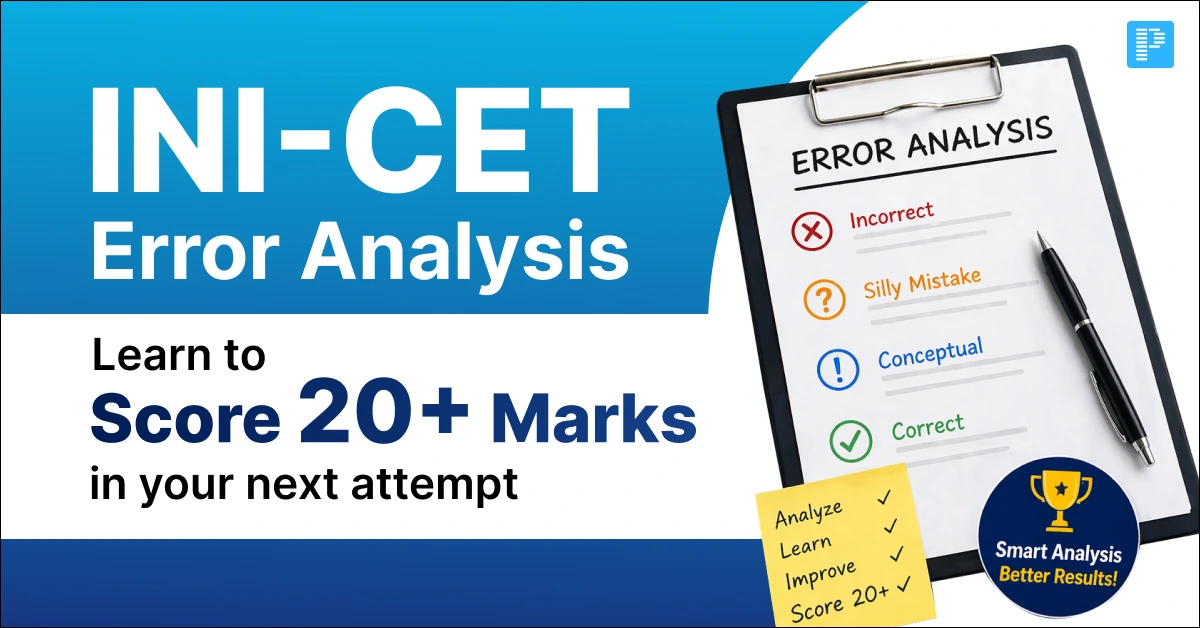
INI-CET Error Analysis: Learn to score 20+ Marks in your next attempt
Apr 24, 2026
Your last INI-CET mock score is in the 48th percentile. You read 14 hours a day in three months. You did Robbins, Harrison and more than 4,000 MCQs. But 31 of the questions you said you were confident about were incorrect, and 19 of them were ones you had already revised twice. It is not the amount of study you do. The issue is that you have never systematically broken down the reasons why you lose marks. The most INI-CET aspirants leave out of all their activities - and the one with the highest ROI - is mistake analysis, which distinguishes between the top 100 and the top 1,000.
QUICK ANSWER
INI-CET error analysis is a systematic post-test review procedure in which all wrong answers are grouped in terms of the type of error - knowledge gap, misread, reasoning error, or time pressure. Research on test-enhanced learning demonstrates that an active review of errors enhances retention by 30-40 per cent compared to passive re-reading. Those aspirants who follow a 4-step model (log → categorize → target → retest) can expect to gain 20-30 marks in 2-3 exams.
INI-CET RELEVANCE
INI-CET is a 200-question test with 19 subjects, completed in 180 minutes, averaging less than 54 seconds per question. With negative marking (for every wrong answer), each preventable error costs you 2 net marks (the mark you lost plus the mark you would have gained). Even removing 10 preventable errors per exam would be a 20-mark difference, which would move you up or down by 500-2,000 places.
In This Post:
- What Is INI-CET Mistake Analysis?
- The 5 INI-CET Error Categories.
- The Maths - How Mistakes Cost You Ranks.
- The 4-Step Mistake Analysis Framework.
- Creating Your Error Log - A Work Template.
- Knowledge Gaps vs. Silly Mistakes: Comparison Table.
- INI-CET Improvement High-Yield Points.
- FAQs

What Is INI-CET Mistake Analysis?
INI-CET mistake analysis is a purposeful, systematic method of examining all the false and omitted questions following a test to determine the nature of error, not merely a correct answer. The majority of the aspirants look at the answer key, say to themselves, " Oh, I knew that and proceed. That's answer-checking, not analysis.
Imagine it as a mortality and morbidity conference within a hospital. It is not to find out that the patient died, but to find out where the clinical decision was made wrong so that it will not happen again. Over the 10 years of training students for competitive exams, I have witnessed the same pattern over and over again: toppers do not necessarily study more; they simply waste fewer marks. They consider any wrong answer as a diagnostic hint regarding their preparation, rather than a chance occurrence.
The study supports this. The testing effect, which is widely discussed in the literature on cognitive psychology and mentioned in Make It Stick (Brown, Roediger and McDaniel, 2014), confirms that information retrieval following failure, particularly with corrective feedback, leaves a stronger long-term memory trace than does information retrieval alone.
Download INI CET Previous Year Question Papers PDF For Free

The 5 INI-CET Errors Categories.
Knowledge gaps are the most frequent cause of INI-CET errors, accounting for about 40-45 per cent of all incorrect responses, based on patterns observed over the last 10 years among student groups. But that leaves more than half your errors still due to non-knowledge sources.
These are the five types of errors that every aspirant should monitor:
1. Knowledge Gaps (Never Learned It): You really had no idea about the concept. The subject was either not updated or was an unimportant one you missed. These are the most sincere mistakes - and ironically enough, the simplest to correct.
2. Retention Failures (Learned but Forgot): You studied the subject, perhaps even made it a point in your notes, but when you were under the exam conditions, you forgot it. This indicates a problem with the revision strategy rather than with the volume of study. In the wards, I equate this to being aware that there is a drug but forgetting the dose when the resident inquires at 2 AM.
3. Misread or Misinterpretation Errors: The question required the least likely, and you answered the most likely. Or you did not get the word except. Such mistakes have nothing to do with medical knowledge; they are failures of attention and exam technique. Question stems of INI-CET can be 6-8 lines long. A single qualifier alters the whole response.
4. Fallacies of Reasoning and Application: You knew the concept, but used it in the wrong way. You were familiar with the pathophysiology and chose the incorrect drug. You knew the diagnosis, but mixed up the investigation of choice with the screening test. Such mistakes represent a lack of depth - you have learnt the fact but not constructed the clinical decision framework around it.
5. Time-Pressure Errors: INI-CET puts enormous time pressure on the participants with 54 seconds per question. These are the questions you might have been able to answer correctly with 30 seconds more - but you were in a hurry, panicked or took too long on another question and had to guess. Time-pressure decisions occur daily in emergency departments. The remedy in either environment is identical: pattern recognition through repetition.
Also Read: INI-CET Question Trends 2026: What 5 Years of Paper Analysis Reveal
Mistakes actually cost you ranks - The Maths.
To illustrate this, we will use the INI-CET marking scheme.
Every right response will receive +4 marks. Each wrong answer deducts a mark. Any unanswered question is rated 0.
When you get a question wrong rather than right, the net swing is 5 marks - the 4 you did not get plus the 1 you lost. When you answered the same question wrong when you should have left it blank, the penalty is 1 mark.
This is what this means in practice. Assume that you now have 22 questions that you miss that belong to the preventable group - misread, time pressure, or something that you would actually rewrite. Assuming that a systematic structure can enable you to turn only 10 of those into correct answers and avoid 5 others, instead of guessing incorrectly:
- 10 converted to correct: +50 marks net swing (10 × 5)
- 5 changed to missed: +5 marks net swing (5 x 1)
Overall gain: 55 raw marks. That moves up the ranking by 1,000-3,000 at competitive INI-CET cutoffs.

The 4-Step Framework of Mistake Analysis.
This structure applies to mock tests, past-year papers, and the real INI-CET review.
Step 1: Document all errors within 24 hours.
Record your error list on the same day you take the test, at most the following morning. Recollection of the reason you used an answer fades quickly. On every question that you answer incorrectly or miss, write: the subject of the question, the subject, your answer, the correct answer, and - most importantly - your reasoning at the time. Why have you chosen B? Were you guessing? Did you have two options?
Step 2: Categorize Each Error
Classify each error that has been logged into one of the five categories above. Be ruthlessly honest. Retention failures are often misdiagnosed by students as knowledge gaps because they are less frustrating. A misdiagnosis of the error type in clinical practice results in the incorrect treatment - the same principle is applicable here.
An approximate distribution I have observed among hundreds of students:
- Knowledge gaps: 40%
- Retention failures: 20%
- Misreads: 15%
- Reasoning errors: 15%
- Time-pressure errors: 10%
When your distribution is wildly different, then that is a diagnostic finding.
Step 3: Hit the Category, not the Topic.
At this point, most aspirants fail. They find something wrong in Pharmacology and believe I should learn more Pharmacology. However, when 60 per cent of your Pharmacology mistakes are misreads, more Pharmacology will not do you any good. You must train reading question stems with time constraints.
There is a remedy for each of the categories of errors:
- Knowledge gaps → Content revision (video lectures, textbook passages) with a focus.
- Retention failures → Spaced repetition and active recall sessions.
- Misreads → Underlining of key words in stems with purpose.
- Reasoning errors → Explaining MCQs and decision trees.
- Time-pressure errors → Timed mini-tests (sets of 20 questions in 18 minutes)
Train with MCQs in the PrepLadder QBank to practice each type of error in realistic situations.
Step 4: Retest and Measure.
Take another mock after 2 weeks of specific practice on your worst category of errors. Repeat the analysis. Compare the distributions. Were there any decreases in misread errors (15 to 8)? Was there a reduction in knowledge-gap errors in Biochemistry? You have no idea how well you are improving without a measurement. Monitor it just as you would monitor a patient's response to treatment.
Also Read: INI-CET -Important Subject-Wise Previous Year Questions' s Topics
Building Your Error Log - A Practical Template
Your error log doesn't need to be fancy. A spreadsheet with seven columns works:
| Coloum | What to record |
| Date | Test date |
| Topic | Question no, specific topic |
| Subject | Subject name |
| Your answer | Your marked option |
| Correct answer | Correct answer |
| Error category | Knowledge/Retention/Misread/Reasoning/Time |
| Action needed | Specific next steps |
Review this log weekly. Patterns emerge within 3-4 tests. You'll see that Microbiology errors are almost all knowledge gaps, while Surgery errors cluster around misreads. This transforms your revision schedule from guesswork into evidence-based preparation.
Knowledge Gaps vs Silly Mistakes - Comparison Table
Feature Knowledge Gap Errors Non-Knowledge Errors (Misread/Reasoning/Time) Root cause Did not learn or did not understand. Knew the idea but did not do it. Share of total errors (typical) 40-45% 55-60% combined The way they are perceived by students. I have to study more. It was a mere foolish error (perilous rejection) Fix Targeted content revision + QBank. Practice on time, reading with stems, and decision trees Time to improve 2-4 weeks per topic 1-2 weeks with deliberate practice Impact of ignoring Continued deficiencies in certain subjects. Constant loss of marks 15-25 on all tests INI-CET strategy pearl High-frequency subjects should be given the first priority (Medicine, Pharmacology, Pathology). Follow the trend: a single mock with a close error record will indicate the prevalent type.
INI-CET Improvement High-Yield Points.
INI-CET POINTS that are high-yield.
- Each incorrect response on INI-CET will result in a net loss of 5 marks relative to a correct response (for correct, -1 for incorrect).
- Errors in non-knowledge (misreads, reasoning, time pressure) are 55-60% of all errors in most aspirants, but get virtually no specific practice.
- The testing effect demonstrates that corrective feedback on errors leads to 30-40 per cent better retention than passive re-reading.
- Finish your error log in 24 hours of each mock - reasoning recall decays quickly after that.
- Sort out, then fix: reading more material won't correct a misread issue.
- One of the most common pitfalls in exams: calling all mistakes a stupid mistake and never examining them - this will ensure that it gets repeated.
- Mnemonic of the 5 types of errors: Kids Really Miss Right Timing - Knowledge, Retention, Misread, Reasoning, Time.
- Students with an error log on 5+ mocks demonstrate a statistically significant 15-25% decrease in repeat-error rates.
- Examiners usually examine subtle wording (least likely, most appropriate next step, except) - 12-5% of INI-CET questions include negative qualifiers.
- To have a structured mock-test schedule with in-built analytics, check out the PrepLadder app.
Commonly Asked Questions
Q1: What is the mistake analysis of INI-CET preparation?
Mistake analysis is a formal post-test analysis in which all incorrect responses are grouped by error type - knowledge gap, retention failure, misread, reasoning error, or time pressure - instead of merely selecting the correct response. This approach targets the source of mistakes and avoids repetition in future tests.
Q2: What is the maximum number of marks that can be realistically improved by analysis?
The average number of errors most aspirants make on INI-CET is 15-25, which could have been avoided. A net gain of 50+ raw marks is obtained by converting even 10 of them into correct answers. Students with error logs in 5 or more mocks tend to improve their marks by 20-30 points in 2-3 cycles.
Q3: What do the INI-CET aspirants do the most during preparation?
Rejecting incorrect responses as foolish errors without classification. Over 55% of all errors are non-knowledge errors (misreads, time pressure, reasoning failures), although the majority of students fill in knowledge gaps. The neglect of the most common type of error ensures that the same amount of marks is lost in the subsequent test.
Q4: What do I need to do to create an error log of INI-CET?
Prepare a basic spreadsheet with seven columns: date, question topic, subject, your answer, correct answer, category of error, and the action required. Check the log every week to identify subject-wise and category-wise trends. Three or four mock data runs typically indicate your dominant error type.
Q5: What is the duration that I need to spend on mistake analysis following each mock?
Spend 3-4 hours on a complete post-mock analysis - about the same amount of time as the exam. This is not time spent in vain; research in cognitive science has shown that error-based review leads to greater retention than the same amount of time spent reading new material.
Q6: What are the differences between INI-CET and NEET PG with regard to patterns of mistakes?
The questions in INI-CET are more clinical-scenario-based and have longer stems than typical NEET PG recall questions. This increases misreading and reasoning errors in INI-CET proportionally. The negative marking scheme (-1 per wrong) also makes skip-vs-guess decisions more consequential - negative marking alone costs aspirants 10-20 marks for guessing without conviction.
CLINICAL PEARL
The exam does not test what you know; it tests what you can do under pressure with what you know. Correct what you are already doing wrong before you seek new information.
Over 10 years of observing students improve their scores, the one most reliable indicator of improvement is not hours studied - it is whether they used their mistakes as information.

PrepLadder
Access all the necessary resources you need to succeed in your competitive exam preparation. Stay informed with the latest news and updates on the upcoming exam, enhance your exam preparation, and transform your dreams into a reality!
Navigate Quickly
What Is INI-CET Mistake Analysis?
Download INI CET Previous Year Question Papers PDF For Free
The 5 INI-CET Errors Categories.
These are the five types of errors that every aspirant should monitor:
Mistakes actually cost you ranks - The Maths.
The 4-Step Framework of Mistake Analysis.
Step 1: Document all errors within 24 hours.
Step 2: Categorize Each Error
Step 3: Hit the Category, not the Topic.
Step 4: Retest and Measure.
Building Your Error Log - A Practical Template
Knowledge Gaps vs Silly Mistakes - Comparison Table
INI-CET Improvement High-Yield Points.
INI-CET POINTS that are high-yield.
Commonly Asked Questions
CLINICAL PEARL
Top searching words
The most popular search terms used by aspirants
- INI CET High Yield Questions
- INICET Preparation Strategy and Tips