What Makes PrepLadder Different: A Feature-by-Feature Breakdown | NEET PG 2026
Jul 24, 2026
In This Post:
- Why Platform Choice Matters More Than Hours Studied
- Version XI - What's New and Why It Matters
- Smarter Video Lectures - What Actually Changed
- QBank, Audio QBank & the 5,000 New MCQs
- SPARK - Spaced Repetition Done Right
- Rapid Revision & Integrated Essentials
- Image Bank & Dissection Videos
- Test Series - Simulating Real Exam Pressure
- Treasures, Structured Notes & Printed Summary Charts
- PrepLadder vs Traditional Coaching
- High-Yield Takeaways for Choosing Your Platform
- FAQs
Why Platform Choice Matters More Than Hours Studied
Here is the deal: the students scoring 650+ aren't just out-studying you. They are using a better system. NEET PG 2026 is a sprint. With 42-minute section locks, you need recall speed and clinical instinct.
Passive learning is the enemy. If an app just gives you endless, boring lectures and basic recall MCQs, it's not helping you for the real deal. In the wards, we see interns who can quote a textbook but can't interpret an ABG in context. That same gap will kill your score if your tools aren't sharp.
Download NEET PG Previous Year Question Papers PDF For Free
|
|
|
|
|
|
|
|
|
|
|
|
Version X - The Foundation
Version X is where the heavy lifting happens. It fixed the biggest headaches students had:
- Lectures that respect your time: These are 15% shorter than before. They use 3D models and real patient cases so you actually see what you’re learning.
- The 18,000+ MCQ QBank: It’s massive, and it’s focused on clinical vignettes. The Audio QBank is a lifesaver. You can listen to explanations while you’re commuting or in the gym. It turns dead time into study time.
- Treasures and Notes: Digital treasures give you high-yield summary charts for when you need to revise in a hurry.
Version XI - What's New and Why It Matters
Version XI isn't replacing what you already have. It’s an upgrade layer. If Version X helps you cover the content, Version XI helps you remember it.
Here’s the new stuff:
- Rapid Revision (280 Hours): These aren't just cut-down main lectures. They are entirely new, PYQ-mapped videos that highlight the traps students fall into.
- Integrated Essentials (50 Hours): The exam doesn't keep subjects in silos anymore. This module teaches you Cardiology by mixing Medicine, Pharma, and Path in one flow.
- Dissection Videos (20 Hours): You can't learn anatomy from a 2D drawing. These real cadaver videos give you the 3D spatial awareness you need for those tricky anatomy IBQs.
- SPARK: This is the game-changer. It’s a smart flashcard system. It tracks what you forget and makes you review it right before it slips out of your brain.
Smarter Video Lectures - What Actually Changed
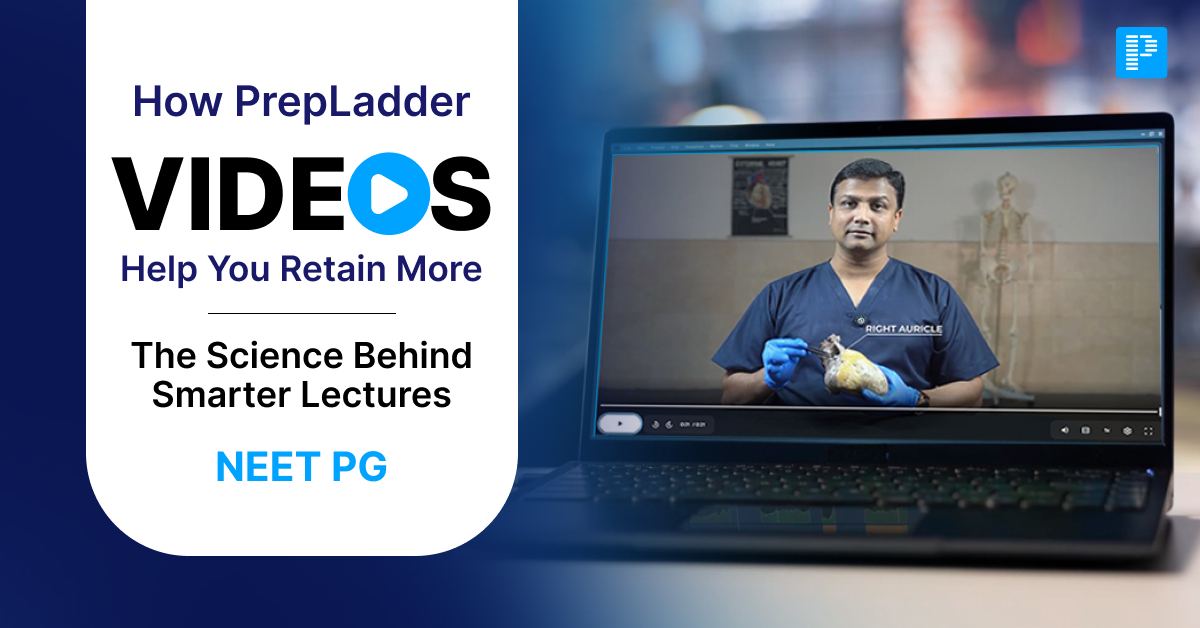
Most apps have videos. But do they work? Version X uses 3D animations for things like neuroanatomy because flat diagrams are useless there. By cutting out the fluff, they made the lectures 15% shorter without losing any actual info.
Version XI takes it further with Rapid Revision. If you can’t explain a concept in 90 seconds, you don't know it. These videos are built for the final sprint where speed is everything.
QBank, Audio QBank & the 5,000 New MCQs
Busy interns usually have about 5 hours of real study time. But our team has seen interns find an extra 2 hours a day just by using the Audio QBank between ward procedures.
Version XI adds 5,000 brand-new MCQs. These were built with input from recent toppers to make sure they match the current flavor of the exam. They aren't just harder; they are smarter.
For a deeper understanding of how to structure your MCQ practice, explore PrepLadder's preparation strategy guides.
SPARK - Spaced Repetition Done Right
In 10 years of mentoring, the #1 complaint we hear is: I studied it, but I couldn't remember it on the test.
That’s a retrieval problem. SPARK fixes this by moving you away from passive re-reading. It forces you to test yourself. It’s based on real science that shows active recall is the only way to build long-term memory. It highlights your weak spots automatically so you don't waste time on things you already know.
Rapid Revision & Integrated Essentials
Rapid Revision (280 hours) is built for the revision phase. Each topic is mapped to PYQs from NEET PG, FMGE, and INI-CET.
Integrated Essentials (50 hours) addresses the trend of multi-subject questions. For example, a cardiac case (Medicine) that requires you to know a drug interaction (Pharma) based on a slide (Path). This module trains you to think across subject boundaries-the way the examiners do.
For subject-wise high-yield topic breakdowns, see PrepLadder's guide on NEET PG high-yield topics for 2026.
Image Bank & Dissection Videos
Images made up 18% of the 2025 paper. That’s about 144 marks. That is the difference between getting your dream seat and having to repeat the year.
PrepLadder’s Image Bank uses high-def radiology and clinical photos. But the real star is the 20 hours of cadaver dissection. Surgeons think in 3D because they’ve seen the tissue. Now, you can too.
Test Series - Simulating Real Exam Pressure
The section-lock format is terrifying if you haven't practiced it. You can't skip around the whole paper anymore. PrepLadder’s mocks replicate this exactly. You learn how to make time-allocation decisions under pressure so you don't panic on August 30.
Treasures, Structured Notes & Printed Summary Charts
Treasures are digital summary charts for facts like drug doses and diagnostic cutoffs. Version XI adds physical Printed Summary Charts. These are one-page, exam-focused summaries built for the final revision weeks when you need maximum recall with minimum reading time.
PrepLadder vs Traditional Coaching
| Feature | PrepLadder (X + XI) | Traditional Offline |
|---|---|---|
| Lecture Style | 15% shorter, 3D models, real cases | 3-hour static lectures |
| Language | English + Hinglish | Usually just one |
| Retention Tool | SPARK Smart Flashcards | None |
| Integrated Teaching | 50-hour Integrated Essentials | Subjects taught in silos |
| Accessibility | Study anywhere, even in the ward | Fixed schedule, fixed room |
| Anatomy | 20 hours of real cadaver videos | Static slides |
High-Yield Takeaways for Choosing Your NEET PG Platform
- Time is your most valuable asset. Don't sit through 1,000 hours of videos if 800 hours of high-density content does the job better.
- Active recall wins. If you aren't using something like SPARK, you're going to forget half of what you read.
- Audio is your secret weapon. Use the Audio QBank to steal study time from your internship shift.
- Integrated is the new standard. If you study subjects in isolation, you’ll be blindsided by the 21% of questions that mix them up.
- Don't ignore the locks. You must practice with section-locked mocks before August 30.
- Anatomy in 3D: Cadaver dissection videos give you the spatial understanding that textbook drawings lack.
- Topper-Validated: The 5,000 new MCQs have been reviewed by recent toppers for maximum relevance.
- The 96% Strike Rate: This shows the alignment between PrepLadder's content and the actual exam.
- Printed Summary Charts: These are the ultimate tool for that last-minute memory refresh.
- The Upgrade: Your Version X progress is saved when you move to Version XI.

Frequently Asked Questions
Q1: What is the main difference between Version X and XI?
Version X is your core syllabus. Version XI is the retention layer. It adds things like SPARK, Rapid Revision, and cadaver videos to make sure you actually remember the core syllabus on exam day.
Q2: Does the test series really lock sections?
Yes. It mirrors the NEET PG 2026 pattern exactly. 42 minutes per section. No going back. It's the only way to build proper exam temperament.
Q3: How does SPARK help with revision?
It’s a digital flashcard system based on spaced repetition. It tracks what you forget and shows it to you more often until it’s locked into your long-term memory.
Q4: Can I skip the main videos and just do Rapid Revision?
If you have a very strong foundation from MBBS, maybe. But for most, the main videos build the concepts and Rapid Revision builds the speed.
Q5: How many image questions should I expect?
Lately, about 18% of the paper (36 questions) is image-based. Version XI focuses heavily on this with the new HD Image Bank and dissection videos.
CLINICAL PEARL
The best preparation platform isn't the one with the most content-it's the one that trains you for the exam as it is today.
After 10 years of mentoring, our team can tell you: nobody wins by just working harder. They win by working in alignment with the test. Choose the tools that make the knowledge stick. You've got this!

PrepLadder
Access all the necessary resources you need to succeed in your competitive exam preparation. Stay informed with the latest news and updates on the upcoming exam, enhance your exam preparation, and transform your dreams into a reality!
Navigate Quickly
Frequently Asked Questions
Q1: What is the main difference between Version X and XI?
Q2: Does the test series really lock sections?
Q3: How does SPARK help with revision?
Q4: Can I skip the main videos and just do Rapid Revision?
Q5: How many image questions should I expect?
CLINICAL PEARL
Top searching words
The most popular search terms used by aspirants
- Medical PG Preparation
- Prepladder