Top 100 One-Liners for NEET PG 2026: The Strategic Key to Last-Minute Revision
Jun 24, 2026

Let’s be honest for a second. You’re staring at a massive, 10-line clinical vignette on your screen. It’s about a patient with a butterfly rash, joint pain, and photosensitivity. You’ve diagnosed SLE in your head within the first three sentences. You feel confident.
But then you look at the actual question, and it isn’t asking for the diagnosis. It’s asking: What is the most specific initial screening test?
This is exactly where many students lose their rank. You had the clinical logic, but you lacked the atomic fact. This is why one-liners still rule the NEET PG. No matter how clinical the paper gets, every complex vignette is ultimately built on a foundation of one-liners. If you don't have these locked in, Step 1 of your reasoning is a waste of time.
Over our 10 years of mentoring medical students, our team has seen that the difference between a 400 score and a 600 score often comes down to 20 or 30 of these high-velocity facts.

Download NEET PG Previous Year Question Papers PDF For Free
Why One-Liners are Your Secret Weapon
The NEET PG 2026 panel loves what we call multi-step questions. To get the mark, you have to complete two distinct cognitive tasks:
- The Diagnosis: Use clinical logic to identify the disease.
- The Execution: Recall a specific one-liner fact (drug of choice, specific marker, or gold standard) to pick the answer.
1. The Domino Effect
If you miss the one-liner in Step 2, the clinical diagnosis you made in Step 1 becomes irrelevant. One-liners are the final cut. Without the right tool, you can't finish the surgery.
2. Beating Decision Fatigue
NEET PG is a 210-minute marathon. By mastering one-liners, you can solve the direct questions in under 10 seconds. This buys you time and mental energy for the complex Surgery or Medicine cases that require deeper thinking.
3. Fighting Brain Volatility
Subjects like Pharmacology, Microbiology, and Biochemistry are volatile. These facts evaporate quickly. Revising them in the final 48 hours keeps them in your RAM (short-term memory) so they are fresh on exam morning.
Also Read: NEET PG 2026: Exam Dates, Syllabus, Pattern, Registration, Eligibility, Preparation Tips

High-Yield One-Liner Samples
While our educators cover the Full 100 One-Liner Marathons in different subjects on our YouTube channel, here is a curated selection of the absolute must-know facts our team has identified for 2026.
1. Pre-Clinical Foundation (Anatomy, Physio, Biochem)
- Most common site of a berry aneurysm → Anterior Communicating Artery.
- The nerve most commonly injured in a mid-shaft humerus fracture → Radial Nerve.
- The Safety Muscle of the tongue → Genioglossus.
- The first bone in the body to start ossifying → Clavicle.
- Most common site of fertilization → Ampulla of the fallopian tube.
- Primary site of airway resistance → Medium-sized bronchi.
- Most sensitive part of the ear to high-frequency sound → Base of the cochlea.
- Surfactant is produced by → Type II pneumocytes.
- The most important buffer in extracellular fluid → Bicarbonate buffer.
- The main inhibitory neurotransmitter in the spinal cord → Glycine.
- Rate-limiting enzyme of Glycolysis → PFK-1.
- Rate-limiting enzyme of Gluconeogenesis → Fructose 1,6-bisphosphatase.
- Rate-limiting enzyme of HMP Shunt → G6PD.
- Only water-soluble vitamins are stored in the liver for years → Vitamin B12.
- Classic mousy odor of urine is seen in → Phenylketonuria.
- The key enzyme deficient in Lesch-Nyhan syndrome → HGPRT.
- Most common vitamin deficiency worldwide → Vitamin A.
- Rate-limiting enzyme of Cholesterol synthesis → HMG-CoA Reductase.
- The primary energy source for the brain during starvation → Ketone bodies.
- The amino acid that is a precursor for Nitric Oxide → Arginine.
2. Para-Clinical Powerhouses (Patho, Pharma, Micro)
- Most common type of necrosis in the brain → Liquefactive.
- Psammoma bodies are the hallmark of → Papillary Thyroid Carcinoma and Meningioma.
- Most specific marker for Myocardial Infarction within the first 6 hours → Troponin I.
- Diagnostic cell for Hodgkin Lymphoma → Reed-Sternberg cell.
- The Starry Sky appearance on histopathology → Burkitt Lymphoma.
- The most common site for an embolic stroke → Middle Cerebral Artery.
- Standard stain used for Amyloid → Congo Red.
- Hallmark of reversible cell injury → Cellular swelling.
- Most common primary malignant tumor of the liver → Hepatocellular Carcinoma.
- The pathognomonic finding in Asbestosis → Ferruginous bodies.
- Drug of choice for MRSA → Vancomycin.
- Drug of choice for Anaphylactic Shock → Adrenaline (1:1000 IM).
- Antidote for Paracetamol (Acetaminophen) poisoning → N-acetylcysteine.
- Antiarrhythmic with the longest half-life (55 days) → Amiodarone.
- DOC for Status Epilepticus → Lorazepam.
- Mechanism of action of Metformin → AMPK activation.
- Standard drug for prophylaxis of Rheumatic Fever → Benzathine Penicillin.
- The major side effect of Clozapine → Agranulocytosis.
- The antidote for Heparin → Protamine Sulfate.
- The DOC for Opioid Overdose → Naloxone.
- Gold standard for TB diagnosis → Culture on LJ medium.
- Pathognomonic finding in Rabies → Negri bodies.
- Standard for high-level disinfection of endoscopes → 2% Glutaraldehyde.
- Most common cause of Neonatal Sepsis → Group B Streptococcus.
- Vibrio cholerae produces yellow colonies on → TCBS agar.
- India Ink preparation is used to visualize → Cryptococcus neoformans capsule.
- The Bully of the nursery (causes diarrhea in infants) → EPEC.
- The definitive host for Toxoplasma gondii → Cats.
- The Crescent-shaped gametocytes on a smear → Plasmodium falciparum.
- The most common cause of Urinary Tract Infections (UTI) → E. coli.
3. The Clinical Giants (Medicine, Surgery, OBG, Peds)
- Most specific ECG finding in Hypokalaemia → Presence of U waves.
- Drug of choice for Absence Seizures → Ethosuximide.
- Pathognomonic sign of Measles → Koplik spots.
- Most common cause of Community-Acquired Pneumonia → Streptococcus pneumoniae.
- The most specific marker for SLE → Anti-dsDNA.
- The Gold Standard investigation for Pulmonary Embolism → CT Pulmonary Angiography.
- The first sign of puberty in a girl → Thelarche.
- The most common site of a Wilms Tumor → Kidney.
- Treatment of choice for Kawasaki Disease → IVIG + Aspirin.
- The Brick Red spots seen in Enteric Fever → Rose Spots.
- Most common site of a Peptic Ulcer → First part of the duodenum.
- Most common hernia in both males and females → Indirect Inguinal Hernia.
- Courvoisier’s Law → Palpable gallbladder + Jaundice = Likely Malignancy.
- The investigation of choice for Acute Cholecystitis → HIDA Scan.
- Most common cause of Intestinal Obstruction in adults → Post-op Adhesions.
- The Rule of 9 is used to calculate → Burn Surface Area.
- Most common site of an amoebic liver abscess → Right lobe of the liver.
- The triad of Murphy’s sign, Fever, and Jaundice → Charcot’s Triad.
- Most common primary bone tumor in children → Osteosarcoma.
- The most common site for a Colles fracture → Distal radius.
- Gold standard for dating a pregnancy in the 1st trimester → Crown-Rump Length (CRL).
- Most common cause of Postpartum Haemorrhage (PPH) → Uterine Atony.
- The most common site for an Ectopic Pregnancy → Ampulla of the fallopian tube.
- The most effective emergency contraception → Copper-T 380A.
- Double Bubble Sign on fetal ultrasound → Duodenal Atresia.
- The most common benign tumor of the uterus → Leiomyoma.
- The first structure visible inside a gestational sac → Yolk Sac.
- The drug used for seizure prophylaxis in Eclampsia → Magnesium Sulfate.
- The bishop score is used for → Assessment of inducibility of labor.
- The most common cause of female infertility in India → PCOS.
4. Short Subjects & Vital Stats (Radio, Derma, Psych, FMT, PSM)
- Investigation of choice for a Head Injury → NCCT Head.
- The most common cause of Blindness in India → Cataract.
- Most common site of epistaxis (nosebleed) → Kiesselbach’s plexus.
- The hallmark of Delirium → Inability to pay attention.
- The Nikolsky sign is positive in → Pemphigus Vulgaris.
- The target lesions are pathognomonic for → Erythema Multiforme.
- Most reliable method of identification in FMT → Dactylography.
- The most sensitive index of community health → Infant Mortality Rate (IMR).
- Target year for TB elimination in India → 2025.
- The denominator for Maternal Mortality Ratio → 100,000 Live Births.
Also Read: High Yield Pathology Topics for PG 2026: Most Asked Concepts & Important Questions
Watch the Full 100 One-Liner Marathons
Reading a list is a good start, but hearing an expert educator explain the logic and the mnemonics is how you truly lock these facts in for the long term. Audio-visual learning creates much stronger neural pathways than passive reading.
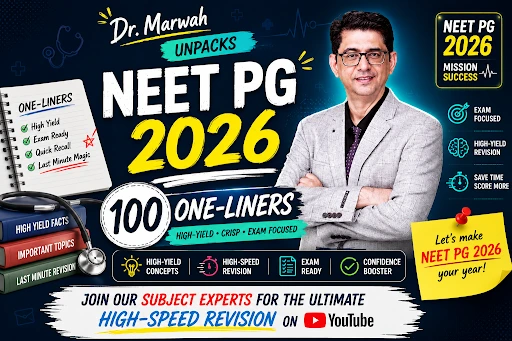
Our team of top-tier educators has recorded dedicated subject-wise marathons. Each video covers the Top 100 One-Liners you need for that specific subject in an ultra-fast, high-energy format. These are designed to be watched in the final week of your prep.
- Medicine: 100 Medicine One Liners Every NEET PG Aspirant Needs to Know
- Biochemistry: "100 one liners of Biochemistry For NEET PG" by Dr. Shanmugapriya
- Surgery: 100 One Liners Of Surgery For NEET PG
- Anatomy: 100 Anatomy One Liners to Boost Your FMGE & NEET PG Score Fast
- Pediatrics: Dr. Meenakshi Bothra's PROVEN 100 One Liners for Pediatric Success
- ENT: 100 ENT One Liners to Boost Your NEET PG Rank

How to Use These One-Liners Effectively
To get the maximum return on investment from these facts, our team recommends three specific techniques:
1. Passive Listening (Productive Resting)
Play our YouTube marathons while you are doing low-brain-power activities, like commuting, eating, or even just resting your eyes. It’s the best way to keep your subconscious mind engaged without burning out.
2. The Active Recall Test
When watching the videos, read the first half of the one-liner, then pause the video. Try to say the answer out loud before the educator reveals it. If you get it wrong, mark that topic for a 5-minute deep dive in your notes.
3. The Last 24-Hour Rule
Re-watch the marathon for your weakest subject the evening before the exam. This ensures those highly volatile facts (like drug doses or stain names) are sitting at the very front of your mind when you walk into the hall.
Frequently Asked Questions
Q1. Are one-liners still relevant if the paper is mostly clinical vignettes?
Yes! As we discussed, the "second step" of almost every clinical question is a one-liner fact. If you have the diagnosis but forget the drug of choice, you still get zero marks.
Q2. Which subjects should I prioritize for one-liner revision?
Pharmacology, Microbiology, and PSM. These three subjects are built on atomic facts and have the highest One-Liner Density on the exam.
Q3. Why watch the YouTube marathons instead of just reading a PDF?
Hearing an educator give a mnemonic or explain the "why" behind a fact makes it 3x more likely to stick under exam stress. Purely visual memory fades much faster than auditory-linked memory.
Q4. How many one-liners can I expect in the 2026 exam?
While direct one-liners may only be 25% of the paper, they are the "hidden" component of at least 60% of the clinical vignettes.
Q5. How do I handle one-liners I’ve never seen before?
Use the "Common things occur commonly" rule. If you're stuck between a rare syndrome and a common disease, 90% of the time, the common one is the answer.
Clinical Pearl
A one-liner is like a surgical instrument. It doesn't matter how much you know about anatomy if you don't have the right tool for the final cut.
Over our 10 years of helping students crack this exam, we’ve noticed that the difference between a good rank and a dream rank is often just 20 to 30 of these atomic facts. Keep your basics strong, watch the marathons on our channel, and we’ll see you on the rank list.

PrepLadder
Access all the necessary resources you need to succeed in your competitive exam preparation. Stay informed with the latest news and updates on the upcoming exam, enhance your exam preparation, and transform your dreams into a reality!
Navigate Quickly
Download NEET PG Previous Year Question Papers PDF For Free
Why One-Liners are Your Secret Weapon
1. The Domino Effect
2. Beating Decision Fatigue
3. Fighting Brain Volatility
High-Yield One-Liner Samples
1. Pre-Clinical Foundation (Anatomy, Physio, Biochem)
2. Para-Clinical Powerhouses (Patho, Pharma, Micro)
3. The Clinical Giants (Medicine, Surgery, OBG, Peds)
4. Short Subjects & Vital Stats (Radio, Derma, Psych, FMT, PSM)
Watch the Full 100 One-Liner Marathons
How to Use These One-Liners Effectively
1. Passive Listening (Productive Resting)
2. The Active Recall Test
3. The Last 24-Hour Rule
Frequently Asked Questions
Q1. Are one-liners still relevant if the paper is mostly clinical vignettes?
Q2. Which subjects should I prioritize for one-liner revision?
Q3. Why watch the YouTube marathons instead of just reading a PDF?
Q4. How many one-liners can I expect in the 2026 exam?
Q5. How do I handle one-liners I’ve never seen before?
Clinical Pearl
Top searching words
The most popular search terms used by aspirants
- Medical PG Preparation
- neet pg one liners
- NEET PG Preparation Strategy