Government vs Private Seats in NEET SS 2025-26 – Which One Should You Prefer?
Apr 2, 2026
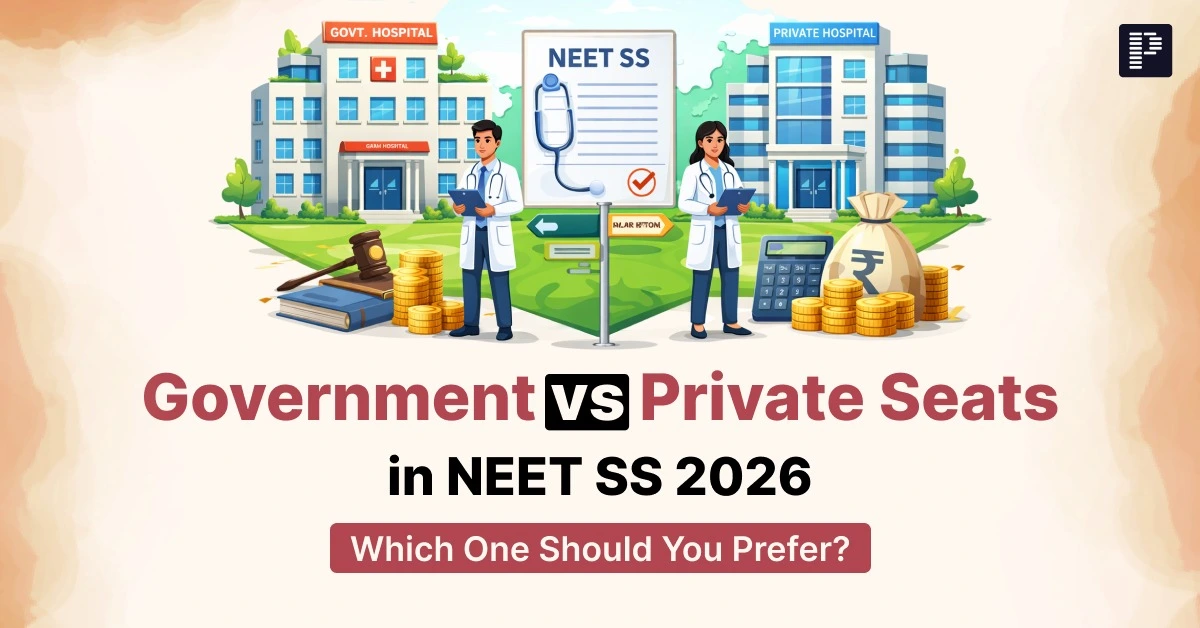
You have cleared the SS 2025 exam. Now you have to decide between a government seat and a private seat. This is a decision. You have to think about the fees and the quality of training you will get.
You will get a government seat with fees, but you may have to work for the government for a few years after you finish your training. If you do not do this, you will have to pay a lot of money. On the other hand, a private seat will cost you more money, but you will not have to work for the government.
NEET SS 2025 government seats cost between ₹30,000 and ₹2 lakh per year. You will get good training, but you may have to sign a bond for 1 to 3 years. If you break this bond, you will have to pay up to ₹50 lakh. Ss 2025 private seats cost between ₹15 lakh and ₹40 lakh per year. You will not have to sign a bond, so you can do what you want after you finish your training.
Quick Answer
If you want to save money and get a reputation, choose a government seat in NEET SS 2025-26. If you want to have freedom and get a seat easily, choose a private seat in NEET SS 2025-26.
SS 2025-26 Seat Distribution Overview
You need to know how the seats are distributed to make a good decision. The government will fill around 2,500 seats in SS 2025. These seats are in over 150 government and private medical colleges and in the Armed Forces Medical Services. Year 2,447 seats were filled in 156 government and private medical colleges and in the Armed Forces Medical Services.
Seat Distribution by Institution Type
Institution Type Approximate Seats Fee Range (Annual) Bond Requirement Government Medical Colleges ~1,200-1,400 ₹30,000 - ₹2 lakh Yes (varies by state) Private Medical Colleges ~600-700 ₹15-25 lakh Generally No Deemed Universities ~400-500 ₹20-40 lakh Generally No AFMS Institutions ~50-100 Minimal/Subsidized Service commitment
|
|
|
|
|
Government Seats: What You're Getting
Government super specialty seats are considered the best for a reason.
Here's what you need to know.
Financial Advantage
The fee difference is huge. Government medical college fees for MD/MS courses are between ₹30,000 and ₹1.5 lakh per year.
For DM/MCh programs, the fees are slightly higher but much lower than those at colleges. Top government institutions like AIIMS Delhi, PGIMER Chandigarh and JIPMER have low fees for super specialty training. The total 3-year cost at these institutions is often equal to one year's fee at universities.
Training Quality & Exposure
Government institutions and central institutes offer great clinical exposure due to the many patients. You'll see cases here that private hospitals rarely see, like diseases and complex illnesses.
This helps build skills that can't be taught in textbooks. Top government institutions consistently rank high in rankings. For example:
- AIIMS Delhi is ranked 1 for 2023, 2024 and 2025.
- PGIMER is Rank 2.
- CMC Vellore is ranked 3rd in the NIRF Medical rankings.
The Bond Reality
Government seats can be complicated. Most states require you to work in government hospitals after training.
A bond in NEET PG is an agreement that requires postgraduate medical students in government medical colleges to work in government hospitals or rural health centres for a fixed period (usually 1–3 years) after completing their PG course.
State-wise Bond Highlights:
State Bond Duration Penalty Amount Maharashtra 1 year ₹50 lakh Uttar Pradesh 2 years ₹40-50 lakh Gujarat 3 years ₹50 lakh Karnataka 2-3 years ₹25-50 lakh Assam 10 years ₹20 lakh
Bond Duration can be as short as 1 year (Kerala, Telangana, Maharashtra) or as long as 10 years (Assam). Penalty amounts range from ₹1 lakh in Mizoram to ₹50 lakh in several southern states.
Also Read: Top Super-Specialties After NEET SS: Best Branches, Scope & Salary
Bond-Free Government Options:
The thing about government options is that medical graduates who complete their MD or MS programme in places like Delhi, Meghalaya, Manipur and Chandigarh do not have to sign up for a service bond after they pass the PG exam.
For specialty courses, some institutions like AIIMS Delhi, PGIMER Chandigarh, BHU AMU JNMC and several central universities do not make you sign a rural service bond, which means medical graduates have complete freedom to choose their career path after they finish their training.
Stipend During Training
When you get a government seat, you also get a stipend that helps you pay for your living expenses. This is what you can expect to get:
- Other central institutes: ₹80,000 to ₹1.26 lakh per month
- State Government Colleges: ₹50,000 to ₹70,000 per month
- Some Private Colleges: you might get a small stipend or no stipend at all
So it is not just that you pay less for your education, but you also get to earn some money while you are still in training, which is a really good thing for medical graduates.
Private and Deemed Seats: What You Need To Know
Private and Deemed Seats are something different. They play a role in what you want to do with your career. You need to know what they are worth to figure out if they are worth the money.
The Truth About Fees
Medical colleges charge different fees. These fees depend on where the college is and how many people want to study a particular subject. On average, the fees for MD or MS courses are between ₹8 lakh and ₹25 lakh per year. Deemed universities are more expensive. They charge between ₹20 lakh and ₹40 lakh per year for seats like these. Private seats, at Deemed universities, can be very costly.
For DM/MCh programs, expect similar ranges:
| College Type | Annual Fees | 3-Year Total |
| Top Private (CMC Vellore, Manipal) | ₹15-20 lakh | ₹45-60 lakh |
| Deemed Universities | ₹20-35 lakh | ₹60-1.05 crore |
| Management Quota | ₹25-40 lakh | ₹75 lakh - ₹1.2 crore |
No Bond Obligations
Private colleges and deemed universities have their own set of seats. They decide who gets in based on SS scores. You pay more compared to government colleges.
Not having service bonds is a plus. You have the freedom to:
- Join hospitals right away
- Start your practice without waiting
- Look for opportunities
- Choose where you want to work
This freedom is very valuable. Especially for paying specialties like Cardiology, Gastroenterology and Surgical Oncology. You can start earning early.
Also Read: How to Crack the INI-SS Exam in 45 Days
Training Quality Considerations
Deemed medical colleges charge more. They have better equipment, modern facilities and more attention from teachers.
Top private colleges like CMC Vellore, Kasturba Medical College Manipal and Sri Ramachandra Medical College have academic standards. They might not have as many patients or complex cases as big government hospitals.
Seat Availability Advantage
Private seats are often available at a lower rate than government seats. This means:
* If your rank is between 2000-5000+, you might still get a seat when government options are gone
* You have choices of specialties at lower ranks
* You have options if counselling gets uncertain
Head-to-Head Comparison: Government vs Private
Factor Government Seats Private/Deemed Seats Annual Fees ₹30,000 - ₹2 lakh ₹15-40 lakh 3-Year Total Cost ₹1-6 lakh ₹45 lakh - ₹1.2 crore Bond Requirement Yes (most states) No Stipend ₹50,000 - ₹1.26 lakh/month Minimal or none Patient Volume Very High Moderate to High Case Complexity Higher (referral cases) Variable Career Flexibility Restricted initially Immediate Closing Ranks Lower (more competitive) Higher (more accessible) Infrastructure Variable (excellent at central institutes) Generally modern Research Opportunities Excellent at top institutes Variable
Specialty-Wise Closing Rank Analysis (NEET SS 2024)
Your rank determines what's realistically available. Here's what recent data shows:
Highly Competitive Specialties (Require Top Ranks)
Specialty Top Govt College Closing Rank Private College Closing Rank DM Cardiology 42-66 (AIIMS/PGIMER) 500-1500 DM Gastroenterology 100-150 600-1800 DM Neurology 120-200 700-2000 MCh Plastic Surgery 150-300 800-2200
Moderately Competitive Specialties
Specialty Govt College Range Private College Range DM Nephrology 300-600 1500-3000 DM Endocrinology 165-400 1200-2500 MCh Urology 400-800 1800-3500 DM Pulmonology 500-1000 2000-4000
More Accessible Specialties
Specialty Govt College Range Private College Range DM Clinical Pharmacology 1500-3000 3500-5500 MCh Surgical Oncology 1000-2500 3000-5000 DM Infectious Diseases 2000-4000 4000-6000
Also Read: Five Rare Diseases That Have No Cure
Decision Framework: Which Should You Choose?
Choose government if:
- Your rank is good enough under 1000 for the specialty you want
- You don't have a lot of money, the ₹1 crore difference is a deal
- You want to see patients and complex cases
- You are okay with serving in an area that helps you gain unique skills
- If you want to work in academics or research, government credentials matter
- You can get into government institutes like AIIMS, PGIMER, and BHU without bonds
Choose Private If:
- Your rank is not good enough for a government college
- You have money and want to start working right away
- You want to start practicing or work in a company immediately
- Paying a bond penalty would be too expensive
- A specific private college offers training in your field
- You want to stay in a location with a private college
The Hybrid Strategy
Many people use a mix of both:
- List top government colleges like AIIMS, PGIMER, and state GMCs as choices
- Add some private colleges as backup
- See what's available round by round
- Calculate the bond penalty versus fees for your situation
Financial Calculation: Making the Numbers Work
- Let's do the math for a DM Cardiology aspirant:
Scenario A: Government Seat with Bond
- Training Cost: ₹1.5 lakh for 3 years
- Stipend: ₹50,000 × 36 months = ₹18 lakh
- Net Gain: ₹16.5 lakh
- Bond Service: 2 years at ₹80,000/month = ₹19.2 lakh earned
- Total Position After 5 Years: +₹35.7 lakh
Scenario B: Private Seat, No Bond
- Training Cost: ₹60 lakh for 3 years
- Stipend: ₹0
- Net Cost: -₹60 lakh
- Immediate Private Practice: ₹2 lakh/month × 24 months = ₹48 lakh
- Total Position After 5 Years: -₹12 lakh
- Scenario C: Government Seat, Pay Bond Penalty
- Training Cost: ₹1.5 lakh
- Stipend: ₹18 lakh
- Bond Penalty: ₹50 lakh
- Immediate Private Practice: ₹2 lakh/month × 24 months = ₹48 lakh
- Total Position After 5 Years: +₹14.5 lakh
The verdict: Government seats with bond service are financially the best. Even paying the bond penalty often costs less than fees.
SS 2025-26 Counselling Strategy
In NEET SS 2025-26, counselling seats are allocated in quotas and categories. Seat allocation happens centrally via MCC based on merit, reservation and preferences.
Round-by-Round Approach
Round 1:
- Be ambitious with government college choices
- List your dream institutions first
- Include 2-3 private backups
Round 2:
- Evaluate Round 1 results
- Upgrade if possible
- Consider seats if government options are exhausted
Mop-Up/Stray Rounds:
- MCC may add new seats or convert vacancies from private/deemed that didn't fill up
- Stay enrolled in counselling through all rounds
- Last-minute opportunities often arise
Also Read: NEET SS Medicine Syllabus 2025: Complete System-Wise Breakdown
Frequently Asked Questions
What is the difference in fees between government and private DM/MCh seats?
The cost of government super specialty seats is around ₹30,000 to ₹2 lakh every year. On the other hand, private and deemed university seats can cost anywhere from ₹15 lakh to ₹40 lakh per year. This means that over 3 years, the difference in fees can be more than ₹1 crore. Also, government seats provide a stipend of ₹50,000 to ₹1.26 lakh, which makes the financial difference even bigger.
Do all government NEET SS seats require a bond?
No, they do not. Some central institutions like AIIMS Delhi, PGIMER Chandigarh and BHU do not require a rural service bond. However, state government colleges usually have a 1 to 3-year service bond. If you break this bond, you may have to pay a penalty of ₹20 lakh to ₹50 lakh, depending on the state. So it is an idea to check the bond terms before accepting a seat.
Can I get a specialty in a private college with a lower rank?
Yes, you can. Private and deemed university seats are often more available at ranks than government colleges. For example, the DM Cardiology seat may be available at ranks 42 to 66 in AIIMS. At ranks 500 to 1500 in private institutions. This means that private seats can be an option for candidates who have moderate ranks.
Is the training in colleges as good as in government colleges?
Some top private institutions like CMC Vellore, Manipal and Sri Ramachandra provide training. However, government centres usually provide exposure to rare and complex cases because they are tertiary referral centres. So both have their advantages.
Should I pay the bond penalty? Start private practice immediately?
You should think carefully about this. If the bond penalty is ₹50 lakh and the private seat costs ₹60 lakh extra, taking a government seat and paying the penalty can save you ₹10 lakh. You will also get a stipend during your training. However, this only makes sense if you can start earning an income immediately after your training, and this depends on your specialty and location.
How many rounds of counselling are there for SS 2025?
There are three rounds of SS counselling, which are Round 1, Round 2 and the Stray Round. The seat matrix is published before each round, and new seats may be added in rounds. So it is an idea to participate in all rounds to have the maximum opportunities.

PrepLadder
Access all the necessary resources you need to succeed in your competitive exam preparation. Stay informed with the latest news and updates on the upcoming exam, enhance your exam preparation, and transform your dreams into a reality!
Navigate Quickly
SS 2025-26 Seat Distribution Overview
Seat Distribution by Institution Type
Government Seats: What You're Getting
Financial Advantage
Training Quality & Exposure
The Bond Reality
State-wise Bond Highlights:
Bond-Free Government Options:
Stipend During Training
Private and Deemed Seats: What You Need To Know
The Truth About Fees
Training Quality Considerations
Seat Availability Advantage
Head-to-Head Comparison: Government vs Private
Specialty-Wise Closing Rank Analysis (NEET SS 2024)
Highly Competitive Specialties (Require Top Ranks)
Moderately Competitive Specialties
More Accessible Specialties
Decision Framework: Which Should You Choose?
Scenario A: Government Seat with Bond
Scenario B: Private Seat, No Bond
SS 2025-26 Counselling Strategy
Round-by-Round Approach
Frequently Asked Questions
What is the difference in fees between government and private DM/MCh seats?
Do all government NEET SS seats require a bond?
Can I get a specialty in a private college with a lower rank?
Is the training in colleges as good as in government colleges?
Should I pay the bond penalty? Start private practice immediately?
How many rounds of counselling are there for SS 2025?
Top searching words
The most popular search terms used by aspirants
- NEET SS
- NEET SS preparation
- NEET SS Specialities