Inherited Tubular Transport Disorders In Children
Sep 28, 2024

Bartter Syndrome
It is a condition where the tubular transport of certain ions is affected. It arises due to defects in the channels present in the thick ascending loop of Henle’s. Depending upon the affected channel, the type of disorder: -
- Antenatal bartter syndrome
- Classic bartter syndrome
- Transient bartter syndrome.
Bartter Syndrome is an Autosomal recessive disorder.
Key Features of Bartter Syndrome
- Hypochloremic metabolic alkalosis.
- Hypokalemia.
- Renal wasting of sodium, potassium, and chloride.
- Hypercalciuria, or increased calcium excretion in the urine, leads to nephrocalcinosis.
- Type I and type II have significant nephrocalcinosis.
- Renal biopsy -JGA hypertrophy and hyperplasia.
- Develop hyperreninemia.
- Secondary hyperaldosteronism.
- Hyperprostagladinemia or hypersecretion of PGE2.
- Due to the hypersecretion of PGE2, urine PGE2 levels -increased.
- Hyperuricemia and hypernatremia may or may not be seen.
Clinical Spectrum of Bartter Syndrome
- Certain forms with early onset can have antenatal polyhydramnios.
- The onset of the disease can occur in infancy and show symptoms like polyuria, polydipsia, vomiting, constipation, and failure to thrive.
- Older children - Recurrent dehydration, muscle weakness, and cramps.
- Usually normotensive but can often develop hypotension as a complication due to dehydration.
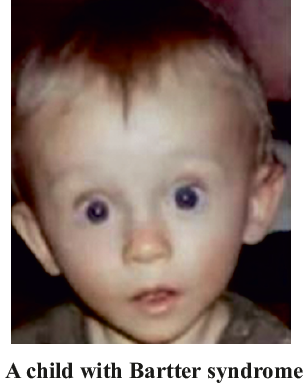
- The following dysmorphic features can be seen in these children:
- Triangular facies with tapering chin.
- Large eyes with strabismus.
- Protruding ears.
- Bilaterally drooping mouth.
Pathophysiology of Bartter Syndrome
The Site of the defect is the thick ascending limb of the loop of Henle's. Bartter syndrome arises due to the direct or indirect reduced function of the NKCC2 cotransporter. This could either be in the absence of an NKCC2 cotransporter, or it could be such that the NKCC2 cotransporter is present and anyone among the other 2 associated channels essential for gradient maintenance is absent. As a result, increased urinary loss of sodium, potassium, and chloride will occur.
- The fluid contraction in the body increases renin and aldosterone secretion.
- Tendency to develop hypokalemia and hypochloremia.
- Hypokalemia triggers the release of PGE2, further increasing aldosterone secretion.
The sodium ions are retained in the collecting duct while potassium and hydrogen ions are secreted, causing metabolic alkalosis with hypokalemia.
Types of Bartter Syndrome
Type Inheritance Defect Key Features I Autosomal recessive In NKCC2, Na-K-2Cl co-transport channel -SLC12A1 gene. Antenatal polyhydramnios.Salt wasting and dehydration in infancy. II Autosomal recessive renal outer membrane K channel or ROMK 1. Antenatal polyhydramnios.Salt wasting and dehydration in infancy. IIIClassic Bartter Autosomal recessive basolateral Cl channel, i.e., the ClC-Kb channel. Onset beyond infancy.Milder, chronic course. IVHyper-PGE Syndrome Autosomal recessive In ClC-Ka and ClC-Kb. Antenatal polyhydramnios.Salt wasting and dehydration in infancy.Sensorineural deafness VTransient Bartter X-linked recessive MAGED2 channel. Antenatal polyhydramnios.Salt wasting and dehydration in infancy.Symptoms resolve in weeks.
Treatment of Bartter Syndrome
In most cases, symptomatic treatment is required. During a crisis or dehydration, an intravenous infusion of normal saline is given. Adequate hydration should be ensured. Potassium chloride supplements are given orally, lifelong. Indomethacin, a prostaglandin synthesis inhibitor, is given at 2-3 mg/kg/day in patients with excessive PGE2. Ibuprofen can also be used (20-30 mg/kg/day). The use of ACE inhibitors and potassium-sparing diuretics is useful in some patients.
Gitelman Syndrome
Gitelman Syndrome has an autosomal recessive inheritance. It is usually milder than Bartter syndrome, and symptoms appear in older children, adolescents, and adults.
Clinical Features of Gitelman Syndrome
- Mild polyuria, polydipsia, episodes of dehydration, and muscle cramps
- Failure to thrive is usually rare.
- A high risk of cardiac arrhythmia exists due to hypokalemia and hypomagnesemia.
- The site of defect is distal tubules in the kidney.
East Syndrome
The defect is in potassium channels in the brain, ear, and kidneys. Hence CNS involvement and ear involvement are also seen. EAST syndrome's clinical features are Epilepsy, Ataxia, SN deafness, and Tubulopathy. It is also called SeSAME Syndrome (Seizures, SN Deafness, Ataxia, MR, Electrolyte Imbalance (Hypokalemia and Hypochloremic Metabolic Alkalosis)
Consider it a variant of Gitelman Syndrome. It is an Autosomal Recessive inheritance. The cause of East syndrome is mutations in the KCNJ10 (Kir4.1) gene, which codes for a Potassium Channel.
Treatment of East Syndrome
- Similar to Gitelman syndrome.
- Potassium and Magnesium supplements.
- Anti-epileptic drugs can be given along with therapies for sensorineural deafness.
Frequently Asked Questions:
Q: How can one differentiate between Batter syndrome and non-renal causes of hypochloremia?
Answer: Urinary Chloride excretion test
Q: How much chloride is excreted in Bartter syndrome?
Answer: In Bartter syndrome, the Chloride excretion is between 20-30 mEq/L.
Q: What is the Site of the defect in Bartter Syndrome?
Answer: Thick ascending limb of the loop of Henle's
Q: What is the site of defect in Gitelman Syndrome?
Answer: The site of the defect is distal tubules in the kidney.
Hope you found this blog helpful for your NEET SS Pediatrics Nephrology preparation. For more informative and interesting posts like these, keep reading PrepLadder’s blogs.
Download the PrepLadder app now and unlock a 24-hour FREE trial of premium high-yield content. Access Video Lectures, digital notes, QBank, and Mock Tests for FREE to ace your NEET SS Pediatrics preparation. Elevate your study experience and gear up for success. Start your journey with PrepLadder today!

PrepLadder
Access all the necessary resources you need to succeed in your competitive exam preparation. Stay informed with the latest news and updates on the upcoming exam, enhance your exam preparation, and transform your dreams into a reality!
Navigate Quickly
Bartter Syndrome
Key Features of Bartter Syndrome
Clinical Spectrum of Bartter Syndrome
Pathophysiology of Bartter Syndrome
Types of Bartter Syndrome
Treatment of Bartter Syndrome
Gitelman Syndrome
Clinical Features of Gitelman Syndrome
East Syndrome
Treatment of East Syndrome
Frequently Asked Questions:
Top searching words
The most popular search terms used by aspirants
- NEET SS Pediatrics Nephrology