Acne Vulgaris: Causes, Classification, and Symptoms
May 29, 2023

Select 93 more words to run Humanizer.
The pilosebaceous units (hair follicles and the sebaceous glands that surround them) are impacted by acne vulgaris, a prevalent chronic skin disorder. In addition to the face, the back and chest can also experience acne. It can present as either inflammatory or non-inflammatory lesions, or both.
It is a common condition associated with sebaceous glands. It is Usually seen in Adolescent and Puberty groups of age. In this we can find Polymorphic lesions on Face, chest, back, upper arms.
Read this blog further to get a quick overview of this important topic for dermatology and ace your NEET PG exam preparation.

Pathophysiology of Acne
When there is Sebaceous hyperplasia. There is altered follicular differentiation (keratinocytes), Which leads to blockage of sebaceous gland opening. Thus resulting in colonization of bacteria (commonly Propionibacterium acnes) which leads to conversion of the Triglycerides into Free fatty acids causing Inflammation.
Clinical Features of Acne
- Seborrhea (sebaceous hyperplasia)
- Comedones (altered follicular differentiation)
- Papules and Pustules (colonization of bacteria)
- Scarring (inflammation)

Causes of Acne Vulgaris
- Genetic factors- if the IGF-1 increased
- Environmental factors
- Androgens (seborrhea)
- Resident flora- Propionibacterium ovale, Propionibacterium acnes,Staph epidermidis. They release lipase that converts Triglycerides to free fatty acids resulting in blockade and inflammation
- Inflammatory markers- IL-1 (believed to be 1st step), TNF-alpha
- Others- Smoking , Diet (High in fat) and Pollution
Clinical Presentation
Comedones are characteristic of acne vulgaris. Comedones are blocked pilosebaceous ducts. Pseudo comedones are seen in Hidradenitis Suppurativa (HS) but Comedone are specific to Acne vulgaris.
Comedones are of Two types:
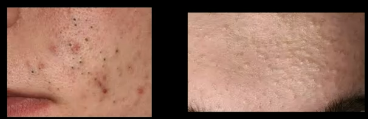
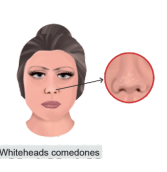
Closed Comedone-
It is Also called white comedones/ white heads. In this the When epidermis is covered.
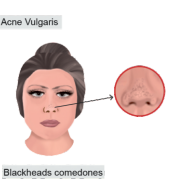
Open Comedone -
It is Also called black comedones/ black heads. When there is no epidermis covered and Keratin that is blocking the gland will get oxidized and become black. Pustules, papules and scarring can be observed.
Females may present with Hormonal acne, Due to overproduction of Androgens from ovaries or adrenals. It is Seen in patients with PCOs, Adrenal tumors, congenital adrenal hyperplasia, prolactinemia, etc. in this we can find More Acne on lower face , Signs of hyperandrogenism like Hirsutism , Seborrhea. Female patterned hair loss
Acne fulminans

It is an ulcerative form of acne. It is Acute in onset. In this the Systemic symptoms like fever or malaise can develop. Treatment includes Antibiotics with Steroids. Steroids are not given in Acne vulgaris but in Acne fulminans and Acne conglobata
Acne conglobata

It is the Most severe form of acne. It is Usually seen in males and is Observed on the trunk. In this we can find Predominant nodules, abscesses, and intercommunicating sinuses. Treatment includes Antibiotics + Oral retinoids + Short course steroids
Neonatal Acne
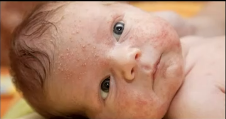
It is Seen in neonates (usually less than 1 month of age). It is due to transfer of maternal androgens. These subsides with time and no treatment is needed
Infantile acne
It is Seen in infants (less than 1 year of age) and they Usually subside by its own but if not, then they can be treated with Benzoyl peroxide
Mid childhood acne
It is Seen in children between 1-7 years of age. Precocious puberty should be considered in this case
Prepubertal acne
It May be due to Adrenarche. It may take 2 years to develop puberty after adrenarche.
Drug induced acne

Generally caused by drugs like Steroids (hence not a treatment choice in Acne vulgaris), Antitubercular drugs, Anticonvulsants and Antipsychotics
Differential features from normal acne
- Comedones are not seen
- Mostly observed on trunk
- Lesions will be monomorphic
Acne excoriee

It is Seen in patients with psychiatric illnesses. In this the Patients scratch the lesions leading to numerous scarring

Grading of Acne
- Grade-01- Comedones. Treatment includes Topical Retinoids
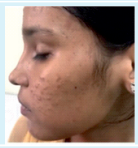
- Grade-02- Comedones + Inflammatory papules and few pustules. Treatment includes Topical Retinoids + Topical Antibiotics. If necessary, Benzoyl peroxide can be given
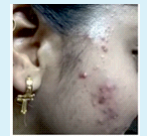
- Grade-03- Comedones + Multiple Inflammatory papules and pustules. Treatment includes Topical Retinoids + Topical Antibiotics + Oral Antibiotics
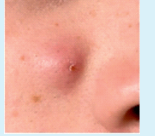
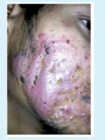
- Grade-04- Nodulocystic acne (Nodules + cysts). It is the Most severe form. Treatment includes Oral Retinoids.
Dermatology Related Articles:
Treatment of acne vulgaris:
- Topical Retinoids
- They include Tretinoin and Adapalene. Side effects include Dry skin, Irritation, Secondary bacterial colonization due to flaking of skin due to dryness. It is Contraindicated in pregnancy
- Benzoyl Peroxide
- It is Used as 2.5%, 5%, 10% face wash or body wash. It is antimicrobial and anti-inflammatory. Side effects include Irritation and Stinging sensation. It may cause staining of clothes
- Topical Antibiotics
- They include Clindamycin and Nadifloxacin. Due to concern of antibiotic resistance, these are nowadays combined with Topical retinoids or Benzoyl peroxide. Other topicals include Azelaic acid and Nicotinic acid
- Chemical peels-
- These are concentrated chemicals that are applied on face and peeled off after 5 mins. This procedure is Done in the clinic itself . mainly Salicylic acid peel is Used in active acne and Glycolic acid peel is Used to reduce pigmentation and post acne scarring
- Intralesional steroids- they are Used when deep nodules or cysts are present
- Systemic antibiotics- They include Minocycline, Doxycycline, Lymecycline. In pregnant females, Erythromycin is given
- Hormonal therapy- it is Cause based therapy. In this OCP’s, Antiandrogens are given
- Metformin- It is given In patients with insulin resistance
- Oral retinoids- the Treatment of choice is Isotretinoin. It acts on all pathogenetic factors (Seborrhea, Bacterial colonization, occlusion, and inflammation). Dose is 0.5-1 mg/kg. We have to Stop this drug when the dose range reaches 120-150 mg/kg. Side effects include
- Teratogenicity (Not given in pregnancy)
- Female patient should be advised to have gap of 1 month (Wash off period is from 1 month to 3 months) between Isotretinoin usage and conceiving
- Dryness
- Cheilitis
- Ocular dryness
- Headache
- Secondary bacterial colonization
- Rarely, pseudotumor cerebri (Not to be combined with tetracyclines)
- Rare but Severe side effect is Diffuse interstitial hyperostosis
- Rarely depression
To scale up your NEET PG preparation with the best-in-class video lectures, QBank, Mock Tests and more, download the PrepLadder App!
Download PrepLadder's NEET PG preparation app for Android
Download PrepLadder's NEET PG preparation app for iOS

PrepLadder Medical
Get access to all the essential resources required to ace your medical exam Preparation. Stay updated with the latest news and developments in the medical exam, improve your Medical Exam preparation, and turn your dreams into a reality!
Navigate Quickly
Pathophysiology of Acne
Clinical Features of Acne
Causes of Acne Vulgaris
Clinical Presentation
Closed Comedone-
Open Comedone -
Acne fulminans
Acne conglobata
Neonatal Acne
Infantile acne
Mid childhood acne
Prepubertal acne
Drug induced acne
Acne excoriee
Grading of Acne
Treatment of acne vulgaris:
Top searching words
The most popular search terms used by aspirants
- NEET PG Dermatology