Last 5 Year PYQs in ENT for NEET PG
Jan 23, 2025

If you are a NEET PG aspirant, we don’t need to tell you about the importance of Previous Years’ Questions (PYQs). They are a game-changer in every sense. Mastering the frequently asked questions gives you a significant edge over the competition.
In this blog, we’ve compiled a list of high-yield questions from the last 5 years in ENT. Each question comes with detailed explanations, so you don’t just memorise the answers but truly understand the concept behind it.
So, without further ado, let’s dive in and tackle some of the most crucial ENT PYQs taht can help you ace NEET PG.
Download FREE PDFs of Last 5-Year NEET PG PYQs – All Subjects
Q1. From which of the following structures does the saccule develop ?
- Saculus anterior
- Saculus posterior
- Pars superior
- Pars inferior
Ans. 4) Pars inferior
- The saccule is one of the two membranous structures located within the vestibule of the inner ear.
- It is responsible for sensing gravity and linear acceleration.
- The saccule develops from the pars inferior, which is the lower portion of the membranous labyrinth within the inner ear.
Also read: Last 5 Year PYQs in Orthopedics for NEET PG
Q2. What is the name of the surgical procedure performed to enlarge the cartilaginous segment of the outer ear canal?
- Meatoplasty
- Tympanoplasty
- Myringoplasty
- Otoplasty
Ans. 1) Meatoplasty
- Meatoplasty is a surgical procedure to widen or enlarge the cartilaginous part of the external auditory canal.
- It is done to improve access for examination or surgical procedures within the ear, particularly in cases of stenosis or atresia (narrowing or closure) of the external auditory canal.
Q3. Stimulation of which of the following causes cough when the external acoustic canal is scratched?
- Auriculotemporal nerve
- Auricular branch of vagus
- Great auricular nerve
- Facial nerve
Ans. 2) Auricular branch of vagus
- When scratching the external acoustic canal, the cough reflex can be triggered due to the stimulation of the auricular branch of the vagus nerve (also known as the Arnold's nerve or Alderman's nerve).
- The vagus nerve has many branches, including the auricular branch, which supplies sensory innervation to the external acoustic canal.
- Stimulation of the auricular branch of the vagus nerve can lead to the cough reflex because the vagus nerve is involved in regulating various functions, including coughing, breathing, and swallowing. Scratching the external acoustic canal can irritate the nerve endings, leading to a reflexive cough response.
Also read: Last 5 Year PYQs in Pediatrics for NEET PG
Q4. Which of the following does not represent a characteristic of tubercular otitis media?
- Ear ache
- Multiple perforations
- Pale granulation
- Foul smelling ear discharge
Ans. 1) Ear ache
- Ear ache or pain is not typically associated with tubercular otitis media.
- Tubercular otitis media is a middle ear infection caused by Mycobacterium tuberculosis.
- Common presentations are painless ear discharge, multiple perforations, hearing loss and facial paralysis.
Q5. A person who met with an accident, and suffered from a skull fracture presents with the following finding. Identify this clinical finding.

- Battle sign
- Bezold abscess
- Mastoiditis
- Griesinger sign
Ans. 1) Battle sign
- The clinical finding described in the question, ecchymosis behind the ear, corresponds to Battle sign, which is often observed in cases of temporal bone fractures.
- It can be confused with other injuries, such as a hematoma from a fracture of the mandibular condyle. Its specificity for head trauma may not always be absolute. Mastoid ecchymosis, a type of bruising, has been associated with liver disease without any trauma.
Q6. What is a drug called Mitomycin-C used for in medical treatment?
- Subglottic stenosis
- Rhinocerebral mucormycosis
- Adenoidectomy
- Tympanoplasty
Ans. 1) Subglottic stenosis
- Mitomycin C It is an anti-proliferative agent
- Mitomycin C can indeed be used in the treatment of subglottic stenosis, particularly in cases of scar tissue formation following surgical intervention.
- Mitomycin C is a potent inhibitor of fibroblast proliferation, which helps reduce the likelihood of excessive scarring. It is typically used in conjunction with surgical procedures such as endoscopic dilation or laser therapy. The mitomycin C solution is applied directly to the affected area during the procedure to prevent the reformation of scar tissue and improve the success of the intervention.
Also read: Last 5 Year PYQs in PSM for NEET PG
Q7. What is the most likely reason for a patient experiencing breathing difficulties and unsuccessful extubation after undergoing a total thyroidectomy?
- Superior laryngeal nerve injury
- Unilateral recurrent laryngeal nerve injury
- Bilateral recurrent laryngeal nerve injury
- Hematoma
Ans. 3) Bilateral recurrent laryngeal nerve injury
- The recurrent laryngeal nerves are crucial for vocal cord movement during respiration. Bilateral recurrent laryngeal nerve injury can lead to bilateral vocal cord paralysis, causing the vocal cords to remain in a closed position, leading to severe difficulty in breathing and stridor.
- This situation would require prolonged intubation to maintain the patient's airway. Therefore, bilateral recurrent laryngeal nerve injury is the most probable cause in this scenario.
- Bilateral laryngeal nerve injury occurs due to neuritis or surgical trauma ( thyroidectomy).
Causes of vocal cord paralysis
- Surgical trauma → In thyroid surgery the right recurrent laryngeal nerve has more possibility to get injured than left recurrent laryngeal nerve.
- Idiopathic
- Malignancy
- Infections- viral, bacterial
- Non-surgical trauma →Ortner's Syndrome or cardio vocal syndrome (Left atrial hypertrophy → compression of RLN)
Bilateral RLN Palsy
- Sensory loss: Below the vocal cords on the BOTH side.
- Motor loss: All muscles are paralyzed on the BOTH side except CRICOTHYROID.
- Position of the vocal cord: Both vocal cords lie midline.
- Phonation: Not affected much.
- Respiration: STRIDOR
Treatment
- TRACHEOSTOMY
- Type 2 Thyroplasty
Q8. A female patient came with complaints of nasal obstruction, loss of smell and foul smelling nasal discharge. On examination the presence of yellowish-green crusts in the nasal cavity along with merciful anosmia is observed. Which of the following additional findings may be observed in this patient?
- Roomy nasal cavity
- Nasal polyps
- Inferior turbinate hypertrophy
- Foreign body
Ans. 1) Roomy nasal cavity
- The likely diagnosis in this case is Atrophic Rhinosinusitis. This disease is also known as Ozaena.
- Clinical Features include:
- Merciful anosmia: The patient is unaware of the foul smell due to marked anosmia.
- Nasal obstruction in spite of unduly wide nasal chambers.
- On examination of the nose of these patients, we find large roomy cavities with foul-smelling crusts.

Also read: Last 5 Year PYQs in Gynaecology & Obstetrics for NEET PG
Q9. What should be the subsequent course of action in managing a patient who arrives at the emergency department with epistaxis, despite unsuccessful attempts to stop the bleeding by pinching the nostrils and nasal packing?
- Ligation of external carotid artery
- Ligation of internal carotid artery
- Ligation of sphenopalatine artery
- Ligation of maxillary artery
Ans. 3) Ligation of sphenopalatine artery
- In this question, the patient presents with epistaxis. Pinching did not relieve it, and he continued to bleed after nasal packing.
- Ligation of arteries: First, the sphenopalatine artery, also known as the artery of epistaxis, is ligated. If surgery fails, embolization should be performed.
Q10. What would be your immediate course of action in managing a patient who is experiencing bleeding from the surgical site following a tonsillectomy while in the recovery room?
- Shift to OT, remove the clots, and cauterize/ligate the vessel
- Shift to OT, start IV antibiotics, and pack the tonsillar fossa
- Give anticoagulants, repeated gargling, and wait for 24 hours
- Do blood transfusion and wait and watch
Ans. 1) Shift to OT, remove the clots, and cauterize/ligate the vessel
- In this question, the patient suffers from a post-tonsillectomy complication.
- It is a reactionary type of hemorrhage, usually occurs within 24 hours of treatment and it is mostly due to the slippage of ligature.
- The treatment would be to shift to the operation theater, remove the blood clots and then repeat the ligation.
- Hence, option A is the Ans. to the question given above.
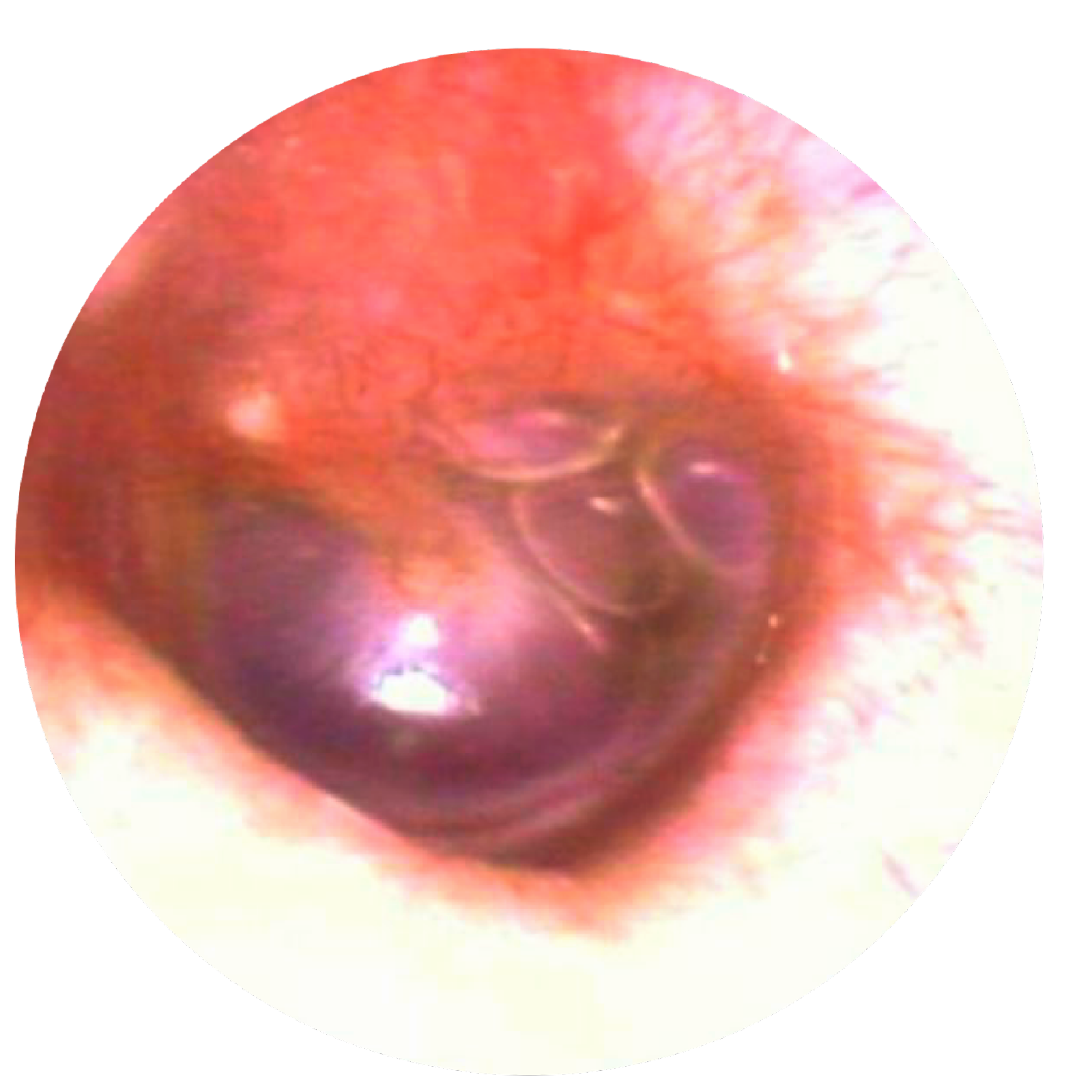
Q11. A 5-year-old child presents with reduced hearing for the past 2-3 months. The otoscopy finding is given below. What is the most likely diagnosis?

- Myringitis bullosa
- Serous otitis media
- Acute otitis media
- Pneumo Tympanum
Ans. 2) Serous otitis media
- Based on the otoscopy finding of a retracted and opaque tympanic membrane with fluid visible behind it, the foremost likely diagnosis is serous otitis media.
- This is often a common condition in children where fluid builds up within the middle ear causing hearing loss, discomfort, and sometimes balance issues.
- It is more often than not caused by a blockage or dysfunction of the Eustachian tube, which interfaces the middle ear to the back of the throat.
- Diagnosis is ordinarily made through otoscopy and tympanometry to assess the appearance and development of the tympanic membrane.
- On examination:
- Tympanic membrane bulging with fluid in middle ear

Also read: Last 5 Year PYQs in Anatomy for NEET PG
Q12. Identify the structure given in the image.

- Malleus
- Incus
- Stapes
- Vomer
Ans. 2) Incus
- The structure given within the picture is the Incus, also known as the anvil. It is one of the three ossicles of the center ear, alongside the malleus and stapes.
- The incus is found between the malleus and stapes and is associated to them by synovial joints.
Q13. A 60-year-old post-COVID male patient came with complaints of one-sided facial swelling, headache, and nasal sinus congestion. He is diabetic and it is uncontrolled. On examination black lesions on the nasal bridge and upper inside of the mouth were observed. Which investigation would you do to confirm the diagnosis of this patient?
- X-ray
- Biopsy with histopathologic examination
- Serum ferritin
- HbA1c
Ans. 2) Biopsy with histopathologic examination
- The patient presents with one-sided facial pain with nasal and oral black mass, which can be a sign of Mucormycosis.
- Post-COVID mucormycosis tends to affect individuals like:
- Who are diabetic with ketosis or are uncontrolled
- Were on mechanical ventilation for 2-3 weeks or longer
- Received steroids for more than 2-3 weeks
- Has iron overload, etc...
- On an MRI, the nasal turbinates appear dark due to fungal invasion, known as the Black Turbinate sign.
- Mucormycosis diagnosis can be made with biopsy or resection of the involved areas. Histopathological examination and culture of tissue samples are essential for confirming the presence of fungal elements and identifying the specific causative organism
Q14. Which nerve is most likely to be affected in a patient who complains of an inability to close the eye, drooling of saliva, and deviation of the angle of the mouth?
- Facial nerve
- Trigeminal nerve
- Oculomotor nerve
- Glossopharyngeal nerve
Ans. 1) Facial nerve
- The presentation of inability to close the eye, drooling of saliva, and deviation of the angle of the mouth is indicative of facial nerve palsy or Bell's palsy, which is caused by the dysfunction of the facial nerve.
- The facial nerve innervates the muscles of facial expression, including those involved in closing the eye, controlling the point of the mouth, and creating saliva.
Also read: Last 5 year PYQs in Dermatology for NEET PG
Q15. An adult man in a restaurant suddenly begins choking on his food. He is conscious. The following procedure was performed. Identify the procedure.

- Heimlich’s maneuver
- Back slap
- Chest thrust
- Blind insertion of finger
Ans. 1) Heimlich's maneuver.
- It is a first-aid procedure utilized to dislodge an object from a person's windpipe when they are choking.
- It includes standing behind the choking individual and applying powerful upward pressure on the abdomen, fair below the ribcage, to make sufficient pressure to dislodge the object.
Q16. Which of the following does not characterize tubercular otitis media?
- Ear ache
- Multiple perforations
- Pale granulation
- Foul smelling ear discharge
Ans. 1) Ear ache
- Tubercular otitis media is a rare form of middle ear infection caused by Mycobacterium tuberculosis Tubercular otitis media often presents with atypical symptoms compared to typical bacterial or viral otitis media.
- Earache is not a typical feature of tubercular otitis media. In fact, one of the distinguishing characteristics of tubercular otitis media is that it is usually painless. Patients may not experience significant ear pain or discomfort.
Also read: Last 5 Years PYQs in Physiology for NEET PG
Q17. Which of the following statements is accurate regarding keratosis obturans?
- Failure of migration of desquamated epithelium long posterior meatal wall
- Widening of meatus and facial nerve palsy might be seen
- Associated bronchiectasis and sinusitis
- All of the above
Ans. 4) All of the above
- Keratosis obturans is a rare condition characterized by the accumulation of desquamated epithelium within the external auditory canal.
- All of the above statements are true about keratosis obturans. It involves the failure of migration of desquamated epithelium along the posterior meatal wall, can lead to widening of the meatus and facial nerve palsy, and in some cases, may be associated with bronchiectasis and sinusitis.
Q18. Identify the lesion of vocal cord in the image given below:

- Reinke’s edema
- Malignancy
- Tracheomalacia
- Laryngeal papilloma
Ans. 4) Laryngeal papilloma
- The image shows grape-like projections in the anterior part of the larynx, which is a characteristic appearance of laryngeal papilloma. Laryngeal papillomas are benign growths caused by human papillomavirus (HPV) infection.
Q19. What type of lesions are associated with the presence of inspiratory stridor?
- Supraglottic
- Subglottic
- Tracheal
- Bronchus
Ans. 1) Inspiratory stridor is commonly found in supraglottic lesions.
- Inspiratory stridor refers to a high-pitched, wheezing sound heard during inspiration. It is caused by the partial obstruction of the upper airway, which disrupts the normal airflow.
- Supraglottic lesions involve structures above the level of the vocal cords, such as the epiglottis, aryepiglottic folds, and false vocal cords. When these structures are affected or swollen, they can cause partial obstruction of the airway during inspiration, resulting in inspiratory stridor.
Also read: Last 5 Year PYQs in Pathology for NEET PG
Q20. What is the technique shown in the provided image?

- Epley’s maneuvre
- Trotter’s method
- McGovern’s technique
- Valsalva maneuvre
Ans. 2) Trotter’s method
- The image depicts Trotter's method. This is the first step to control epistaxis.
- This method involves the application of digital pressure over Kisselbach's plexus and bends forward for at least 15-20 minutes
To scale up your NEET PG exam preparation with the best-in-class video lectures, QBank, Mock Tests and more, download the PrepLadder App!
Download PrepLadder's NEET PG preparation app for Android
Download PrepLadder's NEET PG preparation app for iOS

PrepLadder Medical
Get access to all the essential resources required to ace your medical exam Preparation. Stay updated with the latest news and developments in the medical exam, improve your Medical Exam preparation, and turn your dreams into a reality!
Top searching words
The most popular search terms used by aspirants
- NEET PG ENT
- NEET PG ENT Preparation
- NEET PG Previous Year Question Paper