Rapid Revision Reignite PSM: Question-Answer Format
Sep 15, 2025


Systematic Review and Meta Analysis
Big Question 1: What are systematic reviews and meta-analysis used for in research?
Broad answer:
- Systematic Review
- A type of literature review that collects and critically analyzes multiple research studies
- Does not include quantitative synthesis of data from all studies available
- Meta-analysis
- One step ahead and perform quantitative analysis: Meta-Analysis
- It is a quantitative approach for systematically combining previous research to arrive at conclusions about the body of research.
Detailed Questions
Q1.1: What are the basic steps involved in conducting a systematic review?
Answer:
| Step 1 | Defining the review question and eligibility criteria |
| Step 2 | Searching for studies |
| Step 3 | Selecting the studies |
| Step 4 | Data extraction |
| Step 5 | Data synthesis |
| Step 6 | Interpretation of the results |
Q1.2: What are the basic steps involved in conducting a meta-analysis?
Answer:
| Formulate review question and define inclusion criteria | |||
| Focused research question | |||
| ↓ | |||
| Identify relevant studies | |||
| Literature searches | Screen title and abstract | Retrieve full-text papers | Apply inclusion criteria |
| ↓ | |||
| Extract data and assess study quality | |||
| Draw a funnel plot (both for Systematic and meta-analysis) | |||
| ↓ | |||
| Present Results: Result in Meta-Analysis is known as a Forest plot | |||
| Narrative summary | Tabular overview of Study features, quality and result | Graphical display of results | |
Q1.3: What is a funnel plot?
Answer:
- A Funnel Plot is drawn for both the systematic review and the Meta-Analysis
- Checks for publication bias
- Also checks for the qualities of the studies
Q1.4: How can the file drawer effect be identified using a funnel plot in meta-analysis?
Answer:
| No file drawer effect | File drawer effect |
| Dots uniformly scattered: No publication bias | Dots are not uniformly scattered: Publication bias present. |
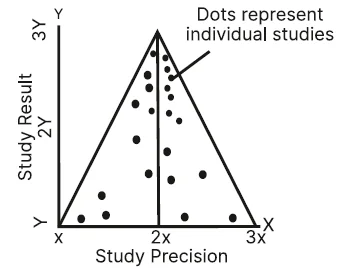
Dots uniformly scattered: No publication bias
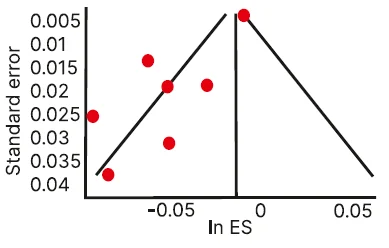
Dots are not uniformly scattered: Publication bias present.
Q1.5: What type of study uses a forest plot, and what is another name for it?
Answer:
- Forest Plot is only made for a Meta-Analysis
- Forest Plot is also known as a Blobbogram
Q1.6: What are the reporting guidelines used for different types of medical research studies?
Answer:
| Type of Study | Reporting Guidelines | |
| Case Report | CARE | Case Report |
| RCT | CONSORT | Consolidated Standard of Reporting Trials |
| Observational Studies | STROBE | Strengthening the Reporting of Observational Studies in Epidemiology |
| Meta Analysis | MOOSE | Meta Analysis of Observation Studies |
| Systematic Reviews | PRISMA | Preferred Reporting items for Systematic Reviews and Meta Analysis |
| Qualitative Research | SRQR | Standards for Reporting Qualitative Research |
| Quality Improvement Studies | SQUIRE | Standards for Quality Improvement Reporting Excellence |
| Diagnostic/Prognostic studies | STARD | Standards for Reporting of Diagnostic Accuracy |
Also Read : PSM Important High-Yield Topics For NEET PG

Descriptive Epidemiology/Infectious Disease Epidemiology
Big Question 2: Explain the concepts of host types and modes of transmission of infectious diseases with examples.
Broad Answer: The host is the organism that harbors the infectious agent. A primary (definitive) host supports the sexual cycle of the pathogen (e.g., Anopheles mosquito in malaria), while a secondary (intermediate) host supports the asexual cycle (e.g., humans in malaria). Dead-end hosts (e.g., humans in rabies) cannot transmit infection further, and obligate hosts (e.g., humans in typhoid, measles) are the only natural hosts. Transmission can be direct (person-to-toperson via contact, droplets, vertical transfer) or indirect (via vehicles like food/water, fomites, or vectors—mechanical or biological). Understanding these concepts is essential for breaking the chain of infection and planning control measures.
Detailed Questions
Q2.1: Define the source of infection.
Answer: Any person, animal, object, or substance from which an infectious agent passes or is disseminated to the host: Source of infection
Q2.2: Define reservoir.
Answer: Any person, animal, arthropod, plant, soil, or substance in which an infectious agent lives and multiplies, on which it primarily depends for survival, and where it reproduces itself in such a manner that it can be transmitted to a susceptible host: Reservoir
Q2.3: In which disease are the host and reservoir the same?
Answer: Tetanus.
Q2.4: Give one example where the reservoir and source are different.
Answer: Hookworm infestation.
Q2.5: Give a few examples of diseases with their reservoirs and sources of infection.
Answer:
| Disease | Reservoir | Source |
| Tuberculosis | Man | Sputum |
| HIV/AIDS | Man | Body secretions, fluids |
| Malaria | Man/mosquito | Infected blood |
| Rabies | Dog/other animals | Saliva |
| Measles | Man | Droplets |
| JE | Pig and birds | Infected mosquitoes |
| Cholera | Man | Unsafe water and food |
| Typhoid | Man (Case or carrier) | Unsafe water and food |
| Plague | Rodents | Infected flies |
| Hookworm | Man | Soil contaminated with infective larvae |
| Tetanus | Soil | Soil |
Q2.6: Give examples of diseases with their primary and secondary hosts.
Answers:
| Primary Host | Secondary Host | |
| Malaria | Mosquito | Man |
| Filaria | Man | Mosquito (culex) |
| Tapeworm | Man | Pig (T.Soilum)Cattle (T. Saginata) |
| Guinea worm | Man | Cyclops |
| Sleeping sickness | Man | TseTse fly |
| Hydatid disease | Dog | Sheep, cattleman |
Q2.7: What are the differences between Droplet Infection and Droplet Nuclei?
Answer:
| Droplet Infection | Droplet Nuclei |
| Direct mode of transmission. | Indirect mode of transmission. |
| Size: >5 microns. Heavier particles | Size: <5 microns. Lighter particles. |
| Under the influence of gravity fall to the ground. | Airborne - Remain suspended in air. |
| Travel a distance <1 meter. | Travel a distance >1 meter. |

Trace Elements/Nutrition Health Programs/Food Adulteration/Food Logos
Big Question 3: Explain Anemia Mukt Bharat program and its components.
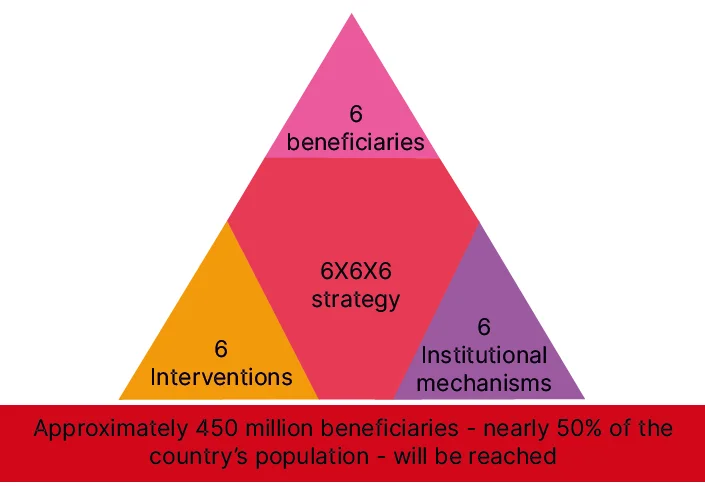
Broad Answer: Anemia Mukt Bharat comprises prophylactic Iron & Folic Acid Supplementation and Deworming. For mild to moderate anemia, it follows a 6x6x6 strategy under the Intensified National Iron Plus initiative, providing iron and folic acid supplements to six beneficiary groups at specific schedules. Severe anemia in pregnant women is managed based on gestational age and Hb levels, involving hospitalization, IV iron sucrose, IV ferric carboxy maltose, and/or blood transfusion.
Detailed Questions
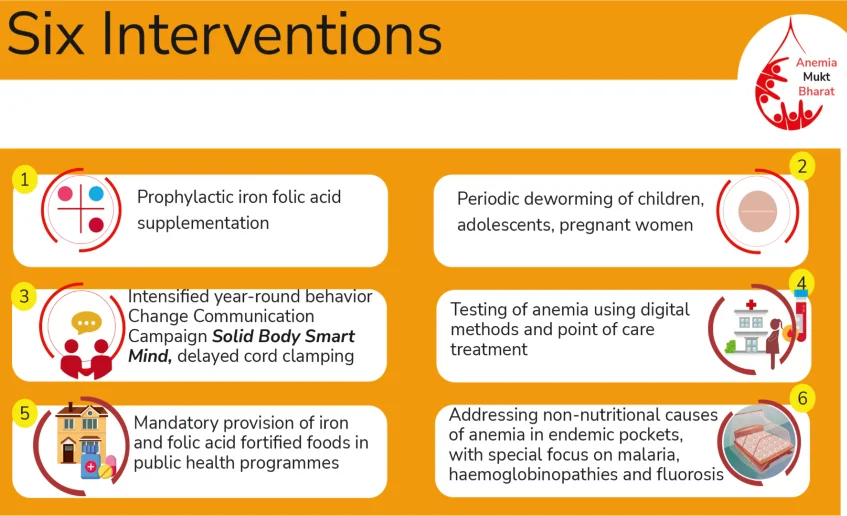
Q3.1: What are the 6 interventions under Anemia Mukt Bharat program?
Answer:
Q3.2: What is the deworming schedule for pregnant women, children <2 years, and children >2 years under the program?
Answer:
- In pregnant women: Full tab of Albendazole (400 mg HS) is given in the 2nd trimester.
- In children <2 years: Half a tab of Albendazole (200 mg HS) is given.
- In children >2 years: Full tab of Albendazole (400 mg HS) is given.
Q3.3: For the management of mild to moderate anemia under Anemia Mukt Bharat, what is the strategy called, and which Ministry is responsible? What level of prevention does it represent?
Answer:
- It follows a 666 strategy.
- Ministry: Ministry of Health and Family Welfare (MOHFW).
- Level of prevention: Primary prevention (Specific protection).
Q3.4: List the six beneficiary populations under the 6x6x6 strategy for prophylactic Iron and Folic Acid Supplementation, specifying the elemental iron and folic acid dosage and schedule for each.
Answer:
| Population | Iron | Folic Acid | Schedule |
| 6-59 month | 20 mg Elemental Iron | 100 mcg Folic acid | Bi-weekly (Syrup) |
| 5-9 years | 45 mg Elemental Iron | 400 mcg Folic acid | Weekly (Pink tabs) |
| 10-19 years | 60 mg Elemental Iron | 500 mcg Folic acid | Weekly (Blue tabs) |
| Reproductive age women | 60 mg Elemental Iron | 500 mcg Folic acid | Weekly (Red tabs) |
| Pregnant and Lactating women | 60 mg Elemental Iron | 500 mcg Folic acid | Daily (Red tabs) |
Classification/Cohort Study
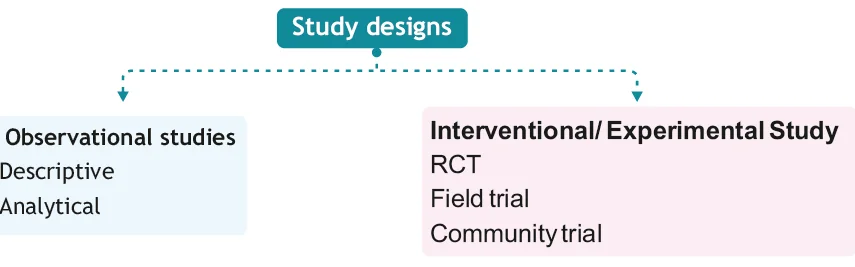
Big Question 4: How are epidemiological study designs classified?
Broad answer:
Detailed Questions
Q4.1: What are descriptive study designs, and what do they focus on in epidemiology?
Answer: A descriptive study design describes a disease in terms of time, place, and person, i.e. studies the distribution of a disease. Example -
- Case report- A case report is an individual case study
- Case series- An aggregation of case reports
In descriptive, the buzzword is distribution. No comparison group.
Q4.2: What is the main focus of analytical study designs, and what are some examples?
Answer: Analytical study design studies the reason why and how disease occurs, i.e studies determinants of a disease. E.g.
- Cohort study
- Case-control study
- Cross-sectional study
- Ecological study
In analytical, the buzzword is determinant. Comparison group is always present.
Q4.3: Name the types of interventional or experimental study designs with examples.
Answer:
- Randomized Control Trial (RCT) - Drug trials
- Field trials - Vaccine trials
- Community trials - Preventive trials
Q4.4: What is a hypothesis, and what are the steps involved in hypothesis testing in epidemiology?
Answer: An assumption yet to be verified. Three steps:
- Formulation of hypothesis: Descriptive epidemiology
- Test hypothesis: Analytical epidemiology
- Confirm hypothesis: Experimental and interventional epidemiology
Q4.5: What are the different types of observational study designs? Explain them along with their synonyms and units of study?
Answer:
| Observational Studies | ||
| Types of studies | Synonyms | Unit of study |
| Ecological | Correlation, geographic, aggregate | Populations |
| Cross sectional | Prevalence | Individuals |
| Case control | Case reference | Individuals |
| Cohort | Follow-up | Individuals |
Q4.6: What are the different types of experimental study designs, explain along with their synonyms and units of study?
Answer:
| Experimental Studies | ||
| Types of studies | Synonyms | Unit of study |
| Randomized control trials | Clinical trials | Patients |
| Field trials | Vaccine trials | Healthy people |
| Community trials | Community studies | Communities |
Q4.7: What is the unit of study for different types of study designs?
Answer:
| Type of Study | Unit |
| Ecological/Correlation | Population |
| Cross-Sectional | Individual |
| Case-Control/Case Reference | Individual |
| Cohort | Individual |
| Randomized Control Trials | Patients |
| Field Trial | Healthy individuals |
| Community Trial | Community |
Concept of Health And Disease
Big Question 5: What is the concept of well-being, and how is it measured using indices like PQLI and HDI?
Broad Answer: Well-being is a multidimensional concept comprising both objective and subjective components. The objective component includes the standard of living, which depends on the Gross National Product (GNP) or Gross National Income (GNI). The subjective component refers to quality of life, i.e., a person's perception, and is assessed using indices like PQLI (Physical Quality of Life Index) and HDI (Human Development Index).
Detailed Questions
Q5.1: What is the difference between the objective and subjective components of well-being?
Answer:
|
Well Being |
|
|
Objective Component
|
Subject Component
|
Q5.2: What is the difference between PQLI and HDI?
Answer:
| PQLI | HDI |
| Mnemonic: ILL | Mnemonic: KIL Given by the United Nations Developmental Program (UNDP) |
| Life expectancy at one year. | Life expectancy at birth. |
| Literacy rate | Knowledge index / Education index |
| Infant mortality rate - > 0 - 100 | Income: Gross National income per capita in purchasing power parity US dollars. |
| Score: 0- 100 Current score: 65 Not used nowadays | Score: 0-1 Current score: 0.644 Rank (India): 134 |
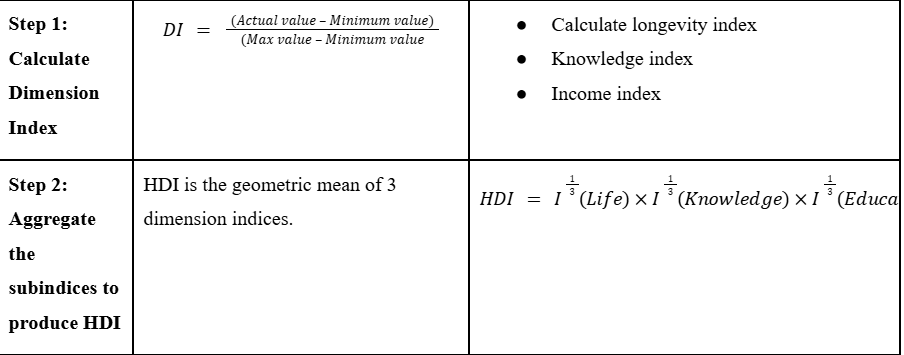
Q5.3: How is the HDI calculated?
Answer:
If you’re looking to strengthen your final prep, don’t miss out on Rapid Revision Reignite in Question-Answer format by PrepLadder. It’s designed to help Medical PG aspirants cover the entire syllabus quickly with concise notes in a Question-Answer format, high-yield MCQs, and expert-led revision videos—perfect for last-minute reinforcement before the exam.
Kickstart your NEET PG prep with PrepLadder’s 24-hour FREE trial! Get instant access to premium resources—Video Lectures (also in Hinglish), digital notes, Audio QBank, and Mock Tests. Experience high-yield learning designed to boost your preparation. Don’t wait—Download the PrepLadder app today and take the first step toward success!

PrepLadder Medical
Get access to all the essential resources required to ace your medical exam Preparation. Stay updated with the latest news and developments in the medical exam, improve your Medical Exam preparation, and turn your dreams into a reality!
Navigate Quickly
Systematic Review and Meta Analysis
Detailed Questions
Descriptive Epidemiology/Infectious Disease Epidemiology
Detailed Questions
Trace Elements/Nutrition Health Programs/Food Adulteration/Food Logos
Detailed Questions
Classification/Cohort Study
Detailed Questions
Concept of Health And Disease
Detailed Questions
Top searching words
The most popular search terms used by aspirants
- NEET PG PSM Preparation
- PSM Preparation
- Rapid Revision