Integrated Medicine + Pathology Approach for NEET PG Clinical Questions
Jul 17, 2026
Let’s look at a scenario that plays out in the exam hall every year. You read a vignette about a 45-year-old male presenting with a sudden, thunderclap headache. You’ve already diagnosed a Subarachnoid Hemorrhage in your mind.
But then you see the actual question. It doesn’t ask for the investigation of choice (NCCT). It asks: ‘This patient likely has an underlying defect in which of the following proteins?’
Suddenly, your Clinical Medicine diagnosis needs a Pathology understanding of Type III Collagen or Polycystin-1.
This is the reality of the 2026 pattern. If you are still studying Medicine and Pathology as two separate silos, you are working twice as hard for half the marks.
The examiners are no longer asking "What is the diagnosis?" They are asking "Why is this happening at a cellular level?" or "Given this microscopic finding, how would you manage the patient?"
Our team has spent 10 years analyzing these "Bridge Questions." With the launch of PrepLadder Version XI in April 2026, we have completely revamped our QBank to move away from isolated subjects and toward these high-yield "Integrated Loops."

The Logic of the Cross-Over Question
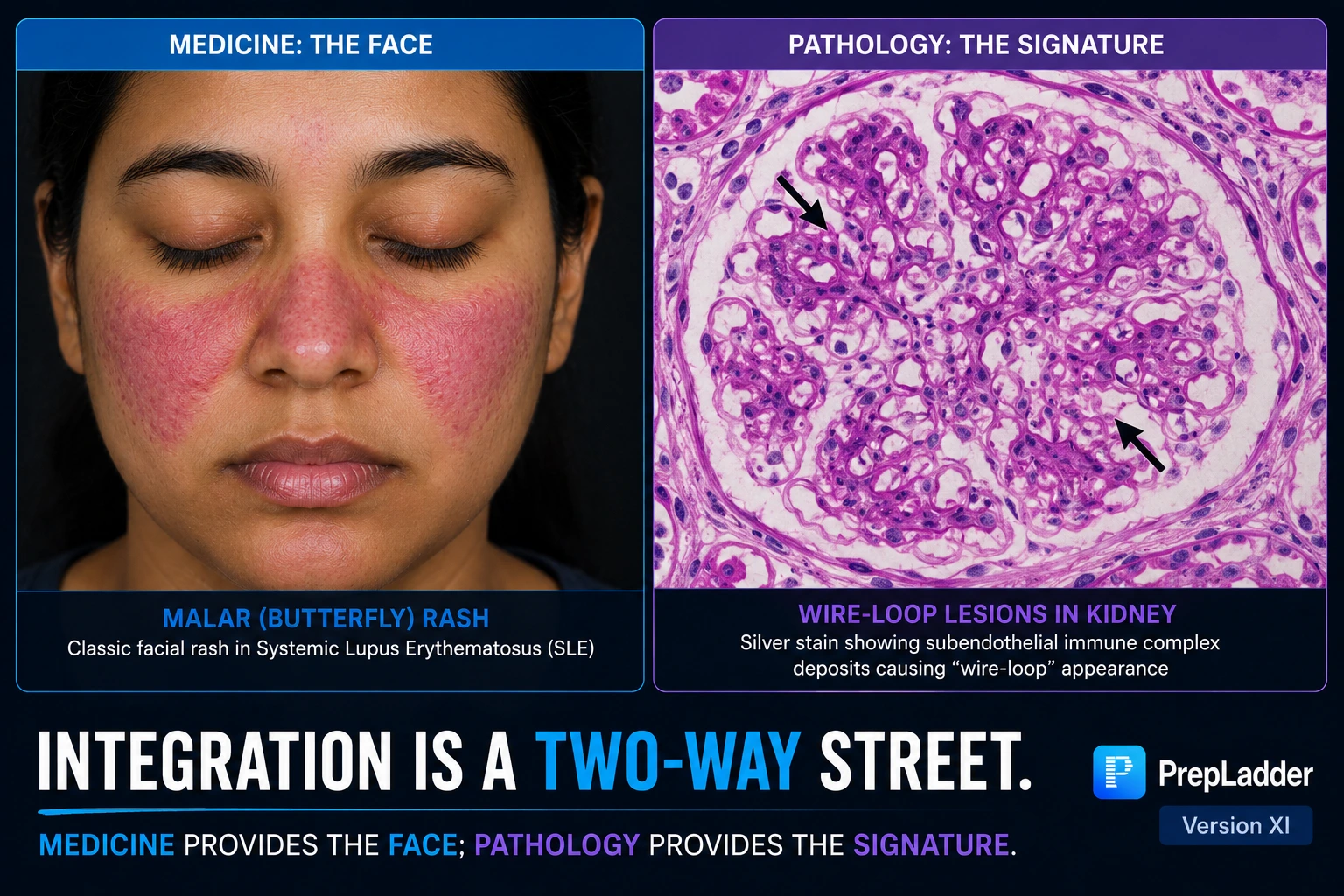
In the modern exam, integration flows in two specific directions. You must be prepared to travel both ways.
- Medicine-to-Pathology: You are given the clinical face (symptoms and signs) and must identify the microscopic signature or the genetic marker.
- Pathology-to-Medicine: You are given a biopsy hint or an immunohistochemistry (IHC) marker and must decide on the clinical investigation or management.
Here are 5 high-yield scenarios that illustrate this integrated style for 2026.
5 High-Yield Integrated Scenarios for 2026
1. The Renal Loop: From Microscopy to Management
In Nephrology, the Pathology report dictates the medical prescription.
- The Scenario: A 40-year-old male with a history of Chronic Hepatitis B presents with generalized edema and frothy urine.
- The Pathology Hint: A renal biopsy is performed, showing a Spike and Dome appearance on silver stain.
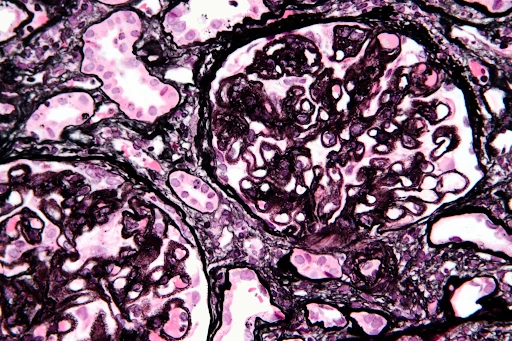
- The Medicine Challenge (The Question): What is the most appropriate next step in the management of this patient’s underlying condition?
- The Integrated Reasoning: The silver stain identifies Membranous Nephropathy. Since the patient has HBV, the question is testing if you know that Membranous is the most common nephrotic syndrome associated with HBV and requires specific antiviral therapy alongside steroids.
- Version XI Edge: Our revamped QBank includes specific "Stain-Trigger" modules where we teach you to jump from a microscopic image directly to a treatment algorithm.
2. The Hematology Loop: From Pathology to Clinical Risk
Hematology is no longer about naming cells; it is about predicting clinical catastrophes.
- The Scenario: A patient with high-grade fever and bleeding gums has a peripheral smear showing faggot cells as shown in the image.
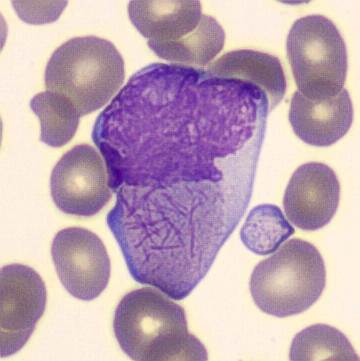
- The Pathology Hint: You identify the Auer rods, which point to APML (AML-M3).
- The Medicine Challenge (The Question): What is the most common cause of early mortality in this patient if treatment is delayed?
- The Integrated Reasoning: You must link the morphology (Auer rods) to the specific clinical complication: Disseminated Intravascular Coagulation (DIC). Auer rods release procoagulants that trigger a systemic clotting crisis.
Also Read: Important Must-Know Topics in Medicine For NEET PG
3. The Endocrinology Loop: From Symptoms to Pathognomonic Findings
Endocrine tumors are rarely asked as a recall. They are asked as visual clues.
- The Scenario: A 22-year-old female presents with a painless, firm thyroid nodule. She has a family history of similar nodules and medullary carcinoma.
- The Medicine Hint: The clinical presentation and family history suggest a MEN 2 syndrome.
- The Pathology Challenge (The Question): A Fine Needle Aspiration of the nodule is performed. Which of the following is the most likely finding on microscopic examination?
- The Integrated Reasoning: You diagnose Medullary Carcinoma based on the clinical context. The answer lies in the Pathology fact: Amyloid stroma with calcitonin staining.
4. The Cardiology Loop: The Morphology-ECG Fusion
- The Scenario: A 65-year-old patient who suffered a massive MI four days ago suddenly presents with new-onset shortness of breath and a harsh pansystolic murmur.
- The Medicine Hint: The timing (Day 4) and the murmur suggest a mechanical complication.
- The Pathology Challenge (The Question): What is the predominant inflammatory cell type responsible for the weakening of the myocardium at this specific time interval?
- The Integrated Reasoning: Day 3–7 post-MI is the time of maximum Macrophage infiltration. These cells clear the necrotic tissue but leave the heart wall thin and prone to rupture (VSR or Papillary muscle rupture).
5. The Gastroenterology Loop: From Genetics to Screening
- The Scenario: A 30-year-old male with a strong family history of colon cancer undergoes a colonoscopy that reveals hundreds of polyps.
- The Pathology Hint: Genetic testing shows a mutation in the APC gene on Chromosome 5q.
- The Medicine Challenge (The Question): What is the recommended age to begin screening for the first-degree relatives of this patient?
- The Integrated Reasoning: The APC mutation confirms FAP (Familial Adenomatous Polyposis). The Medicine mark is knowing that screening must begin early, typically at age 10-12, with annual sigmoidoscopy.
Read More: Essential Medicine Image-based Questions for NEET PG

Why Version XI is Built for This
Our team spent 10 years realizing that students don't need more subjects; they need better connections.
- Integrated Circle Modules: In Version XI, we have introduced system-based circles. You don't solve Medicine and then Pathology. You solve the Respiratory System, where the questions shuffle between morphology and management.
- The NEW Active Recall Flashcards: Our April 2026 Flashcards are designed in Trigger-Response pairs. The front shows an image (e.g., Reed-Sternberg cell), and the back asks for the clinical staging system (Ann Arbor). This forces your brain to bridge the gap instantly.
- Pathognomonic Image Bank: 18% of the exam is image-based. Our revamped QBank ensures that every clinical vignette is paired with its pathological hallmark-high-resolution EM, IHC, or gross morphology.
Also Read: Important Pathology Questions on Cell Injury – MCQs & Key Concepts
Frequently Asked Questions
Q1. Is it better to finish Pathology before starting Medicine?
Our team recommends the Parallel Pass. Finish a system in Pathology and immediately switch to that system in Medicine. If you wait three months to start Medicine, you will forget the hints (translocations, stains) that solve the clinical cases.
Q2. How many integrated questions can I expect in 2026?
Based on the 2025 paper, nearly 53% of the questions were either clinical vignettes or multi-subject integrated questions. This means over 100 marks are won through your ability to connect Med and Path.
Q3. How does Version XI help if my Pathology basics are weak?
The revamped QBank includes foundation tags. If you miss an integrated question, the app will offer a 5-minute basics recap specifically on the Pathology required to solve that clinical case.
Q4. Why does the app focus on Immunohistochemistry so much?
Because the examiners do, in 2026, you cannot diagnose a lymphoma or a breast tumor without IHC. Our Version XI Flashcards have a dedicated section for the IHC Cheat Sheet.
Q5. Are the latest 2024-2025 guidelines integrated into the Pathology modules?
Yes. For example, the KDIGO 2024 renal guidelines and the WHO 5th Edition classification of tumors are fully integrated across both subjects in our app.
Q6. What is the last line first technique for these questions?
Read the question (the last line) before the 10-line vignette. If the question asks for a genetic marker, you will read the story specifically looking for "Pathology Hints" rather than getting distracted by minor vitals.
Clinical Pearl
A disease starts at the cell and ends at the bedside. If you can visualize that entire journey, no vignette can trick you. The examiner is simply looking for the doctor who can connect the lab report to the life of the patient.
Over our 10 years of experience, we’ve seen that the topper isn't the one who knows the most facts-it’s the one who sees the most patterns. Trust the PrepLadder Version XI tools, master the integrated clusters, and we’ll see you on the rank list.
PathologyPathologypathologyretentionimmunohistochemistrymicroscopicpathological
PrepLadder
Access all the necessary resources you need to succeed in your competitive exam preparation. Stay informed with the latest news and updates on the upcoming exam, enhance your exam preparation, and transform your dreams into a reality!
Navigate Quickly
The Logic of the Cross-Over Question
Download Compiled Clinical Scores for Quick Revision for FMGE PDF
5 High-Yield Integrated Scenarios for 2026
1. The Renal Loop: From Microscopy to Management
2. The Hematology Loop: From Pathology to Clinical Risk
3. The Endocrinology Loop: From Symptoms to Pathognomonic Findings
4. The Cardiology Loop: The Morphology-ECG Fusion
5. The Gastroenterology Loop: From Genetics to Screening
Why Version XI is Built for This
Frequently Asked Questions
Q1. Is it better to finish Pathology before starting Medicine?
Q2. How many integrated questions can I expect in 2026?
Q3. How does Version XI help if my Pathology basics are weak?
Q4. Why does the app focus on Immunohistochemistry so much?
Q5. Are the latest 2024-2025 guidelines integrated into the Pathology modules?
Q6. What is the last line first technique for these questions?
Clinical Pearl
Top searching words
The most popular search terms used by aspirants
- NEET PG Medicine
- Pathology Preparation