Last 5 Year PYQs in Microbiology for FMGE
Jan 7, 2026

When it comes to preparing for FMGE, there is no smarter way to understand exam patterns, identify high-yield topics, and refine your strategy than by solving previous years’ questions (PYQs).
As Microbiology is a volatile and high-scoring subject, it requires conceptual clarity and consistent revision to ace the exam.
But what if you had access to the most frequently asked questions from the last five years. That’s exactly what we’ve got for you in this blog.
We have compiled high-yield Microbiology PYQs that have been frequently tested in FMGE. We have included detailed explanations to help you better understand the concepts and improve your retention.
Without further ado, let’s dive right in.
Download FMGE Last 5-Year PYQs – Subject-wise PDFs
|
|
|
|
|
|
|
|
|
|
|
|
|
|
|
|
|
|
|
|
|
|
|
|
|
|
||
Q1. What is the likely pathogen responsible for an 8-year-old boy's continuous diarrhea, starting 20 hours ago, which is rice watery in consistency, causing drowsiness, unresponsiveness, sunken eyes, and poor skin turgor?
- Vibrio cholera
- Entamoeba coli
- Escherichia
- Shigella sonnei
Ans. 1) Vibrio Cholera
- Vibrio cholerae is a bacterium that causes cholera, a severe diarrheal disease. The symptoms of cholera include continuous, watery diarrhea, which is consistent with the description provided. The drowsiness and unresponsiveness may be due to severe dehydration and electrolyte imbalances resulting from profuse diarrhea.
Q2. What is the vector responsible for transmitting the Zika virus among the options listed?
- Aedes australis
- Aedes albopictus
- Aedes mitchellae
- Aedes polynesiensis
Ans. 2) Aedes Albopictus
- Zika virus is primarily transmitted to humans through the bites of infected mosquitoes, specifically Aedes aegypti and Aedes albopticus.
Also read: Last 5 Year PYQs in Anatomy for FMGE
Q3. The receptor used for the entry of HIV virus into the host cell is?
- CCR7
- CCR5
- CD6
- CD8
Ans. 2) CCR5
- Receptors essential for the entry of HIV into the host cell are:
- CD4: HIV enters the target cells by binding its gp120 to the CD4 receptor on the host cell surface. CD4 molecules are mainly expressed on helper T cells and also on the surface of monocytes, macrophages, Langerhans cells, astrocytes, keratinocytes, and glial cells.
- A second co-receptor is necessary for the fusion of HIV to gain entry into the host cell.
- CXCR4 molecules are present on T lymphocytes.
- CCR5 molecules are present on the cells of macrophages.
Q4. A 4-year-old boy developed bloody diarrhea and abdominal cramps. The bacteria isolated from the stool specimen were non-motile and did not ferment lactose or mannitol. Which of the following organisms is implicated here?
- Shigella dysenteriae
- E. coli
- Salmonella
- Shigella sonnei
Ans. 1) Shigella Dysenteriae
- Shigella dysenteriae is a bacterium known to cause bacillary dysentery, characterized by symptoms such as bloody diarrhea and abdominal cramps. Shigella species (sonnei) are non-motile and do not ferment lactose or mannitol, which matches the findings described in the stool specimen.
Q5. A 6-year-old boy presents with lower abdominal pain and diarrhea. The stool examination finding is shown below. Which of the following is most likely a causative organism?

- Giardia lamblia
- Shigella dysenteriae
- Entamoeba histolytica
- Campylobacter jejuni
Ans. 3) Entamoeba Histolytica
- The given image is of E. histolytica trophozoites. Entamoeba histolytica is a parasitic amoeba that can cause amoebic dysentery. Points for identification of trophozoite are:
- It is 12 to 60 μm and actively motile in freshly passed dysenteric stool.
- Cytoplasm – Outer ectoplasm is clear, transparent, and refractile. Inner endoplasm is finely granular, having a ground glass appearance.
- Pseudopodia are finger-like projections formed by sudden jerky movements of ectoplasm in one direction.
- The nucleus is spherical, 4-6 μm in size, and contains a central karyosome, surrounded by a clear halo and anchored to the nuclear membrane by fine radiating fibrils, giving a cartwheel appearance.
- Ingested erythrocytes may also be present within the cytoplasm of E. histolytica trophozoites.
Also read: Last 5 Year PYQs in FMT for FMGE
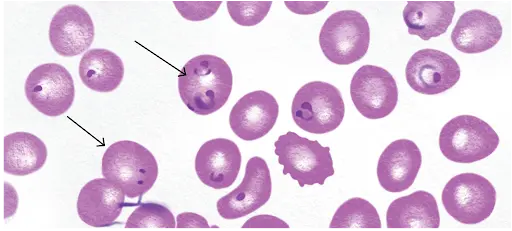
Q6. A 55-year-old man comes with complaints of fever and increasing fatigue for the past week. On examination, he is febrile, hypotensive, and tachycardic. The findings of the microscopic examination of his peripheral blood smear are given below. What is the causative agent?
- Plasmodium vivax
- Plasmodium falciparum
- Plasmodium ovale
- Plasmodium malariae
Ans. 2) Plasmodium Falciparum
- The image shows multiple ring forms/headphone-shaped late trophozoites in erythrocytes; the most likely causative agent of malaria in this case is Plasmodium falciparum.
- Plasmodium falciparum is one of the species of Plasmodium that causes cerebral malaria in humans, characterized by high fever, headache, anorexia, nausea, anemia, hypotension, tachycardia, hepatosplenomegaly, thrombocytopenia, confusion, increased muscle tone, seizures, paralysis, and coma.
Q7. Reinfection with which of the following viruses can lead to more severe disease with complications?
Ans. 1) Dengue
- Dengue is caused by four different serotypes of the dengue virus (DEN-1, DEN-2, DEN-3, and DEN-4). If a person is infected with one serotype and later gets infected with a different serotype, they are at a higher risk of developing severe dengue, also known as dengue hemorrhagic fever (DHF) or dengue shock syndrome (DSS). This phenomenon is known as antibody-dependent enhancement (ADE).
- ADE occurs when the antibodies produced during the first infection bind to the virus particles of the second serotype but fail to neutralize them effectively. ADE was shown to enhance viral entry into immune cells via their Fcγ receptors, which promote viral replication, leading to increased viremia and pro-inflammatory responses.
Q8. A 13-year-old girl has had 4 episodes of meningitis over the last 4 years, with the disease lasting a few days at a time, slowly resolving neurological symptoms such as visual and memory loss. A CSF cytology shows lymphocytic pleocytosis, and a diagnosis of Mollaret’s meningitis is made. Which organism is implicated here?
- Measles virus
- Mumps virus
- Herpes simplex virus
- Rubella virus
Ans. 3) Herpes Simplex Virus
- Mollaret's meningitis, aka recurrent benign lymphocytic meningitis, is a rare condition where there are recurrent episodes of meningitis lasting for 2 to 4 days and associated with spontaneous resolution and intermittent relapses occurring weeks to years apart. The most common pathophysiology is the reactivation of the Herpes simplex virus (HSV 2 >> HSV 1). It can also be caused by the Epstein-Barr virus.
Also Read: Last 5 Year PYQs in OBG for FMGE
Q9. A farmer with a history of flea bite in a godown presents with the features of high fever, painful inguinal lymphadenopathy, vomiting, diarrhea, and hypotension. Smears prepared from the discharge of these swellings revealed bacteria with bipolar staining. Which stain will help in the diagnosis?
- Neisser stain
- Wayson’s stain
- Albert’s stain
- McFadyeans reaction
Ans. 2) Wayson's Stain
- The patient's presentation of high fever, severe inguinal lymphadenopathy, nausea, vomiting, and hypotension, as well as a history of a flea bite suggestive of bubonic plague caused by Yersinia pestis.
- Yersinia pestis is a gram-negative bacteria that has the ability to exhibit bipolar staining, giving it a safety pin appearance when stained with Wayson stain.
Q10. A 21-year-old girl who presented with multiple beefy-red painless ulcers over the vulval region is diagnosed with granuloma inguinale. What is the causative organism?
- Chlamydia trachomatis
- Klebsiella granulomatis
- Haemophilus ducreyi
- Herpes simplex virus 2
Ans. 2) Klebsiella Granulomatis
Klebsiella granulomatis, a gram-negative bacteria, is the causative organism for granuloma inguinale, also known as donovanosis.
- Granuloma inguinale is a chronic sexually transmitted disease in which painless, beefy-red ulcers develop in the genital and inguinal regions.
Q11. Besides NK cells, what other types of cells are capable of identifying and lysing target cells that have specific antibody-bound membrane surface antigens as part of their effector mechanisms in cell-mediated immunity?
- Natural killer (NK) cells only
- Macrophages only
- Neutrophils and eosinophils
- Neutrophils only
Ans. 3) Neutrophils and eosinophils
- Both components of option 3 come into the category of granulocytes, making them part of the innate immune system. They play an essential part in cases of inflammation and immune responses against pathogens.
- The most common type of WBCs is the neutrophils, and these are famous for their rapid response to infection. They can recognize and phagocytose antibody-bound target cells, leading to their destruction. Additionally, these release antimicrobial substances and produce reactive oxygen species to improve their killing abilities.
- When it comes to parasites and allergic reactions, eosinophils come into play. As mentioned above, they also eliminate antibody-bound target cells, which include the release of cytotoxic granules and the production of reactive oxygen species.
Also read: Last 5 Year PYQs in Medicine for FMGE
Q12. A patient has presented with fever and blister on the hand, followed by the development of axillary lymphadenopathy. What will you ask the patient with regard to history?
- History of a rat bite
- History of exposure to a cat
- History of similar complaints among family members
- History of louse bite
Ans. 2) History of exposure to a cat
- The presentation of a blister on the hand, followed by axillary lymphadenopathy, is highly suggestive of cat scratch disease among the given options
- It occurs when an infected cat licks a person’s open wound or bites or scratches a person hard enough to break the surface of the skin. It is caused by the bacteria Bartonella henselae, characterized by a febrile illness with lymphadenopathy.
- In immunocompromised patients, it causes bacillary angiomatosis, in which vascular nodules appear on the skin and mucosa.
- B. henselae can be demonstrated in lymph node biopsy with Warthin-Starry staining.
Q13. A patient came to the gynecology OPD with complaints of foul-smelling, frothy vaginal discharge and intense itching. On examination, the cervix appears strawberry-like. Which of the following statements is false regarding the causative organism?
- It exists in cyst and trophozoite forms
- It is an obligate parasite
- The gold standard for diagnosis is culture on CPLM
- The treatment of choice is metronidazole
Ans. 1) It exists in cyst and trophozoite forms
- The clinical presentation of foul-smelling frothy-vaginal discharge with a strawberry cervix is suggestive of trichomoniasis caused by Trichomonas vaginalis.
- Trichomonas vaginalis is an obligate parasite that exists only in trophozoite form and is both diagnostic and infective.
- Diagnosis by culture is the gold standard test. It is cultured in cysteine peptone liver maltose medium (CPLM).
- The drug of choice for trichomoniasis is a single dose of 2-gram metronidazole for both partners.
Also read: Last 5 year PYQs in Anesthesia for FMGE
Q14. Which of the following methods is used to sterilize a glass petri dish?
- Autoclaving at 121 degrees Celsius for 30-60 minutes
- Hot air oven at 160 degrees Celsius for 120 minutes
- Autoclaving at 134 degrees Celsius for 3 minutes
- Hot air oven at 121 degrees Celsius for 30-60 minutes
Ans. 2) Hot air oven at 160 degrees Celsius for 120 minutes
- The method used to sterilize a glass petri dish is a hot air oven at 160 degrees Celsius for 120 minutes.
- A hot air oven uses dry heat for the sterilization of materials that may be damaged by moist heat or that are impenetrable to moist heat.
- This method involves heating the petri dish at a high temperature in a dry oven, which leads to the oxidation of the cell constituents.
- The most common cycles used are:
- 170°C for 60 minutes,
- 160°C for 120 minutes,
- 180°C for 30 minutes.
- Materials sterilized are:
- Glassware
- Cotton swabs
- Gel, oil, wax, and dusting powder.
- Greasy paraffin wax
- Metallic instruments.
Q15. Which of the following statements is accurate regarding antigenic drift?
- There is a gradual sequential change in antigenic structure
- Causes a sudden increase in the number of cases
- The new antigens formed are unrelated to the previous antigens
- Antibodies to the predecessor viruses do not neutralize the new variants
Ans. 1) There is a gradual sequential change in antigenic structure
- Antigenic drift is a phenomenon that occurs in influenza viruses. It involves a gradual, sequential change in the antigenic structure of the virus due to mutations in the genes that code for its surface proteins.
- These surface proteins, hemagglutinin (HA) and neuraminidase (NA), are responsible for the recognition and binding of the virus to host cells and the release of newly formed virus particles from infected cells, respectively.
- The accumulation of these mutations in the HA and NA genes over time can lead to the emergence of new strains.
Q16. A 38-year-old IV drug abuser presents with a 1-week history of malaise, fatigue, and rigors. His temperature on admission was 38.5° C. Examination revealed a pansystolic murmur, loudest at the left sternal edge. Three sets of blood cultures were taken. Which organism is most likely to be found in his blood culture?
- Streptococcus sanguis
- Enterococcus faecium
- Coxiella burnetii
- Staphylococcus aureus
Ans. 4) Staphylococcus aureus
- The clinical presentation and history of intravenous drug abusers are suggestive of infective endocarditis (IE) with valvular involvement.
- In IV drug abusers, the most common organism causing infective endocarditis is Staphylococcus aureus.
Also read: Last 5 year PYQs in Dermatology for FMGE
Q17. Penicillin was given to the patient, and immune hemolytic anemia developed. Which type of hypersensitivity reaction is this?
- Type 1
- Type 2
- Type 3
- Type 4
Ans. 2) Type 2
- Type 2 hypersensitivity reaction, also known as cytotoxic hypersensitivity, involves the activation of the immune system against specific cells or tissues. In this case, penicillin can induce the production of antibodies that bind to the patient's own red blood cells, causing them to be targeted and destroyed by the immune system. This is what happens in immune hemolytic anemia.
Hope you found this blog helpful for your FMGE Medicine Preparation. For more informative and interesting posts like these, keep reading PrepLadder’s blogs.
Download PrepLadder's FMG Exam preparation app for Android
Download PrepLadder's FMG Exam preparation app for iOS
Also, check the Previous Year Question Papers for FMG Exams.

PrepLadder Medical
Get access to all the essential resources required to ace your medical exam Preparation. Stay updated with the latest news and developments in the medical exam, improve your Medical Exam preparation, and turn your dreams into a reality!
Top searching words
The most popular search terms used by aspirants
- FMGE Microbiology
- FMGE Microbiology Preparation