20 High-Yield ENT Flashcards for NEET PG 2026
Jul 23, 2026

Flashcard 1
External Ear

- Incisura terminalis is the site of incision in an endaural surgery.
- This incision is known as a Lempert endaural incision.
Flashcard 2
Middle Ear Cleft

- Function: Ventilation of the middle ear
- Components:
- Eustachian tube (anterior): Connects the middle ear and the nasopharynx.
- Middle ear proper
- Attic
- Aditus (communication between the attic and the Antrum)
- Mastoid air cells (posterior)
- Ventilatory pathway of the middle ear/ Middle ear cleft:
- On inhalation, the air reaches the nose → nasopharynx → eustachian tube → middle ear proper → Attic → Aditus → Antrum → Rest of the mastoid air cells.

Flashcard 3
- Parts included in the bony labyrinth:
- SCC
- Elliptical and spherical recess
- Scala vestibuli and tympani.
- Cochlear duct connected to saccule via Ductus reuniens /cannalis reuniens
- Saccular and utricular ducts combine to form endolymphatic ducts leading to endolymphatic sac
- Vestibular aqueduct: Bony covering around the endolymphatic duct

Also Read: Tonsillitis: Causes, Symptoms, Risk Factors, Diagnosis
Auditory Pathway
Sound from cochlea → to 8th nerve → to brain. This entire pathway is called the Auditory pathway.
ENT Most Important 100 one-liners - PDF

Flashcard 4
Order of Auditory Pathway

Mnemonic: ECOLI MA
- E- Eighth nerve (8th)
- C- Cochlear Nucleus
- O- Superior olivary complex
- L- Lateral lemniscus
- I- Inferior colliculus
- M- Medial geniculate body
- A- Auditory cortex
Flashcard 5
Rinne Test
- In a normal ear
- AC > BC → RINNE positive
- > represents AC is Longer than BC.
- > represents AC is louder than BC.
- AC > BC → RINNE positive
- In conductive hearing loss
- AC < BC → RINNE negative
- Because the conductive pathway in AC gets affected.
- AC < BC → RINNE negative
- In SNHL
- AC > BC → RINNE positive
- Because the Sensory neural pathway in both AC and BC gets affected.
- But BC gets affected more than AC.
- AC > BC → RINNE positive
- False negative Rinne
- i.e., AC < BC → RINNE negative
- Seen in U/L severe to profound SNHL.
Also Read: Glomus Tumor - Types, Clinical Features, Diagnosis
Flashcard 6
Pure Tone Audiometry

- Pure tones are produced from the audiometer, with which AC and BC are both tested.
- The intensity of the pure tone is increased or decreased in 5db.
- The chart graph is called an audiogram.
- This confirms the type of hearing loss (Conductive / Sensorineural / Mixed)
- The degree of hearing loss can also be measured accurately.
- The patient is made to sit in a soundproof room.
Flashcard 7
Fistula Test

- A positive fistula test means communication between the middle and inner ear is present.
- A negative fistula test means no communication between the middle ear and the internal ear.
- False positive fistula (Hennebert's test) is seen in case of congenital syphilis.
- A false negative fistula test is seen in patients with a dead labyrinth.
Also Read: Essential Questions About Ear in ENT
Flashcard 8
Malignant Otitis Externa

- Seen in patients with uncontrolled diabetes, immunosuppressed
- Caused by: Pseudomonas infection
- Symptoms: Excruciating pain increases on chewing/ jaw movements
- Pseudomonas infection involves the bones: Base of the skull along with facial nerve is involved
- Later, lower cranial nerves (9th,10th,11th) are also involved
- Symptoms due to cranial nerve involvement is also seen
- Locally invasive, aggressive infection
Flashcard 9
Keratosis obturans

- Ciliary motility disorder in the external auditory canal
- Normally, cilia will vibrate, pushing all the dead epithelium towards the external auditory canal; in ciliary motility disorder, epithelium gets trapped layer by layer, forming a plug of dead desquamated mass- onion skin lamellar arrangement
- Overlying bone gets widened, and ballooning of overlying bone is seen
- Rarely, 7th nerve palsy can also occur
- Treatment: Remove the mass after giving keratolytics to soften the mass
Also Read: Anatomy OF External Ear and its Diseases
Flashcard 10
- The fungus causing otomycosis most commonly is Aspergillus niger
- Myringitis bullosa is caused by viral infection/ Haemophilus influenzae. It is a condition where bullous vesicles are seen on the tympanic membrane
- Malignant otitis externa is caused by Pseudomonas
- Malignant otitis externa is characterized by excruciating pain which increases on chewing and jaw movement
- The hallmark of malignant otitis externa includes granulation tissue in the bony cartilaginous junction
- A patient presenting with painful ear discharge, edema of the external auditory canal, and facial palsy not responding to antibiotics most likely has malignant otitis externa
- The drug of choice for rapidly spreading infection of the EAC with bone involvement and granulation tissue is anti-pseudomonas antibiotics:
- Piperacillin
- Tazobactam
- Facial nerve palsy is seen in malignant otitis externa/ Ramsay hunt syndrome/ Keratosis obturans
- Keratosis obturans is characterized by onion ring appearance
- Chalky white tympanic membrane is seen in tympanosclerosis
Flashcard 11


Flashcard 12
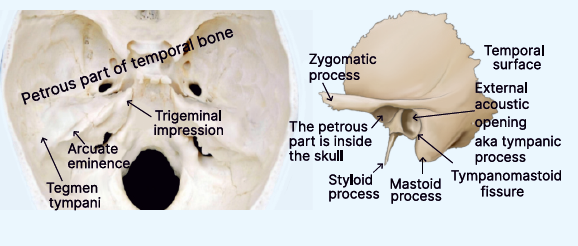
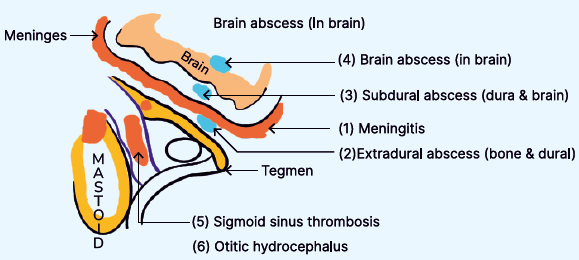
Complications of ASOM and CSOM
Extracranial Intracranial Mastoiditis Meningitis Labyrinthitis Extradural abscess Facial nerve palsy Subdural abscess Petrositis Brain abscess Osteomyelitis Lateral sinus thrombophlebitis Septicemia Otitic hydrocephalus
Also Read: Nasal Polyps: Causes, Symptoms and Treatment: NEET PG ENT
Flashcard 13
Lateral Sinus Thrombophlebitis

- Infection spreads from middle ear to mastoid sinus
- Posterior border of mastoid has sigmoid sinus
- Infection results in thrombosis of sigmoid sinus
- Leads to intermittent emboli in the bloodstream: Hectic picket fence type of fever with rigor- fever doesn't touch the baseline
- Mastoid emissary veins can also not drain into the sigmoid sinus- edema and bluish discolouration of the mastoid: Griesinger sign
- Cranial circulation cannot drain into the sigmoid sinus- raised ICP- manifests as papilledema- dilatation of optic disc
- Tobey-Ayer's test: Compression of IJV on the healthy side produces a rise in CSF pressure.
- Crowe-Beck test: Pressure of the IJV on the healthy side produces engorgement of the retinal veins.
Flashcard 14
Stapedial Otosclerosis: Tests

Test Inference Rinne Negative Weber Lateralised to abnormal ear Absolute bone conduction Normal Gelles test Negative Tympanometry As-Type graph Stapedial reflex Absent Pure tone audiometry Carhart’s notch
Flashcard 15
Glomus tumors
- Benign tumor of the middle ear
- Glomus tumor originates from paraganglionic cells
- Cells of the sympathetic nervous system that secrete catecholamines: epinephrine, norepinephrine, dopamine
- Usually present across major blood vessels like internal carotid artery, internal jugular vein
- In the middle ear, the floor is related to the internal jugular vein, and on the promontory (formed by the basal turn of ganglia), a plexus is formed- tympanic plexus- formed by glossopharyngeal nerve and sympathetic plexus of the carotid
- From these sympathetic plexuses and the sympathetic plexus covering the internal jugular vein, the tumor arises
- Glomus juglare: Arising from the sympathetic plexus covering the internal jugular vein
- Glomus tympanicum: Arising from the tympanic plexus
Also Read: Chronic Suppurative Otitis Media (CSOM): Symptoms & Treatment
Flashcard 16
- First branch of facial nerve is GSPN
- Nerve involved in hyperacusis is the nerve to the stapedius
- Lacrimation is affected when facial nerve is injured above the level of 1st genu
- Taste is affected when mastoid segment of facial nerve is involved
- Most common cause of facial nerve palsy: idiopathic> traumatic
- Iatrogenic facial nerve palsy occurs during mastoidectomy
- Which segment of facial nerve is affected first in ischemia and labyrinthine edema
- Which segment of facial nerve is affected in iatrogenic trauma: vertical/mastoid segment
- Which fracture of petrous bone is responsible for facial injury: transverse fracture
- Crocodile tears occur due to faulty innervation with chorda tympani nerve
Flashcard 17
- External nose has 2 no. of paired bones and 1 no. of unpaired bones
- External nose has3 no. of paired cartilages and 1 no. of unpaired cartilages
- Other name of pseudostratified columnar epithelium of nose is Schneiderian membrane
- Nasion is the frontal bone with the nasal bone in midline
- Rhinion is the nasal bone with the upper lateral cartilage in midline
- Limen Nasi is the lower border of the upper lateral cartilage
- Turbinate, which is not a part of the ethmoid bone, is the inferior turbinate
- Sinus draining into hiatus semilunaris is the frontal sinus and Anterior ethmoidal sinus
- Sinus draining into infundibulum is Maxillary sinus
- Sinus draining into superior meatus is the posterior ethmoid sinus
- Sphenoid sinus drains into the sphenoethmoidal recess
- Sinus absent at birth is Frontal sinus
- Sinus whose development coincides with development of secondary dentition is the maxillary sinus
- Earliest sinus to develop and be visible radiologically is the maxillary sinus
- Largest sinus is the maxillary sinus
- Last sinus to develop is the frontal sinus
- Most common sinusitis in children is Ethmoidal sinusitis
- Most common sinusitis in adults is Maxillary sinusitis
Also Read: ENT Image Based Questions for NEET PG
Flashcard 18
Antrochoanal polyp

- Polyp that originates from the maxillary antrum and extends posteriorly from the choana
- Single/ unilateral- Occurs due to infection in the maxillary sinus.
- Greyish white mass
- Grows into nasal cavity reaching nasopharynx
- Seen in young age group
- Male predominant
- Organism responsible for infection: Streptococcus pneumoniae
Flashcard 19
Sinusitis and its Complications
- Inflammation of sinus mucosa
- Can be acute (< 4 weeks) or chronic (>12 weeks)
- Between 4 - 12 weeks- subacute form of sinusitis
One liners
- Most common sinus affected in an adult: Maxillary sinus
- Most common sinus affected in children: Ethmoidal sinus (as it is most developed in children)
- Least common sinus affected: Sphenoid sinus (as it is the posterior most sinus)
Also Read: Juvenile Nasopharyngeal Angiofibroma: Site of Origin, Staging
Flashcard 20
Pott's Puffy Tumor

- Infection of the frontal sinus can spread to the overlying bone, causing a subperiosteal abscess
- Osteomyelitis of the frontal bone, known as Pott's puffy tumor
Download the PrepLadder app now and unlock a 24-hour FREE trial of premium high-yield content. Access Video Lectures, digital notes, QBank, and Mock Tests for FREE to ace your NEET PG preparation. Elevate your study experience and gear up for success. Start your journey with PrepLadder today!

PrepLadder Medical
Get access to all the essential resources required to ace your medical exam Preparation. Stay updated with the latest news and developments in the medical exam, improve your Medical Exam preparation, and turn your dreams into a reality!
Navigate Quickly
Flashcard 1
External Ear
Flashcard 2
Middle Ear Cleft
Flashcard 3
Auditory Pathway
ENT Most Important 100 one-liners - PDF
Flashcard 4
Order of Auditory Pathway
Flashcard 5
Rinne Test
Flashcard 6
Pure Tone Audiometry
Flashcard 7
Fistula Test
Flashcard 8
Malignant Otitis Externa
Flashcard 9
Keratosis obturans
Flashcard 10
Flashcard 11
Flashcard 12
Complications of ASOM and CSOM
Flashcard 13
Lateral Sinus Thrombophlebitis
Flashcard 14
Stapedial Otosclerosis: Tests
Flashcard 15
Glomus tumors
Flashcard 16
Flashcard 17
Flashcard 18
Antrochoanal polyp
Flashcard 19
Sinusitis and its Complications
One liners
Flashcard 20
Pott's Puffy Tumor