Autophagy: Exploring Types, Aging, Free Radicals, and Ferroptosis
Jul 3, 2023

The body uses autophagy to recycle old and damaged cell components. Each tissue and organ in your body is made up primarily of cells. There are numerous components inside each cell that keep it working. These components may malfunction or stop operating over time. They accumulate inside a healthy cell as trash or litter. Your body's cellular recycling process is called autophagy. It enables a cell to dismantle its useless components and recycle the salvageable fragments into brand-new, functional cell components. The components that a cell doesn't use can be discarded. Your cells' quality control process is autophagy. A cell's ability to function properly can be slowed down or prevented by having too many unnecessary parts.
Read this blog further to get a quick overview of this important topic Autophagy: Types of Autophagy, Cellular Ageing, Free Radical Injury, Ferroptosis for pathology and ace your NEET PG exam preparation.
Scenarios where we end up eating our own cells or organelles;
- Senile
- Malnutrition
- Cancers
- Neurodegenerative Conditions
- Alzheimer's disease
- Parkinson's disease

Types of Autophagy
There are 4 types of mechanisms for autophagy:
- Macro-Autophagy
- Micro-Autophagy
- Chaperone Mediated Autophagy (CMA)
- Mitophagy
General outline of Macro-Autophagy:
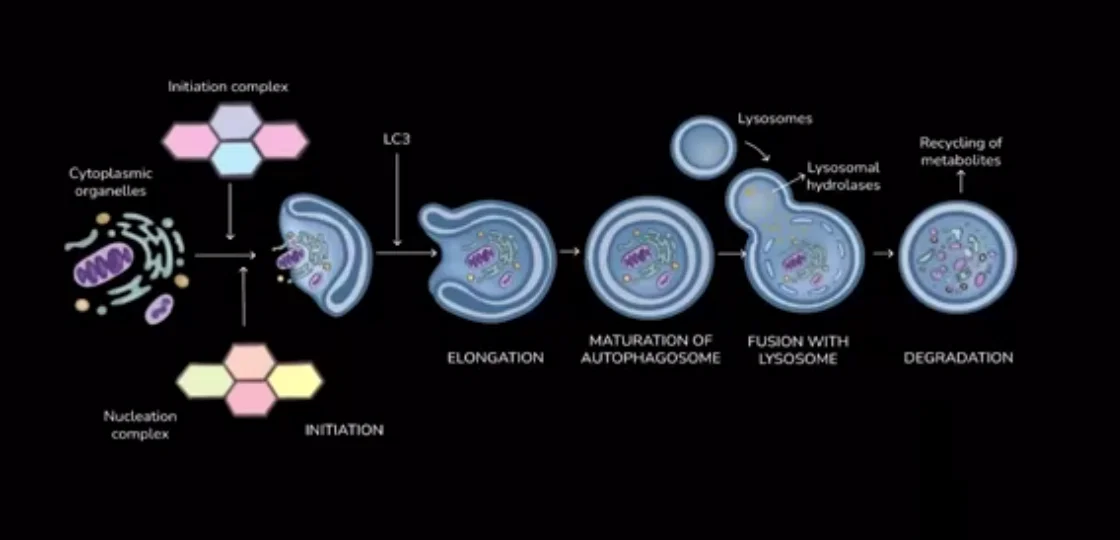
Macro-Autophagy
In this there is formation of Autophagosome, in this autophagy there is formation of phagophore or autophagosome or the plate formation occurs. Eating of Endoplasmic Reticulum and Ribosomes occurs. ULK1 COMPLEX starts the formation of the plate called Phagophore. Plate will gradually elongate and become bigger. BECLIN-1 helps in elongation. LC3 (Light Chain 3) completes the full plate formation and now the plate is called Auto-Phagosome (APS). Auto-Phagosome fuse with the lysosome to form Autophagolysosome (APLS). Finally, all the substrates are broken inside the ALPS.
Micro Autophagy
It is the Simplest process in which there is Direct uptake by lysosomes via endocytosis.
Chaperone Mediated Autophagy
CMA stands for Chaperone Mediated Autophagy.Chaperon corrects misfolded protein. Examples of Chaperone is HSP (Heat Shock Proteins)
Mechanism of CMA
Chaperone binds with misfolded protein. The complex enters the lysosome via LAMP 2A (Lysosome Associated Membrane Protein 2A) for autophagy.
Mitophagy
A type of Macro-Autophagy. In this there is Autophagosome formation. In this Only eating of mitochondria occurs. Old mitochondria are represented by PINK and PARKIN molecules on their surface. It confirms eating up of old mitochondria.
| Marker of autophagy | LC3 (Light Chain 3) |
| Most important gene for autophagy | ATG1 |
| ATG5 gene mutation | Increased risk to get tuberculosis (TB) |
| ATG16L gene mutations | Increased risk of Crohn's Disease (Inflammatory Bowel Disease) |
Also Read: Trisomy 18: Causes, Symptoms, Types, Diagnosis, Treatment and Prevention
Cellular Ageing
Causes of Cellular Ageing:
- Free radical injury (via chemicals, poisons and pollution) is the most common cause of ageing.
- Telomere shortening
- Insulin resistance
- DNA repair defects
Telomere Shortening
Thousands of telomeres are present at the terminal end of chromosomes from human birth. One telomere sequence is TTAGGG. With each cell division, telomeres become shorter, thus ageing occurs. This can be prevented by "Telomerase". Telomerase is a RNA Dependent DNA Polymerase enzyme. Telomerase is very famously known as "Immortality Gene".
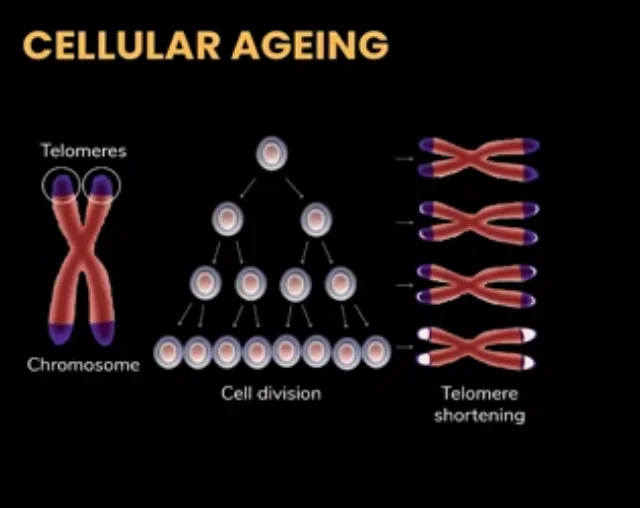
Types of Cells and Telomere Length

Type of Cell Telomere Length Somatic cell Drops down Stem cell Gradual decrease Germ cell No changeMaximum telomerase activity is seen Cancer cell Reactivate telomeraseSurvive longer
Pathology Related Articles :
Premature Ageing
Progeroid Syndrome Werner Syndrome or Adult Progeria Syndrome Hutchinson Gilford Syndrome or Laminopathy Cockayne Syndrome Occurs in adulthood (from age 16 or 18) Cachexia occurs in patients Later onset disease Early Childhood Onset - DNA Helicase defect LMNA (Lamin A) gene defect where the nucleus is not developed properly ERCC gene defect 

Free Radical Injury
Most common cause of ageing . Free Radical is Also known as ROS (Reactive Oxygen Species).
- They are of three types:
- Superoxide
- Hydrogen peroxide
- Hydroxyl (most potent free radical)
All of them cause lipid peroxidation. Lipofuscin pigment is generated, a tell-tale sign of free radical injury.
Free Radical Formation
- Oxygen → Superoxide due to the environmental chemicals, toxins, poisons, and reperfusion injury.
- Superoxide → Hydrogen Peroxide by Superoxide Dismutase (SOD).
- Hydrogen peroxide → Hydroxyl (most potent) and the reaction is called Fenton's Reaction.
- In Fenton's Reaction the ferrous ion → ferric ion.
Clinical Correlation
Superoxide Dismutase (SOD) is of two types:
- Cytoplasmic SOD (Cu-Zn SOD)
- Mitochondrial SOD (Mn SOD)
SOD 1 gene mutation can cause ALS (Amyotrophic Lateral Sclerosis - Microscope studies show Bunina Bodies). ALS is both upper and lower motor neuron disorder.
Ferroptosis
It is Iron mediated cell death. Glutathione Peroxidase Type 4 is the master regulator of ferroptosis. Mitochondria changes are very similar to necrosis; there is Loss of cristae and Rupture of Membrane.
Download the PrepLadder App and get the best neet pg online coaching with world-class video lectures, QBank, Mock Tests and more!
Download PrepLadder's best app for neet pg preparation for Android
Download PrepLadder's best app for neet pg preparation for ios

PrepLadder Medical
Get access to all the essential resources required to ace your medical exam Preparation. Stay updated with the latest news and developments in the medical exam, improve your Medical Exam preparation, and turn your dreams into a reality!
Navigate Quickly
Types of Autophagy
Macro-Autophagy
Micro Autophagy
Chaperone Mediated Autophagy
Mitophagy
Cellular Ageing
Causes of Cellular Ageing:
Telomere Shortening
Types of Cells and Telomere Length
Premature Ageing
Free Radical Injury
Free Radical Formation
Ferroptosis
Top searching words
The most popular search terms used by aspirants
- Medical PG Pathology
- NEET PG Pathology